
Introduction
T-Mobile outage Mobile connectivity has become an essential part of everyday life in the United States. Whether you’re working remotely, navigating with GPS, completing online banking, attending virtual meetings, or simply staying connected with family and friends, most daily activities depend on a reliable cellular network. That dependence becomes especially noticeable when a major carrier experiences an unexpected disruption.
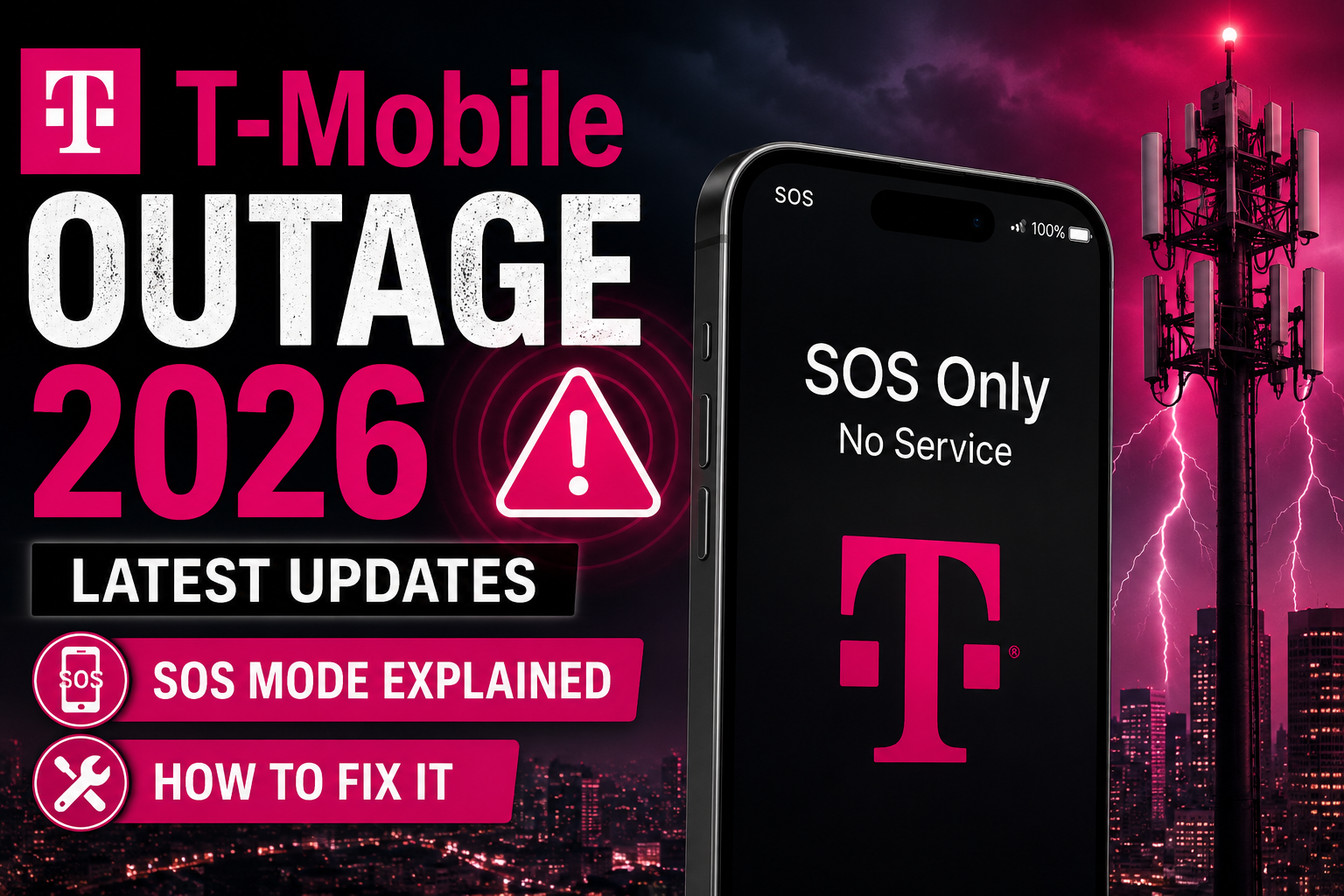
The recent T-Mobile outage quickly became one of the most discussed technology events across the country after thousands of customers reported losing cellular service within a short period. Many users discovered that their phones suddenly displayed “SOS” or “SOS Only”, preventing normal voice calls, text messaging, and mobile data access. Social media platforms filled with screenshots, customer complaints, and questions as people attempted to understand whether the problem was caused by their device, their SIM card, or T-Mobile’s network itself.
While outages are not uncommon in modern telecommunications, large-scale disruptions remind consumers just how dependent modern life has become on wireless infrastructure. A temporary interruption can affect businesses, emergency communications, transportation services, online payments, healthcare providers, and countless everyday tasks.
This guide provides a complete overview of the latest T-Mobile outage. Instead of simply summarising news reports, we’ll explore the event from every angle, including:
- What happened during the outage
- Why many phones entered SOS Mode
- What may have caused the disruption
- Which services were affected
- How network outages are investigated
- Immediate troubleshooting steps
- What customers should expect going forward
Whether you experienced the outage yourself or simply want to understand how cellular networks operate during unexpected failures, this comprehensive guide explains everything in clear, practical language.
What Is the T-Mobile Outage?
A T-Mobile outage occurs whenever customers lose access to one or more mobile network services because of technical issues affecting the carrier’s infrastructure. Depending on the severity of the incident, users may experience:
- No cellular signal
- Unable to place calls
- Failed text messages
- Mobile internet not working
- Extremely slow data speeds
- Intermittent connection
- Phones switching to SOS mode
- Delayed voicemail notifications
Not every outage affects every customer equally. Wireless networks consist of thousands of interconnected components spread across the country. An issue affecting one portion of the infrastructure may only impact certain regions, while a larger network problem can create nationwide disruptions.
In this latest incident, reports arrived rapidly from customers in multiple states, indicating that the issue extended beyond isolated tower failures.
Timeline of the Latest T-Mobile Outage
Although network investigations continue after any significant outage, customer reports allow a general timeline to be established.
Early Reports
Customers initially began reporting unusual cellular behaviour during the afternoon. Common complaints included:
- Calls immediately disconnecting
- No mobile data connection
- Messages remaining undelivered
- Phones displaying SOS instead of carrier signal
- Signal bars disappearing unexpectedly
Within a relatively short period, online outage reporting platforms showed a sharp increase in customer complaints.
Peak Reporting Period
As more customers attempted to use their phones, reports increased dramatically.
The most frequently reported issues included:
| Reported Problem | Customer Experience |
|---|---|
| No Signal | Complete loss of network |
| SOS Mode | Emergency calling only |
| Data Failure | Websites and apps unavailable |
| Calling Issues | Calls would not connect |
| SMS Problems | Messages delayed or failed |
| Network Registration Failure | Device unable to reconnect |
For many customers, restarting the phone did not immediately resolve the issue because the problem appeared to originate from the carrier network rather than individual devices.
Service Gradually Returned
Rather than recovering instantly, connectivity returned gradually.
Some users reported:
- Signal returned after restarting
- Mobile data restored before calling
- Calls worked but texting remained delayed
- The connection became stable after several hours
Large telecommunications networks typically restore services in stages rather than simultaneously across the country.
Why Did Phones Suddenly Show SOS Mode?
Perhaps the most confusing aspect of the outage was the appearance of SOS on thousands of smartphones.
Many people believed their phones had malfunctioned, but that usually wasn’t the case.
What Does SOS Mean?
Modern smartphones continuously search for their registered cellular network.
Normally, your phone displays:
- T-Mobile
- Signal bars
- 5G
- LTE
However, if your phone cannot establish a secure connection with its carrier, it may display the following:
- SOS
- SOS Only
- Emergency Calls Only
This means your device can still attempt emergency calls if another compatible network is available, but regular carrier services are unavailable.
Why It Happens
SOS Mode may appear for several reasons:
Network Outage
The carrier infrastructure becomes temporarily unavailable.
This was the most common explanation during the recent outage.
Authentication Failure
Every SIM card must authenticate with the carrier.
If authentication servers cannot verify the subscriber, the device may lose normal service.
Tower Communication Problems
Cell towers communicate constantly with regional network controllers.
If communication fails:
- towers cannot authenticate devices
- calls fail
- mobile data disconnects
Core Network Issues
Even if towers remain operational, problems inside the core network may interrupt the following:
- Voice routing
- Internet access
- Subscriber verification
- Location management
Is SOS Mode Dangerous?
No.
Seeing SOS does not mean:
- your phone is broken
- your SIM card is permanently damaged
- your number has been cancelled
Instead, it indicates that your device cannot currently connect to its primary carrier.
Understanding How Cellular Networks Work
To understand why outages happen, it’s helpful to understand the basic structure of a wireless network.
A smartphone does not connect directly to the internet.
Instead, communication passes through multiple layers.
Phone
   ↓
Nearby Cell Tower
   ↓
Regional Network
   ↓
Core Infrastructure
   ↓
Internet / Telephone Network
If any component experiences problems, customers may lose service.
The Cell Tower
Each tower serves nearby devices.
Its responsibilities include:
- Receiving calls
- Sending data
- Managing radio signals
- Handing users to neighbouring towers
Regional Switching Centres
These facilities coordinate the following:
- Tower management
- Subscriber routing
- Call switching
- Resource allocation
Core Network
This is effectively the “brain” of the carrier.
It performs:
- User authentication
- Billing verification
- Internet routing
- Voice management
- SMS delivery
- Security processing
A problem here can affect customers over large geographic areas.
Possible Causes Behind the T-Mobile Outage
While T-Mobile outage network operators investigate every major incident carefully, several categories of technical issues commonly contribute to outages.
1. Software Deployment Problems
Modern mobile networks receive frequent software updates.
Updates may improve:
- Security
- Performance
- 5G optimisation
- Network efficiency
Occasionally, unexpected software conflicts can disrupt services.
2. Routing Errors
Large carriers operate enormous routing systems.
Incorrect routing tables may cause the following:
- failed authentication
- dropped connections
- unreachable services
Routing issues can spread quickly across multiple regions.
3. Cloud Infrastructure Problems
Today’s telecom networks increasingly rely on cloud-based systems.
If cloud services experience interruptions, they may affect:
- customer authentication
- account verification
- messaging
- voice services
4. Database Synchronisation Issues
Subscriber databases store:
- SIM information
- phone numbers
- service plans
- authentication keys
If these databases fail to synchronise properly, customers may temporarily lose access.
5. Fibre Network Disruptions
Cell towers rely on high-speed fibre connections.
Damage caused by:
- construction
- weather
- equipment failure
can isolate towers from the wider network.
6. Power Failures
Although backup systems exist, unexpected failures can affect the following:
- switching centres
- data centres
- regional hubs
Most facilities have generators, but equipment faults can still create disruptions.
7. Cybersecurity Events
Whenever a major outage occurs, speculation often turns to cyberattacks.
While telecom companies continuously defend against cyber threats, not every outage is the result of malicious activity. In many cases, software bugs, hardware failures, or configuration errors are far more likely explanations.
Only a completed technical investigation can determine the exact cause of a specific outage.
Which Services Were Affected?
A cellular outage doesn’t always disable every service equally.
Different customers reported different experiences.
Voice Calling
Many users were unable to do the following:
- make outgoing calls
- receive incoming calls
- access voicemail
Mobile Data
Some customers experienced:
- no internet
- extremely slow browsing
- apps refusing to load
- streaming interruptions
SMS and MMS
Text messaging issues included:
- delayed delivery
- failed sending
- missing verification codes
Wi-Fi Calling
Customers already connected to stable Wi-Fi sometimes continued making calls through Wi-Fi Calling, while others experienced temporary registration issues depending on their device configuration.
Visual Voicemail
Some customers noticed:
- delayed notifications
- voicemail unavailable
- messages appearing later
Why Were Some Customers Unaffected?
One interesting aspect of large outages is that not everyone experiences the same problems.
Several factors influence whether a customer notices an outage.
Geographic Location
Different regions connect to different network infrastructure.
A fault affecting one network segment may not impact another.
Device Model
Different smartphones:
- support different frequency bands
- use different modem chips
- reconnect differently after interruptions
5G vs LTE
Some devices automatically switched between the following:
- 5G
- LTE
- Extended Range LTE
Others remained disconnected longer.
Tower Congestion
As customers repeatedly restarted phones during the outage, nearby towers occasionally experienced increased registration attempts, creating temporary congestion even after systems began recovering.
Why Outages Spread So Quickly Today
Years ago, customers might not have realised an outage until much later.
Today, outages become national news within minutes.
Several factors contribute to this rapid awareness.
Social Media
Platforms like X, Reddit, Facebook, and Threads allow users to instantly share screenshots, service issues, and real-time updates.
A handful of isolated reports can quickly grow into a nationwide conversation as more people recognise they’re experiencing the same problem.
Real-Time Outage Reporting Platforms
Independent outage tracking websites collect reports directly from users.
As reports surge, they provide a visual indication that a widespread issue may be occurring.
These platforms don’t determine the cause of an outage, but they help identify patterns and affected regions more quickly.
Always-Connected Lifestyles
Because smartphones now serve as communication devices, wallets, navigation systems, work tools, entertainment hubs, and authentication devices, even a short interruption becomes highly noticeable.
Activities affected during an outage may include:
- Video meetings
- Mobile payments
- Ride-sharing apps
- Food delivery
- Banking verification codes
- Smart home controls
- Business communication
For many people, losing cellular service for even a brief period disrupts far more than phone calls.
Areas Affected by the T-Mobile Outage
One of the first questions customers asked during the outage was whether the disruption was local or nationwide. While the exact impact varied by location, reports indicated that the outage affected users across multiple regions of the United States rather than being limited to a single city or state.
Like most nationwide wireless providers, T-Mobile operates a vast network consisting of thousands of cell towers, regional switching centres, fibre connections, cloud-based systems, and core network infrastructure. A problem affecting one of these major systems can create widespread service interruptions, even if not every customer loses service.
Why Some Cities Experienced More Issues Than Others
Network performance depends on several regional factors, including:
- Local tower density
- Network traffic levels
- Infrastructure routing
- Regional data centres
- Ongoing maintenance work
- Weather-related conditions
This means two customers living only a few miles apart may have experienced very different levels of service during the outage.
Urban vs Rural Areas
The impact of a network outage is often different depending on population density.
Urban Areas
Large metropolitan areas typically have:
- More cellular towers
- Greater network capacity
- Higher customer density
- Increased data usage
While cities often have more redundancy, they also experience significantly higher traffic. During an outage, thousands of devices may simultaneously attempt to reconnect, placing additional strain on available infrastructure.
Rural Communities
Rural customers may experience the following:
- Fewer nearby towers
- Larger coverage areas per tower
- Longer recovery times
- Reduced backup routing options
When a rural tower loses connectivity, customers may have fewer alternative towers available for automatic handoff.
How Cellular Networks Recover After an Outage
Many people expect service to return instantly once engineers resolve the issue. In reality, restoration is usually a gradual process.
Step 1: Identify the Problem
Engineers first determine whether the issue involves:
- Hardware failure
- Software malfunction
- Configuration error
- Power disruption
- Fibre connectivity
- Authentication systems
Accurate diagnosis is critical before any changes are made.
Step 2: Apply the Fix
Depending on the cause, engineers may:
- Roll back software updates
- Restart network services
- Reconfigure routing
- Replace faulty hardware
- Restore fibre connections
- Restart authentication servers
Step 3: Monitor Network Stability
Restoring service is only part of the process. Engineers also monitor the network for:
- Call completion rates
- Data session stability
- Authentication success
- Tower utilisation
- Error logs
If additional issues appear, further adjustments may be necessary.
Step 4: Customers Reconnect
Once systems begin recovering, millions of devices gradually reconnect.
Phones may automatically:
- Register with nearby towers
- Restore mobile data
- Receive delayed messages
- Download pending voicemail notifications
This stage can take additional time depending on local network demand.
How to Check If the T-Mobile Outage Is Still Active
If your phone still isn’t working, don’t immediately assume the network remains down.
Several simple checks can help determine whether the issue is local or widespread.
Check Signal Strength
Look for:
- Signal bars
- 5G indicator
- LTE indicator
- Carrier name
If the device still displays SOS or Emergency Calls Only, it may not have reconnected yet.
Test Multiple Services
Rather than checking only one feature, test the following:
- Voice calls
- Text messaging
- Mobile data
- Web browsing
- Video streaming
Sometimes one service returns before others.
Restart Your Device
A restart forces the phone to search for the network again.
This process refreshes the following:
- Cellular registration
- SIM authentication
- Network configuration
Toggle Airplane Mode
Turning Aeroplane Mode on for 20–30 seconds and then off prompts the phone to reconnect to the nearest available tower.
This is one of the quickest troubleshooting methods.
Check Another Phone
If possible, compare with:
- Another T-Mobile customer
- A family member
- A nearby coworker
If multiple phones have the same issue, it likely points to a network problem rather than an individual device.
Step-by-Step Troubleshooting Guide
Most outages are caused by carrier infrastructure rather than customer devices, but these steps can help restore service once the network begins recovering.
1. Restart Your Phone
A reboot clears temporary network errors and forces a fresh connection.
2. Remove and Reinsert the SIM Card
If your device uses a physical SIM:
- Power off the phone
- Remove the SIM carefully
- Wait one minute
- Reinsert it securely
- Restart the device
This refreshes the connection between the phone and the network.
3. Check eSIM Settings
If you use an eSIM:
- Confirm the eSIM profile is enabled
- Verify mobile data settings
- Ensure the correct line is active
Avoid deleting the eSIM unless instructed by T-Mobile support.
4. Reset Network Settings
Resetting network settings can resolve lingering configuration issues.
Keep in mind this usually removes:
- Saved Wi-Fi networks
- Bluetooth pairings
- VPN settings
Be prepared to reconnect these services afterwards.
5. Update Carrier Settings
Both Android and iPhone devices occasionally receive carrier configuration updates that improve network compatibility.
Installing these updates may help after a major outage.
6. Check for Operating System Updates
Operating system updates often include:
- Modem improvements
- Network stability fixes
- Security enhancements
Running the latest supported version of your device software can reduce compatibility issues.
Understanding the “SOS Only” Message
Many customers worried that the SOS Only message meant they could no longer call emergency services.
Fortunately, that’s not what it means.
What You Can Still Do
When another compatible carrier’s signal is available, your phone may still allow emergency calls to local emergency services.
However, normal services such as the following:
- Standard voice calls
- SMS messaging
- Mobile data
remain unavailable until your phone reconnects to your primary carrier.
What You Cannot Do
While in SOS mode, you generally cannot:
- Browse the internet using mobile data
- Send standard text messages
- Receive regular incoming calls
- Use mobile hotspot
- Access voicemail through the network
Wi-Fi-based services may continue working if connected to a stable internet connection.
The Importance of Wi-Fi Calling
One feature that proved especially valuable during the outage was Wi-Fi Calling.
How It Works
Instead of routing calls through a nearby cell tower, Wi-Fi Calling uses your internet connection.
This allows customers to:
- Make calls
- Receive calls
- Send texts
- Stay connected indoors
provided they have a working broadband or Wi-Fi connection.
Benefits During Outages
If your home internet remains operational, Wi-Fi Calling may continue working even when cellular service is disrupted.
This can be particularly useful for:
- Remote workers
- Families
- Small businesses
- People in areas with weak cellular coverage
If your device supports Wi-Fi Calling, enabling it before future outages can improve resilience.
Business Impact of the T-Mobile Outage
Wireless disruptions affect more than personal communication.
Businesses increasingly rely on mobile connectivity for daily operations.
Customer Service
Businesses using mobile phones for support may experience:
- Missed customer calls
- Delayed responses
- Reduced availability
Delivery Services
Drivers depend on mobile data for:
- GPS navigation
- Route optimisation
- Customer communication
- Proof of delivery
Any interruption can delay operations.
Field Teams
Construction crews, maintenance technicians, healthcare workers, and sales representatives often rely on mobile connectivity while working away from the office.
A prolonged outage can reduce productivity and slow response times.
Mobile Payments
Some businesses use smartphones or tablets for:
- Card processing
- Inventory management
- Digital receipts
Network interruptions may temporarily affect these services if no Wi-Fi backup is available.
How Emergency Services Are Protected
Many people worry that a carrier outage means emergency services stop functioning.
In reality, emergency communication systems are designed with multiple layers of redundancy.
These include:
- Multiple network providers
- Dedicated emergency infrastructure
- Backup routing
- Priority communication systems
Although individual customers may temporarily lose normal cellular service, emergency agencies generally operate through additional communications systems beyond consumer mobile networks.
Comparing T-Mobile with Other Major US Carriers
Every major wireless provider occasionally experiences service interruptions.
Here’s a general comparison of the largest carriers.
| Carrier | Nationwide Coverage | 5G Availability | Reliability Focus |
|---|---|---|---|
| T-Mobile | Extensive | Strong nationwide 5G footprint | High-speed 5G expansion |
| Verizon | Extensive | Broad coverage | Network reliability |
| AT&T | Extensive | Nationwide deployment | Enterprise and consumer services |
| US Cellular | Regional | Selected markets | Regional coverage |
No carrier can guarantee 100% uptime. Modern telecommunications networks are highly complex and require continuous maintenance, upgrades, and monitoring.
Why Modern Networks Are More Complex Than Ever
Today’s wireless networks are far more advanced than those of a decade ago.
Modern infrastructure supports the following:
- 5G connectivity
- Internet of Things (IoT) devices
- Smart vehicles
- Cloud applications
- Streaming services
- Remote work
- Artificial intelligence workloads
- Connected healthcare devices
As networks become more capable, they also become more sophisticated, requiring careful coordination across software, hardware, cloud platforms, and physical infrastructure.
Tips to Prepare for Future Network Outages
While no customer can prevent a carrier outage, you can reduce its impact with a few practical steps.
Keep Wi-Fi Calling Enabled
If your device supports it, enable Wi-Fi Calling before you need it.
Maintain an Updated Contact List
Store important contacts for both:
- On your device
- In your cloud account
This ensures you can still reach people using alternative communication methods.
Download Offline Maps
Navigation apps often allow offline map downloads.
These can be invaluable if mobile data becomes unavailable during travel.
Save Important Documents Offline
Keep copies of:
- Travel itineraries
- Insurance cards
- Identification documents
- Emergency contacts
Offline access ensures they’re available without a cellular connection.
Carry a Portable Power Bank
During extended outages, customers often use Wi-Fi, messaging apps, or repeated troubleshooting steps that increase battery consumption.
A charged power bank can help keep your phone operational for longer.
Use Multiple Communication Options
Consider installing internet-based messaging apps that work over Wi-Fi.
Having more than one communication method increases flexibility during service disruptions.
Common Myths About Cellular Outages
Myth 1: My Phone Is Broken
Not necessarily. If thousands of customers lose service at the same time, the issue is far more likely to be network-related.
Myth 2: Replacing the SIM Card Always Fixes It
SIM replacement only helps if the SIM itself is faulty. During a carrier outage, replacing it rarely resolves the problem.
Myth 3: Buying a New Phone Will Restore Service
If the carrier’s network is unavailable, a new phone will generally experience the same issue.
Myth 4: 5G Causes Outages
Wireless outages can affect both 4G LTE and 5G networks. The presence of 5G alone does not cause widespread service failures.
Myth 5: Outages Mean the Network Has Been Hacked
Although cyberattacks are possible in any industry, many outages result from routine technical issues such as software bugs, hardware faults, maintenance errors, or infrastructure failures.
Expert Advice for Consumers
Technology experts generally recommend a calm, methodical approach during network outages.
Best practices include:
- Avoid repeatedly restarting your phone every few minutes.
- Check whether friends or family are experiencing the same issue.
- Use Wi-Fi for internet access if available.
- Enable Wi-Fi Calling in advance.
- Wait for official updates from your carrier before making major changes to your device.
- Avoid resetting or deleting your eSIM unless specifically instructed.
Patience is often the best approach while engineers work to restore service.