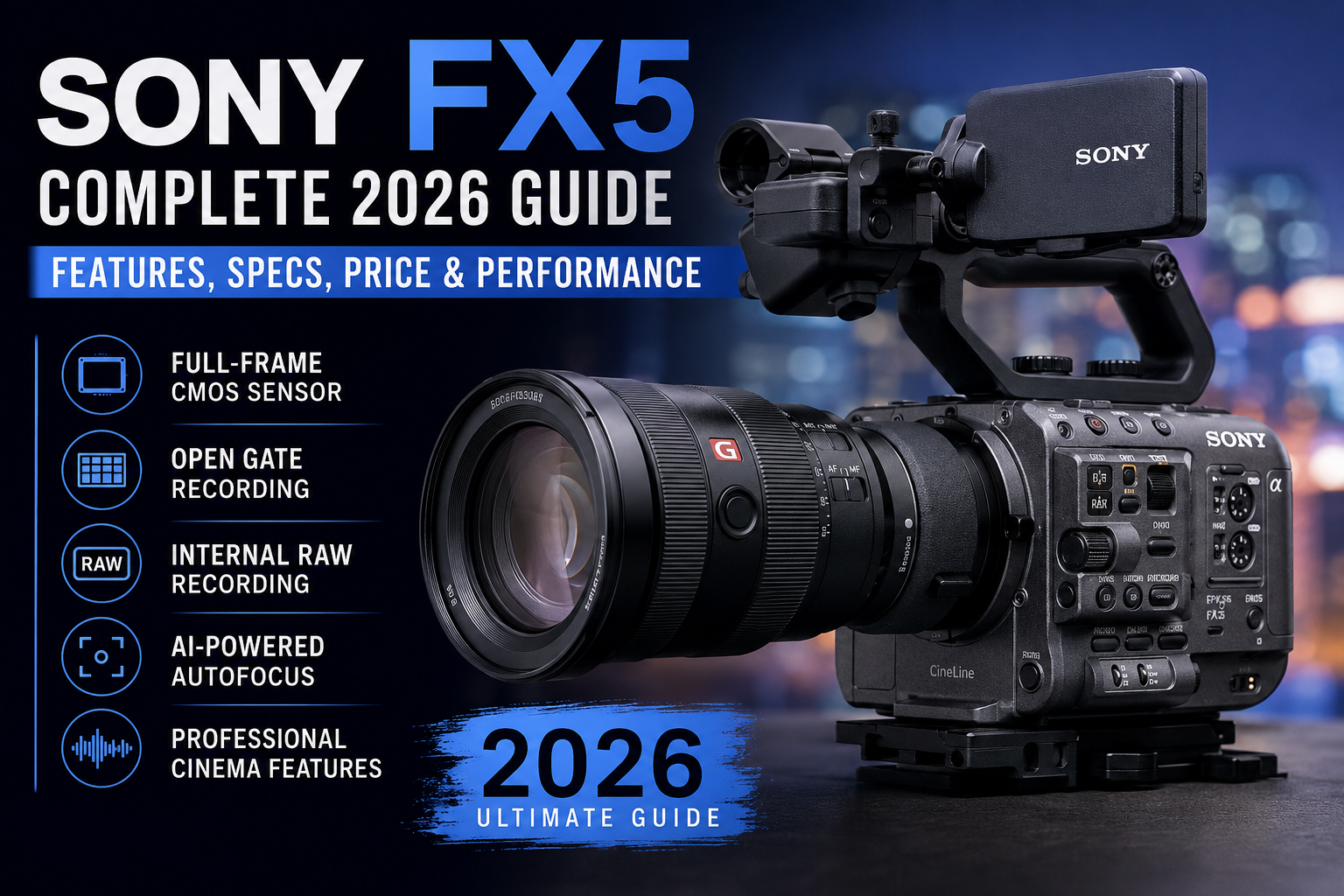

Sony FX5: The Complete 2026 Guide to Features, Performance, Recording Formats, and Professional Filmmaking
The cinema camera market continues to evolve as filmmakers demand higher image quality, more flexible recording options, faster workflows, and compact designs that can travel anywhere. Sony has consistently responded to those needs with cameras that balance cinematic performance and practical usability.
The Sony FX5 represents the next step in Sony’s Cinema Line, bringing together advanced sensor technology, high-resolution recording, intelligent autofocus, AI-assisted features, and professional production tools in a body designed for both solo creators and large production teams.
Whether you’re producing documentaries, commercials, YouTube content, weddings, corporate films, streaming productions, or independent movies, the FX5 aims to deliver professional image quality while remaining easier to operate than larger cinema cameras.
This guide explores everything you need to know about the Sony FX5—from its imaging capabilities and recording options to autofocus, workflow improvements, and real-world shooting scenarios. If you’re considering adding this camera to your production kit, you’ll find practical insights to help determine whether it fits your creative and business needs.
What Is the Sony FX5?
The Sony FX5 is a professional digital cinema camera within Sony’s Cinema Line. Positioned between compact hybrid cameras and larger broadcast-orientated cinema systems, it is designed for filmmakers who want exceptional image quality without sacrificing portability.
Unlike traditional mirrorless cameras that prioritise both photography and video, the FX5 focuses primarily on filmmaking. Every aspect of the camera—from cooling and recording options to controls and ergonomics—is tailored toward video production.
Its feature set is aimed at professionals who regularly shoot:
- Feature films
- Commercial advertisements
- Documentaries
- Wedding films
- Corporate productions
- Live events
- Social media content
- Music videos
- Television projects
- Online education and courses
Rather than simply increasing resolution, Sony appears to have emphasised workflow efficiency, recording flexibility, and image quality across a wide variety of shooting environments.
Sony Cinema Line: Where Does the FX5 Fit?
Sony’s Cinema Line now offers several cameras serving different production needs.
| Camera | Best For | Portability | Production Level |
|---|---|---|---|
| FX30 | Entry-level filmmakers | Excellent | Beginner to Intermediate |
| FX3 | Hybrid creators | Excellent | Professional |
| FX5 | Professional cinema production | Excellent | Advanced Professional |
| FX6 | Broadcast & documentary | Good | Professional |
| BURANO | High-end commercial cinema | Moderate | Premium |
| VENICE Series | Hollywood filmmaking | Limited | Enterprise Cinema |
The FX5 fills an important gap by offering many high-end cinema capabilities while remaining compact enough for handheld shooting, travel productions, and solo operators.
Why Sony Developed the FX5
The filmmaking industry has changed dramatically over the past decade.
Today, production companies expect crews to work faster than ever while delivering cinema-quality visuals. Independent creators often handle directing, cinematography, editing, and colour grading themselves.
Modern productions also require the following:
- Faster turnaround
- Smaller crews
- Higher resolutions
- Better low-light performance
- Reliable autofocus
- Flexible codecs
- Efficient editing workflows
- Advanced color grading options
The FX5 appears designed to meet these evolving expectations by combining professional recording capabilities with user-friendly operation.
Key Highlights of the Sony FX5
Some of the most notable capabilities include:
- High-resolution full-frame image sensor
- Open Gate recording
- Internal RAW recording
- High frame-rate recording
- AI-assisted autofocus
- Advanced subject recognition
- Wide dynamic range
- Professional codec support
- Cinema Line color science
- Dual native ISO architecture
- Active cooling system
- Improved monitoring tools
- Professional connectivity
- Compact production-ready body
Instead of focusing on a single specification, Sony has created a balanced package intended for demanding production environments.
First Impressions
From an ergonomic standpoint, the FX5 follows Sony’s familiar Cinema Line design philosophy.
The layout prioritises accessibility, allowing frequently used controls to remain within easy reach during handheld operation.
Notable design considerations include:
- Comfortable grip
- Dedicated video controls
- Multiple customizable buttons
- Improved menu navigation
- Professional mounting points
- Accessory compatibility
- Efficient heat management
This makes the camera adaptable for multiple shooting configurations, including:
- Gimbal operation
- Shoulder rigs
- Handheld documentary work
- Studio production
- Vehicle mounting
- Drone applications (where payload permits)
Newly Developed Image Sensor
At the heart of every cinema camera is its sensor, and the FX5 introduces a newly developed imaging system designed specifically for professional video production.
A modern cinema sensor isn’t simply about increasing megapixels. Instead, it must balance the following:
- Detail
- Readout speed
- Dynamic range
- Rolling shutter control
- Color accuracy
- Low-light performance
- Heat efficiency
The FX5’s sensor is engineered to capture high-resolution footage while maintaining fast readout speeds, enabling advanced recording modes without compromising overall image quality.
For filmmakers, this translates into cleaner footage that holds up well during editing and colour grading.
Why Sensor Technology Matters
The sensor determines much more than image resolution.
It influences:
Image Detail
A quality sensor captures fine textures in:
- Clothing
- Hair
- Skin
- Architecture
- Landscapes
- Product shots
This level of detail becomes particularly important for commercial work where every frame may be scrutinised.
Dynamic Range
Dynamic range describes how much detail the camera can preserve between the brightest highlights and the darkest shadows.
A wider dynamic range helps filmmakers retain the following:
- Bright skies
- Window detail
- Shadow texture
- Indoor lighting balance
- Sunset colors
This provides greater flexibility during colour correction and helps footage look more natural in challenging lighting conditions.
Faster Readout Speed
Modern productions increasingly rely on moving cameras.
Whether filming sports, wildlife, vehicles, or handheld sequences, rapid sensor readout minimises image distortion caused by rolling shutter.
Benefits include:
- Straighter vertical lines
- More natural camera movement
- Cleaner whip pans
- Better action footage
- Improved handheld realism
Full-Frame Advantages
The Sony FX5 uses a full-frame imaging system, offering several creative benefits over smaller sensor formats.
These include:
Better Low-Light Performance
Larger sensors generally collect more light, making them better suited for shooting in environments such as:
- Concerts
- Weddings
- Night streets
- Documentary productions
- Indoor interviews
- Event coverage
This reduces dependence on excessive artificial lighting.
Shallower Depth of Field
Many filmmakers seek cinematic background separation.
A full-frame sensor allows the following:
- Smooth background blur
- Better subject isolation
- More cinematic portraits
- Enhanced interview compositions
- Professional commercial aesthetics
Wider Lens Perspective
Wide-angle lenses remain truly wide on full-frame systems.
This benefits:
- Architecture
- Travel
- Real estate
- Landscapes
- Documentary work
- Interior filming
Open Gate Recording Explained
One of the standout features of the Sony FX5 is open-gate recording.
For many creators, this may be one of the most valuable additions because it provides significantly greater flexibility during post-production.
What Is Open Gate?
Traditional video recording captures only a portion of the camera sensor.
Open Gate recording instead captures nearly the entire sensor area.
This provides a taller image that contains additional visual information above and below the standard widescreen frame.
Think of it as recording more of the scene than you immediately need.
Why Filmmakers Love Open Gate
Recording the full sensor opens up numerous creative possibilities.
These include:
Easier Cropping
Editors can reframe shots without sacrificing quality.
This helps when:
- Correcting composition
- Stabilizing footage
- Adjusting interviews
- Improving framing after filming
Vertical Content Creation
Today’s productions rarely exist on just one platform.
A single commercial might need versions for:
- YouTube
- Instagram Reels
- TikTok
- Website banners
OpenGate recording allows editors to generate multiple aspect ratios from a single recording session.
Better Visual Effects
VFX artists often prefer having additional image area.
Extra frame information assists with:
- Motion tracking
- Object removal
- CGI integration
- Camera matching
- Virtual production
More Flexible Deliverables
Clients increasingly request multiple versions of the same project.
For example:
Original shoot:
16:9 landscape
Deliverables:
- TV commercial
- Instagram Reel
- YouTube Short
- Website banner
- Digital advertising
- LED display
- Event presentation
Open Gate makes this workflow significantly more efficient.
Understanding Internal RAW Recording
Professional filmmakers often choose RAW recording because it preserves far more image information than traditional compressed video formats.
Instead of relying solely on external recorders, the FX5 introduces internal RAW recording support, simplifying high-end production workflows.
What Is RAW Video?
RAW video stores image data before many processing decisions are permanently applied.
This allows editors greater control over:
- Exposure recovery
- White balance adjustments
- Highlight retention
- Shadow detail
- Noise reduction
- Color grading
- Skin tone refinement
Rather than locking creative choices during filming, RAW gives more flexibility in post-production.
Why Internal RAW Is Important
Traditionally, shooting RAW often required:
- External recorder
- Additional batteries
- Extra cables
- Larger camera rigs
- Increased setup time
Internal RAW recording reduces equipment complexity while keeping the production setup more compact and mobile.
This is especially beneficial for:
- Travel filmmakers
- Wedding videographers
- Documentary crews
- Solo operators
- Run-and-gun productions
Professional Color Science
Sony’s Cinema Line cameras are recognised for producing images designed to withstand intensive colour grading.
The FX5 continues this philosophy by prioritising consistent colour reproduction across various lighting conditions.
Professional colour science offers advantages such as the following:
- Natural skin tones
- Balanced highlight roll-off
- Smooth gradients
- Better color matching between cameras
- Flexible grading for different visual styles
Whether you’re aiming for a clean corporate look, a cinematic narrative style, or a bold commercial aesthetic, strong colour science provides a reliable starting point.
Who Will Benefit Most from the Sony FX5?
The FX5 isn’t intended for every type of creator. Its capabilities are best suited to professionals and serious enthusiasts who require advanced video tools.
It may be an excellent fit for:
- Independent filmmakers
- Documentary producers
- Commercial production houses
- Wedding cinematographers
- YouTube production studios
- Corporate video teams
- Streaming professionals
- Music video directors
- Educational content creators
- Freelance cinematographers
Those who primarily shoot still photography or casual video may find that a hybrid mirrorless camera better suits their needs, while dedicated filmmakers can take advantage of the FX5’s cinema-focused design.
Recording Formats: Built for Modern Productions
Professional productions rarely have a single delivery format anymore. A project may be exported for:
- YouTube
- Netflix-style streaming
- Television
- Digital advertising
- Instagram Reels
- TikTok
- Corporate presentations
- Cinema projection
Because of this, flexibility in recording formats is just as important as image quality.
The Sony FX5 is designed to support workflows ranging from fast-turnaround content creation to high-end commercial filmmaking.
Why Recording Formats Matter
Every recording format involves a trade-off between:
- Image quality
- File size
- Editing performance
- Storage requirements
- Delivery speed
Choosing the right format can significantly reduce editing time while preserving the image quality your project demands.
For example:
| Project Type | Recommended Workflow |
|---|---|
| YouTube videos | Compressed codec for faster editing |
| Weddings | High-quality compressed recording |
| Commercials | Internal RAW or high-bitrate recording |
| Documentaries | Efficient codec with manageable file sizes |
| Feature films | Maximum-quality recording |
The FX5 offers enough flexibility to adapt to each of these scenarios.
Internal RAW Workflow
RAW recording is often associated with large cinema productions, but it can also benefit independent creators who want greater control in post-production.
Advantages of Internal RAW
- Better highlight recovery
- More flexible white balance adjustments
- Improved shadow detail
- Greater color grading latitude
- Less image degradation during editing
Instead of committing to a finished look while shooting, RAW allows creative decisions to be made during post-production.
When Should You Shoot RAW?
RAW isn’t necessary for every project.
It’s most useful for:
Commercial Advertising
Brand campaigns often undergo extensive colour grading and revisions.
RAW provides the flexibility required to satisfy changing client requests.
Feature Films
Narrative productions frequently require:
- Day-for-night grading
- Stylized color palettes
- Complex visual effects
- Extensive exposure adjustments
RAW provides a better starting point for these workflows.
Music Videos
Creative lighting, smoke, coloured LEDs, and dramatic grading benefit from the additional image data retained in RAW recording.
High-End Client Work
Clients paying premium production rates often expect maximum image quality.
Using RAW can help future-proof footage for revisions and remastering.
Understanding Codecs
A codec determines how video is compressed and stored.
Not all codecs are created equally.
Some prioritise smaller files, while others preserve maximum detail.
Professional editors typically choose codecs based on the project’s requirements rather than always selecting the highest quality.
Efficient Compression
Efficient codecs help reduce the following:
- Storage costs
- Upload times
- Backup duration
- Editing delays
They also make collaboration easier when teams work remotely.
High-Quality Compression
High-bitrate recording preserves the following:
- Fine textures
- Skin tones
- Gradients
- Motion detail
- Color transitions
This becomes increasingly important during heavy colour grading.
High Frame Rate Recording
Slow motion has become an essential storytelling tool across nearly every genre.
Examples include:
- Sports
- Weddings
- Nature
- Commercials
- Automotive films
- Fashion
- Product videos
The FX5 supports high frame-rate recording for smooth slow-motion playback.
Benefits of High Frame Rates
High frame-rate footage can emphasise the following:
- Emotional reactions
- Water splashes
- Hair movement
- Running sequences
- Sports action
- Wildlife
- Vehicle movement
Rather than simply slowing footage down, it enhances storytelling by allowing viewers to appreciate details that would otherwise pass too quickly.
Image Quality During Slow Motion
One challenge with high frame-rate recording is maintaining image quality.
Professional filmmakers expect:
- Sharp details
- Minimal rolling shutter
- Accurate colors
- Stable exposure
- Reliable autofocus
The FX5 is designed to maintain consistent image quality across multiple recording modes, reducing compromises when switching between standard and slow-motion footage.
Autofocus: Smarter Than Ever
Autofocus technology has evolved dramatically over the past decade.
Today’s professional cameras are capable of recognising subjects and maintaining focus with remarkable precision.
The Sony FX5 builds upon Sony’s established autofocus expertise by incorporating advanced tracking and subject recognition technologies.
Why Reliable Autofocus Matters
Professional productions often involve unpredictable movement.
Examples include:
- Wedding ceremonies
- Sports
- Wildlife
- Children
- Documentary interviews
- Live events
- Street filmmaking
Missing focus can mean losing an irreplaceable moment.
Accurate autofocus helps reduce that risk.
AI-Assisted Subject Recognition
Modern AI processing enables cameras to identify different types of subjects more intelligently.
Instead of simply detecting contrast, AI systems analyse shapes, patterns, and movement to improve tracking performance.
Potential subject categories include:
- People
- Eyes
- Faces
- Animals
- Birds
- Vehicles
This allows the camera to maintain focus even when subjects briefly leave the frame or change direction.
Face Detection
Interview shoots often involve subtle movements.
Reliable face detection helps maintain consistent sharpness while allowing the operator to concentrate on composition and storytelling.
Eye Detection
Eye autofocus is especially useful for the following:
- Portrait films
- Interviews
- Weddings
- Fashion
- Commercial productions
Keeping the subject’s eyes sharp helps create a polished, professional look.
Subject Tracking
Tracking technology benefits moving subjects such as the following:
- Athletes
- Dancers
- Children
- Wildlife
- Cars
- Cyclists
Rather than repeatedly adjusting focus manually, operators can allow the camera to follow the selected subject.
Manual Focus Still Matters
Despite advances in autofocus, manual focus remains essential for many cinematic productions.
Experienced cinematographers often prefer manual focus for:
- Dramatic scenes
- Controlled camera moves
- Rack focus transitions
- Macro work
- Narrative filmmaking
The FX5 supports both approaches, giving filmmakers the freedom to choose based on the production.
Dynamic Range in Real Productions
A wide dynamic range becomes especially valuable in difficult lighting.
Consider these situations:
Wedding Ceremony
Bright windows behind the couple.
Without sufficient dynamic range:
- White dress loses detail.
- Windows become overexposed.
- Faces appear too dark.
Greater dynamic range helps preserve all three.
Outdoor Documentary
Clouds move constantly.
Lighting changes every few seconds.
A camera with strong dynamic range handles these variations more gracefully.
City Night Scenes
Street lights, neon signs, and shadows create challenging exposure conditions.
Better dynamic range allows more highlight retention while maintaining shadow detail.
Low-Light Performance
Many productions happen after sunset.
Examples include:
- Weddings
- Concerts
- Festivals
- Night documentaries
- Restaurants
- Events
- Street scenes
Good low-light performance reduces reliance on artificial lighting while preserving natural atmosphere.
Benefits of Better Low-Light Performance
- Cleaner shadows
- Less image noise
- More natural colors
- Reduced lighting equipment
- Faster production setup
For solo creators, this can simplify shooting in challenging environments.
Color Science for Professional Editors
Colour science influences how footage appears before any grading is applied.
Good colour science provides the following:
- Accurate skin tones
- Natural greens
- Balanced blues
- Pleasing highlights
- Consistent color matching
Editors spend less time correcting footage and more time refining the creative look.
Memory Cards and Storage Requirements
One aspect often overlooked when purchasing a cinema camera is storage.
Higher resolutions and advanced recording formats generate significantly larger files.
Professional filmmakers should plan for both recording media and long-term archiving.
Why Storage Planning Matters
Large productions may generate several terabytes of footage in a single day.
Without an organised storage strategy, teams may experience the following:
- Delayed backups
- Missed deadlines
- Media management issues
- Increased production costs
Choosing the Right Memory Cards
When selecting recording media, consider:
- Sustained write speed
- Reliability
- Capacity
- Heat resistance
- Manufacturer reputation
Professional productions generally favour memory cards that are specifically designed for high-bitrate video recording.
Backup Strategy
Many production companies follow a “3-2-1” backup approach:
- Three copies of footage
- Two different storage devices
- One off-site or cloud backup
This helps protect valuable footage from accidental loss.
Audio Features for Professional Productions
Excellent video deserves equally strong audio.
The FX5 is designed to integrate with professional audio equipment, making it suitable for interviews, documentaries, corporate productions, and film sets.
Common audio accessories include:
- Shotgun microphones
- Wireless lavalier systems
- Boom microphones
- Portable audio recorders
Clean audio reduces editing time and improves the final viewing experience.
Monitoring Tools
Professional monitoring helps ensure consistent results during production.
Useful monitoring features may include:
- Waveform monitoring
- Zebras
- Focus peaking
- False color
- Histogram
- Audio meters
- Timecode display
These tools assist camera operators in making informed exposure and focus decisions on set.
Connectivity Options
Modern productions often require cameras to integrate with a variety of external devices.
Potential connectivity options include:
- External monitors
- Recorders
- SSD solutions
- Production switchers
- Remote controls
- Wireless transmitters
- Network workflows
Flexible connectivity allows the FX5 to adapt to different production environments, from solo shoots to multi-camera broadcasts.
Real-World Workflow Improvements
A professional camera should streamline production rather than slow it down.
The FX5 emphasises efficiency through features that reduce setup time and simplify operation.
Examples include:
- Quick menu access
- Customizable buttons
- Efficient cooling
- Reliable battery performance
- Flexible recording options
- Compact form factor
These improvements help crews focus on storytelling rather than technical limitations.
Sony FX5 vs Sony FX3
Many creators considering the FX5 may already own or be familiar with the Sony FX3.
Here’s a general comparison:
| Feature | Sony FX5 | Sony FX3 |
|---|---|---|
| Primary Focus | Professional cinema production | Hybrid filmmaking |
| Recording Flexibility | More advanced | Excellent |
| Internal RAW | Available | More limited workflow |
| Open Gate | Available | Limited |
| Professional Expansion | Greater | Moderate |
| Workflow | Cinema-focused | Creator-focused |
Choose the FX3 if:
- You prioritise portability.
- You create YouTube or travel content.
- You need both photo and video flexibility.
Choose the FX5 if:
- Video is your primary business.
- You work with production teams.
- You require advanced recording capabilities.
- You regularly deliver commercial or cinematic projects.
Sony FX5 vs Sony FX6
The FX6 has long been a favourite among documentary filmmakers and broadcast professionals.
The FX5 expands Sony’s Cinema Line by introducing newer imaging technologies and recording options while maintaining a compact design.
| Category | FX5 | FX6 |
|---|---|---|
| Sensor Technology | Newer generation | Proven professional sensor |
| Open Gate | Yes | No |
| Internal RAW | Yes | External workflow emphasis |
| Compact Design | Excellent | Very good |
| Professional Controls | Excellent | Excellent |
| Cinema Workflow | Enhanced | Mature |
For creators seeking newer recording flexibility, the FX5 presents an attractive option.