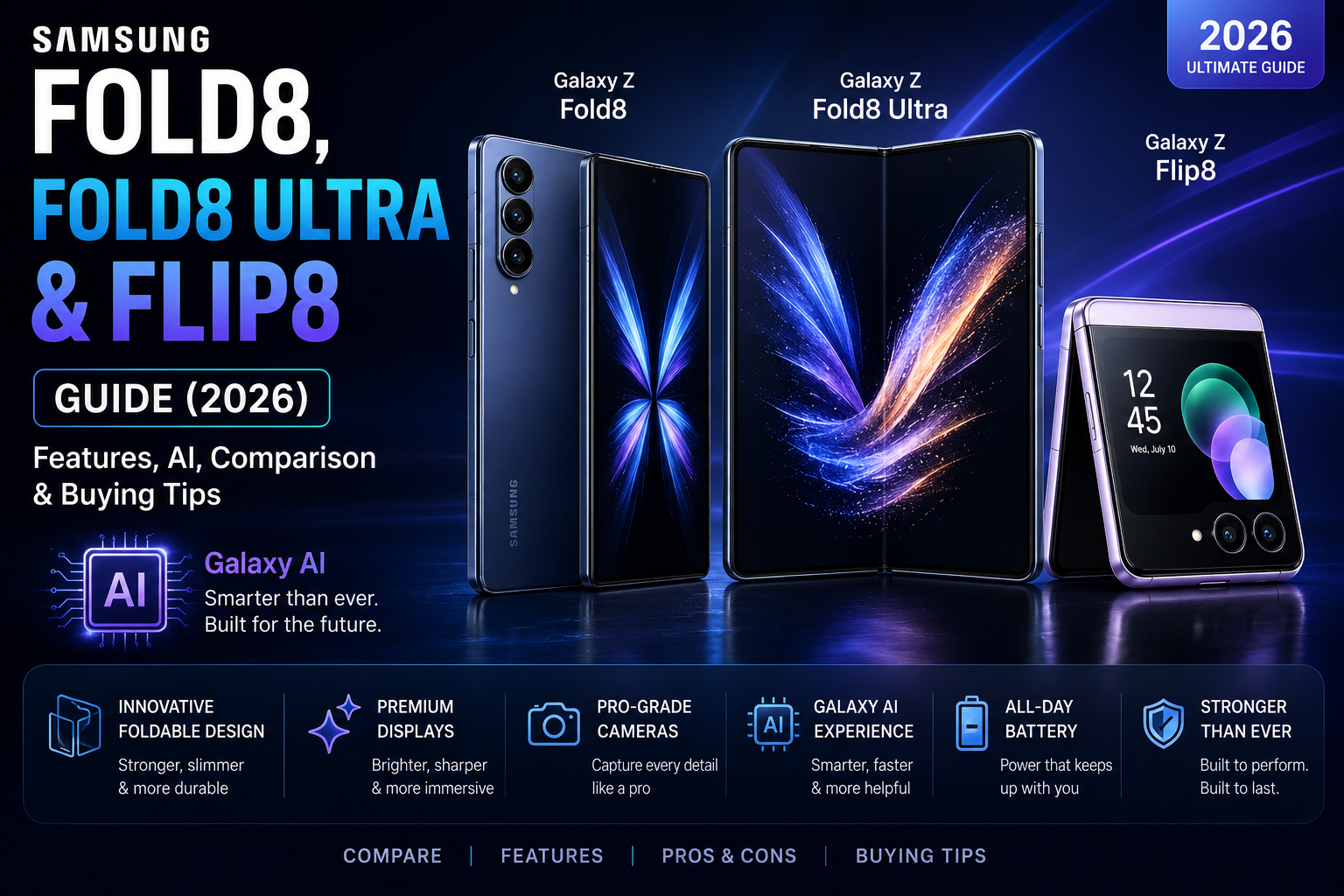

Samsung’s Foldable Revolution: How Galaxy Z Fold8, Fold8 Ultra & Flip8 Are Shaping the Future of Smartphones
For years, smartphones evolved through gradual improvements—faster processors, brighter displays, better cameras, and longer battery life. While these upgrades certainly mattered, they rarely changed how people interacted with their devices. Foldable smartphones introduced something different: a new way of using a phone altogether.
Samsung has been at the centre of this transformation. Rather than treating foldables as experimental gadgets, the company has spent years refining them into practical devices designed for work, entertainment, creativity, and everyday communication.
In 2026, Samsung’s latest foldable lineup represents another major step forward. Instead of focusing solely on hardware upgrades, the company is emphasising durability, artificial intelligence, multitasking, and software experiences that take full advantage of flexible displays.
The newest generation is designed for a wide range of users:
- Professionals managing multiple tasks
- Students balancing productivity and entertainment
- Travelers wanting one device instead of two
- Content creators working on the go
- Mobile gamers seeking immersive displays
- Business users who rely on AI-powered workflows
As foldable technology becomes more mature, many consumers are beginning to ask an important question:
Are foldable phones finally ready to replace traditional flagship smartphones?
This guide explores Samsung’s latest foldable innovations, how they compare to conventional smartphones, and why 2026 may become one of the most significant years in the evolution of mobile technology.
Why Samsung Continues to Lead the Foldable Smartphone Market
Creating a foldable smartphone is significantly more challenging than building a conventional device.
Manufacturers must solve several engineering problems simultaneously:
- Flexible display durability
- Strong yet lightweight hinges
- Heat management
- Water resistance
- Dust protection
- Battery optimization
- Software adaptation
- Long-term reliability
Each improvement requires years of research and testing.
Samsung invested early in flexible OLED technology, allowing it to gain valuable experience before most competitors entered the market. Over multiple generations, the company has refined nearly every aspect of foldable design, learning from customer feedback and real-world usage.
Instead of treating foldables as luxury experiments, Samsung has steadily expanded their appeal by improving comfort, performance, and software functionality.
Today’s foldables are designed to serve as reliable daily devices rather than niche technology showcases.
The Evolution of Samsung Foldables
Samsung’s foldable journey reflects a gradual process of refinement rather than dramatic reinvention.
Each generation introduced meaningful improvements that addressed practical concerns raised by users.
Early Focus
The first foldable devices primarily demonstrated what flexible display technology could achieve.
Users appreciated the innovation but often encountered challenges such as the following:
- Visible display creases
- Thicker designs
- Limited app optimization
- Higher weight
- More fragile construction
Despite these limitations, they proved that foldable smartphones had genuine potential.
Refinement Phase
Later generations shifted attention toward everyday usability.
Samsung gradually improved:
- Hinge mechanisms
- Display protection
- Water resistance
- Battery efficiency
- Camera systems
- Software optimization
Applications became increasingly capable of transitioning smoothly between folded and unfolded modes.
Productivity Era
As foldables matured, Samsung focused on replacing multiple devices with one.
Modern foldables now support:
- Split-screen multitasking
- Floating windows
- Desktop-like productivity
- Stylus compatibility
- AI-powered workflows
- Advanced document editing
- Professional video creation
Rather than simply offering a larger display, foldables began functioning more like compact tablets that fit into a pocket.
Meet Samsung’s Latest Foldable Family
Samsung’s current lineup includes devices tailored to different lifestyles and usage preferences.
Samsung Foldable Phones: Galaxy Z Fold8
The Galaxy Z Fold 8 is designed for users seeking maximum productivity.
When folded, it behaves like a traditional smartphone.
When opened, it transforms into a large workspace suitable for:
- Email management
- Document editing
- Reading
- Streaming
- Video conferencing
- Creative work
- Gaming
This flexibility allows users to carry a single device instead of both a phone and a tablet.
Samsung Foldable Phones: Galaxy Z Fold8 Ultra
The Fold8 Ultra expands on the flagship experience with an emphasis on premium performance.
Potential highlights include the following:
- Larger immersive display
- Enhanced camera hardware
- Higher productivity capabilities
- Premium materials
- Advanced AI integration
- Improved multitasking efficiency
For professionals who spend much of their day on mobile devices, the Ultra model aims to function as a pocket-sized workstation.
Samsung Foldable Phones: GalaxySamsung Foldable Phones Z Flip8
The Galaxy Z Flip8 targets users who value portability and style without sacrificing flagship performance.
Its compact design easily fits into the following:
- Small pockets
- Handbags
- Travel accessories
When unfolded, it provides a familiar smartphone experience with a full-size display.
The external screen enables users to quickly do the following:
- View notifications
- Control music
- Answer calls
- Check navigation
- Access widgets
- Use quick camera features
This combination of convenience and functionality makes the Flip series especially appealing to users who prioritise mobility.
Understanding Foldable Smartphone Technology
Many consumers wonder what actually makes a foldable smartphone different from a regular flagship.
The answer extends far beyond the folding display.
Samsung’s engineering combines several advanced technologies into a single device.
Samsung Foldable Phones: Flexible OLED Display
Unlike conventional smartphone screens, foldable displays use flexible materials capable of bending thousands of times without breaking.
This allows the display to do the following:
- Fold inward
- Open flat
- Maintain image quality
- Deliver vibrant colors
- Preserve high refresh rates
Modern flexible OLED panels also support HDR content and adaptive brightness for an immersive viewing experience.
Advanced Hinge Engineering
The hinge is arguably the most important mechanical component.
A well-designed hinge must:
- Open smoothly
- Stay stable at multiple angles
- Resist wear
- Protect internal components
- Support frequent daily use
Continuous improvements in hinge design have made foldables feel significantly more durable than earlier generations.
Ultra-Thin Glass
One of the biggest misconceptions is that foldable displays are made entirely of plastic.
Modern Samsung foldables incorporate ultra-thin glass layers combined with protective materials that improve both flexibility and durability.
The result is a display that feels more natural while maintaining the ability to fold repeatedly.
Adaptive Software
Foldable hardware is only useful if software can fully utilise it.
Samsung has invested heavily in software experiences that automatically adjust applications when users
- Fold the phone
- Unfold it
- Rotate it
- Enter multitasking mode
This seamless transition creates a more intuitive experience than simply enlarging a standard smartphone interface.
How Artificial Intelligence Is Changing the Samsung Experience
Artificial intelligence has become one of the biggest priorities in modern smartphones.
Rather than adding isolated AI features, Samsung is integrating intelligence throughout the operating system.
This enables devices to become more proactive and context-aware.
Smarter Productivity
AI can help simplify everyday tasks such as the following:
- Summarizing documents
- Organizing notes
- Translating conversations
- Scheduling events
- Managing reminders
- Drafting messages
Instead of switching between multiple applications, users can complete many workflows directly on the device.
Better Communication
Language barriers continue to shrink thanks to AI-powered communication tools.
These features may assist with:
- Live translation
- Voice transcription
- Subtitle generation
- Language detection
- Conversation summaries
For travellers and international professionals, these capabilities improve communication without requiring separate translation devices.
Samsung Foldable Phones: AI-Powered Photography
Modern smartphone photography increasingly depends on software rather than hardware alone.
Samsung’s AI systems can help improve the following:
- Portrait quality
- Low-light performance
- Dynamic range
- Color accuracy
- Object recognition
- Scene optimization
Rather than manually adjusting settings, users can capture high-quality photos with minimal effort.
Intelligent Multitasking
Large foldable displays create opportunities for AI-assisted workflows.
For example, users may simultaneously:
- Watch a presentation
- Take notes
- Ask AI questions
- Generate summaries
- Search the web
- Respond to emails
This transforms the smartphone into a more capable productivity tool.
Design Philosophy: Built for Everyday Life
Samsung’s latest foldables are not designed solely to impress technology enthusiasts.
Their design reflects everyday practicality.
Several improvements contribute to a more comfortable experience:
Slimmer Construction
Modern foldables continue becoming thinner and easier to carry.
Reduced thickness makes the following:
- Pocket storage easier
- One-handed use more comfortable
- Daily transportation more convenient
Improved Weight Distribution
Balanced weight reduces fatigue during prolonged use.
This is especially important for users who frequently:
- Read books
- Watch movies
- Edit documents
- Attend video meetings
Premium Materials
Higher-quality materials contribute to:
- Better durability
- Enhanced appearance
- Comfortable grip
- Improved structural strength
Premium finishes also give foldables the look and feel expected from flagship smartphones.
Better External Displays
Cover screens have become significantly more useful.
Instead of serving only as notification panels, they now support many everyday interactions without requiring users to unfold the device.
Common quick tasks include:
- Replying to messages
- Checking weather
- Calendar events
- Music playback
- Fitness tracking
- Navigation previews
Why Foldables Appeal to Different Types of Users
One reason Samsung continues expanding its foldable lineup is that different users benefit from different form factors.
| User Type | Primary Benefit |
|---|---|
| Business Professionals | Multitasking and productivity |
| Students | Reading, note-taking, research |
| Travelers | One device replaces phone and tablet |
| Content Creators | Larger editing workspace |
| Gamers | Immersive display experience |
| Remote Workers | Improved video meetings and multitasking |
| Casual Users | Entertainment and social media |
Rather than targeting only technology enthusiasts, foldables increasingly appeal to mainstream smartphone buyers.
Are Foldables Becoming the New Flagship Standard?
Only a few years ago, foldable smartphones were viewed as experimental products with premium prices and limited practicality.
That perception is changing.
Several factors are accelerating adoption:
- Improved durability
- Better software optimization
- Stronger battery performance
- Advanced AI features
- More refined designs
- Increased consumer awareness
- Expanding app support
As manufacturers continue investing in foldable technology, these devices are becoming more practical for everyday use rather than serving as luxury showcases.
Samsung Fold8 vs Fold8 Ultra vs Flip8: Which One Is Right for You?
Samsung’s foldable lineup has expanded beyond offering a single premium option. Instead, each model serves a different type of user. While all three devices share Samsung’s focus on premium design, AI integration, and flexible displays, their strengths differ based on how people use their smartphones every day.
The Fold8 emphasises productivity, the Fold8 Ultra targets users who want the most advanced experience possible, and the Flip8 is built for portability without sacrificing flagship-level performance.
Choosing the right model depends less on specifications alone and more on your daily routine, work style, and entertainment preferences.
Quick Comparison Overview
| Feature | Galaxy Z Fold8 | Galaxy Z Fold8 Ultra | Galaxy Z Flip8 |
|---|---|---|---|
| Design | Book-style foldable | Premium book-style foldable | Compact clamshell |
| Best For | Productivity | Power users & professionals | Everyday users |
| Portability | Excellent | Very Good | Outstanding |
| Multitasking | Excellent | Exceptional | Good |
| Gaming | Excellent | Outstanding | Very Good |
| Camera Experience | Flagship | Premium flagship | High-end |
| AI Features | Advanced | Most comprehensive | Advanced |
| Entertainment | Excellent | Exceptional | Very Good |
Rather than thinking about which phone is “better”, it’s more useful to consider which one fits your lifestyle.
Display Technology: Bigger Than Just Screen Size
Samsung has spent years perfecting AMOLED technology, and its foldable displays showcase some of the company’s most advanced screen innovations.
A foldable display is not simply a larger phone screen. It changes how users interact with apps, multitask, watch content, and create documents.
Dynamic Viewing Experience
Modern foldable displays provide benefits that extend beyond entertainment.
Users can comfortably:
- Read lengthy articles
- Review spreadsheets
- Edit presentations
- Watch movies
- Join video conferences
- Browse multiple websites simultaneously
The larger canvas reduces the need for constant zooming or switching between applications.
Adaptive Refresh Rate
High refresh rate displays make scrolling feel smoother while improving responsiveness during gaming and animations.
Adaptive refresh technology helps conserve battery life by automatically adjusting the refresh rate depending on what’s being displayed.
For example:
- Reading static text uses less power.
- Watching videos optimises frame synchronisation.
- Gaming activates higher refresh rates for smoother gameplay.
This intelligent adjustment balances performance with efficiency.
Improved Outdoor Visibility
Premium smartphones increasingly need to perform well under direct sunlight.
Samsung’s display technology focuses on:
- High brightness
- Improved contrast
- Better anti-reflective properties
- Enhanced color accuracy
These improvements help maintain readability whether users are indoors or outside.
Multitasking That Feels Like a Mini Computer
One of the biggest advantages of the Fold series is the ability to use multiple applications simultaneously.
Instead of switching between apps every few seconds, users can keep several windows open at once.
For professionals, this significantly improves workflow efficiency.
Split-Screen Productivity
Examples include:
- Email beside Microsoft Word
- Browser beside Google Docs
- YouTube beside Notes
- Calendar beside Gmail
- Spreadsheet beside Calculator
This reduces interruptions and keeps important information visible.
Floating Windows
Some apps can appear as movable floating windows.
For example:
- Calculator
- Messaging apps
- Music controls
- AI assistant
- File manager
Users can quickly access these tools without leaving their current task.
Drag-and-Drop Support
Large displays make drag-and-drop interactions much easier.
Common examples include:
- Moving photos into documents
- Sharing files between apps
- Copying text
- Organizing folders
- Saving images from the browser
These desktop-like interactions make foldables attractive for business users.
Performance Designed for Heavy Workloads
Modern flagship smartphones must do much more than launch apps quickly.
Today’s users expect smooth performance while
- Editing videos
- Playing AAA-quality mobile games
- Running AI features
- Streaming 4K content
- Managing dozens of browser tabs
- Switching between multiple applications
Samsung’s foldable lineup is engineered to handle these demanding tasks efficiently.
Everyday Speed
For most users, performance improvements are most noticeable during everyday activities.
Apps launch quickly, animations remain fluid, and multitasking feels responsive even after extended use.
Routine tasks such as the following:
- Messaging
- Video calls
- Banking
- Navigation
- Social media
- Shopping
All benefit from optimised hardware and software working together.
Gaming Performance
Mobile gaming continues to evolve, with titles featuring console-like graphics and increasingly demanding hardware requirements.
Foldable displays provide several gaming advantages:
- Larger field of view
- Better touch controls
- Enhanced immersion
- Comfortable landscape orientation
- Improved multitasking for streaming or chatting
Many competitive gamers also appreciate the smooth refresh rates and responsive touch input offered by Samsung’s flagship displays.
Thermal Management
Powerful processors generate heat during intensive tasks.
Samsung’s thermal management systems are designed to
- Maintain consistent performance
- Reduce overheating
- Improve gaming stability
- Support long editing sessions
Effective cooling helps prevent performance drops during demanding workloads.
Camera System: More Than Megapixels
Consumers often compare smartphones based solely on megapixel counts, but image quality depends on many factors beyond sensor resolution.
Samsung focuses on combining advanced hardware with intelligent image processing.
Portrait Photography
AI-assisted portrait modes help create the following:
- Natural background blur
- Improved edge detection
- Balanced skin tones
- Better subject separation
These enhancements aim to produce professional-looking portraits without requiring manual editing.
Night Photography
Low-light photography has become one of the most important smartphone features.
Samsung’s computational photography works to do the following:
- Reduce image noise
- Preserve detail
- Improve brightness
- Maintain realistic colors
The result is clearer nighttime photos with greater consistency.
Zoom Capabilities
Modern flagship cameras increasingly rely on advanced optical systems combined with AI-powered image enhancement.
This allows users to capture distant subjects while maintaining greater detail than traditional digital zoom alone.
Video Recording
Content creators continue to rely heavily on smartphones for video production.
Samsung foldables support features designed for creators, including the following:
- High-resolution recording
- Image stabilization
- HDR video
- Slow motion
- Time-lapse
- Multi-camera modes
The Fold series also offers unique shooting angles by partially folding the device, reducing the need for a tripod in many situations.
Samsung Foldable Phones: Samsung Galaxy AI: A Smarter Mobile Experience
Artificial intelligence has become one of Samsung’s defining software features.
Rather than existing as a single application, AI is integrated throughout the operating system.
Writing Assistance
AI tools can help users:
- Rewrite messages
- Correct grammar
- Adjust writing tone
- Summarize lengthy content
- Generate quick replies
These features save time while improving communication.
Intelligent Search
Instead of navigating through menus, users can increasingly search using natural language.
For example:
- Find old photos
- Locate documents
- Search settings
- Identify objects in images
Natural language interactions make smartphones easier to use.
Productivity Enhancements
AI can assist with:
- Meeting summaries
- Note organization
- Calendar suggestions
- Reminder creation
- Translation
- Voice transcription
Professionals managing busy schedules benefit from these time-saving tools.
Battery Life and Charging
Foldable smartphones require careful power management because of their larger displays and multitasking capabilities.
Samsung focuses on balancing battery capacity with software optimisation.
Several factors influence battery performance:
- Screen brightness
- Refresh rate
- Network usage
- Gaming
- Camera activity
- AI processing
Adaptive power management helps allocate resources based on usage patterns.
Fast Charging
Modern charging technologies allow users to regain significant battery capacity in a relatively short period.
This is especially useful for:
- Frequent travelers
- Business professionals
- Students
- Remote workers
Quick charging minimises downtime throughout the day.
Wireless Charging Convenience
Wireless charging continues to add convenience for users with compatible charging accessories.
Premium foldables also support ecosystem features that allow compatible devices, such as earbuds or smartwatches, to be charged wirelessly from the phone.
Software Experience: One UI Optimized for Foldables
Hardware alone cannot deliver a premium foldable experience.
Samsung’s One UI has been refined specifically for flexible displays.
Taskbar Functionality
The Fold series includes desktop-inspired taskbars that make app switching significantly faster.
Frequently used applications remain accessible while users continue working.
App Continuity
One of the defining foldable features is seamless app continuity.
For example:
- Read an article on the cover display.
- Open the phone.
- Continue reading instantly on the larger screen.
This transition happens smoothly without interrupting the user experience.
Flex Mode
Certain applications automatically adapt when the phone is partially folded.
Examples include:
- Video calls
- Camera controls
- Media playback
- Photography
- Video recording
This allows hands-free operation in situations where a stand or tripod would otherwise be necessary.
Security and Privacy
As smartphones increasingly store sensitive information, security remains a major priority.
Samsung includes multiple layers of protection designed for both personal and professional users.
Common security features include:
- Biometric authentication
- Secure storage
- Device encryption
- Privacy controls
- Secure payment support
For enterprise users, these protections help safeguard confidential business information.
Samsung Ecosystem Benefits
Foldable smartphones become even more useful when connected with other Samsung devices.
The ecosystem enables smoother interactions between:
- Galaxy tablets
- Galaxy watches
- Galaxy Buds
- Smart TVs
- Windows PCs
- Smart home devices
Examples include:
- Copying text across devices
- Sharing files instantly
- Continuing work from phone to tablet
- Managing notifications across devices
- Controlling connected smart appliances
This interconnected experience encourages productivity while reducing friction between devices.
Who Should Buy Each Samsung Foldable?
Samsung Foldable Phones: Galaxy Z Fold8
Ideal for:
- Business professionals
- Entrepreneurs
- Remote workers
- Students
- Frequent travelers
- Productivity-focused users
Samsung Foldable Phones: Galaxy Z Fold8 Ultra
Best suited for:
- Power users
- Creative professionals
- Mobile content creators
- Heavy multitaskers
- Technology enthusiasts
Samsung Foldable Phones: Galaxy Z Flip8
Perfect for:
- Everyday smartphone users
- Social media enthusiasts
- Fashion-conscious buyers
- Travelers
- Students
- Users upgrading from traditional smartphones
Pros and Cons of Samsung Foldables
| Pros | Cons |
|---|---|
| Innovative foldable design | Premium pricing compared to many traditional phones |
| Excellent AMOLED displays | Larger models may feel heavier than standard smartphones |
| Powerful multitasking features | Some apps are still being optimized for foldable layouts |
| Advanced AI capabilities | Repairs can be more specialized due to foldable components |
| Strong productivity experience | Battery life varies depending on heavy multitasking |
| Premium build quality | Users may need time to adapt to the new form factor |
| Seamless Samsung ecosystem | Availability of certain models or features may differ by region |
Buying Advice: Which Samsung Foldable Offers the Best Value?
The best choice depends on how you use your smartphone.
Choose the Samsung Foldable Phone Galaxy Z Fold 8 if you want a versatile device that balances productivity, entertainment, and portability.
Consider the Samsung Foldable Phone Galaxy Z Fold8 Ultra if you rely on your phone for demanding creative work or intensive multitasking or want Samsung’s most feature-rich foldable experience.
The Samsung Foldable Phone Galaxy Z Flip8 is an excellent option for users who prioritise portability, style, and flagship features in a compact design.
Rather than chasing the highest specifications, focus on the device that aligns with your daily habits and long-term needs.
The Future of Samsung Foldables: What’s Next?
Foldable smartphones have moved beyond being a niche category. They are steadily becoming a core part of Samsung’s flagship strategy, representing a long-term vision for how people will interact with mobile technology.
Rather than treating foldables as luxury devices for early adopters, Samsung continues refining them for everyday use. Improvements in durability, software optimisation, battery efficiency, and AI capabilities suggest that foldables are evolving into practical smartphones suitable for a much wider audience.
The next phase of innovation is likely to focus on making foldables feel even more seamless—thinner designs, lighter materials, smarter software, and better integration with connected devices.
AI Will Become Even More Personal
Artificial intelligence is expected to play a much larger role in future Galaxy devices.
Instead of simply responding to commands, future AI systems may become proactive digital assistants capable of understanding habits, predicting needs, and helping users complete tasks with fewer manual steps.
Possible future AI capabilities include:
- Personalized daily planning
- Context-aware reminders
- Intelligent travel assistance
- Advanced voice interactions
- Smarter photo organization
- Real-time language interpretation
- Predictive battery management
- Automated workflow suggestions
As on-device AI continues to improve, many tasks will become faster while keeping more personal data processed locally on the device.
Foldables vs Traditional Smartphones
Many consumers considering a premium smartphone wonder whether they should purchase a foldable device or a traditional flagship.
The answer depends largely on how the device will be used.
Samsung Foldable Phones: Traditional Smartphones Excel At
- One-handed operation
- Simplicity
- Familiar design
- Slightly lower weight
- Broader accessory compatibility
Samsung Foldable Phones: Foldables Excel At
- Productivity
- Multitasking
- Reading documents
- Watching videos
- Mobile gaming
- Split-screen applications
- Creative workflows
- Larger workspace
For users who frequently switch between multiple apps or work on the go, foldables provide advantages that conventional smartphones cannot easily match.
Samsung vs Apple: The Emerging Foldable Competition
For many years, Samsung and Apple have competed in the premium smartphone market by taking different approaches to innovation.
Samsung has generally introduced new hardware categories earlier, while Apple has often waited until technologies have matured before entering a market.
With increasing industry attention on foldable devices, many consumers are watching to see how competition between the two companies evolves.
Samsung’s Current Strengths
Samsung has several years of practical experience designing foldable smartphones.
This experience has allowed the company to refine the following:
- Flexible displays
- Hinge engineering
- Foldable software optimization
- Multitasking features
- Accessory ecosystem
- AI-powered productivity
These refinements contribute to a more polished foldable experience.
Apple’s Potential Approach
Although Apple is widely expected to continue exploring foldable technologies, the company’s strategy has traditionally emphasised ecosystem integration, user experience, and software optimisation.
Whenever Apple introduces new product categories, the focus often extends beyond hardware specifications to include a cohesive software experience.
This ongoing competition is likely to benefit consumers by accelerating innovation across the smartphone industry.
Samsung’s Growing Ecosystem Advantage
Modern smartphones rarely function as standalone devices.
Instead, they connect with a broader ecosystem of products and services.
Samsung’s ecosystem includes:
- Galaxy Watches
- Galaxy Buds
- Galaxy Tablets
- Smart TVs
- Windows PCs
- Smart home products
- Health tracking devices
The more Galaxy devices a user owns, the more seamless the overall experience becomes.
Examples include:
- Instant file transfers
- Cross-device copy and paste
- Shared notifications
- Automatic device switching
- Smart home control
- Multi-device productivity
This interconnected experience creates convenience that extends beyond the smartphone itself.
Foldables and Mobile Productivity
One of Samsung’s biggest goals is transforming smartphones into true productivity tools.
Instead of carrying multiple devices, professionals increasingly rely on one foldable phone for:
- Email management
- Video meetings
- Spreadsheet editing
- Presentation reviews
- Document annotation
- Cloud collaboration
- Digital signatures
- Remote desktop access
Combined with cloud storage and AI-powered software, foldables are becoming capable mobile workstations.
Entertainment on a Foldable Display
Entertainment remains one of the strongest reasons consumers choose larger foldable screens.
A bigger display enhances experiences across multiple categories.
Streaming
Large AMOLED displays make movies and TV shows more immersive with richer colours and improved contrast.
Reading
Digital books, magazines, PDFs, and long-form articles become easier to read thanks to the expanded screen space.
Gaming
Many modern games benefit from:
- Wider viewing areas
- Better touch controls
- Higher refresh rates
- More immersive gameplay
Social Media
Viewing and creating content becomes more enjoyable with additional screen real estate for editing photos, videos, and stories.
Durability: How Far Foldables Have Come
One of the earliest concerns surrounding foldable smartphones was durability.
Over multiple generations, Samsung has introduced meaningful improvements designed to increase long-term reliability.
Areas of improvement include:
- Stronger hinge construction
- Improved flexible glass
- Better display protection
- Enhanced structural materials
- Improved resistance to everyday wear
While foldables still require reasonable care like any premium smartphone, they have become far more dependable than earlier models.
Common Myths About Foldable Phones
Several misconceptions continue to influence purchasing decisions.
Let’s separate myth from reality.
Myth 1: Foldables Break Easily
Modern foldables are designed for everyday use and undergo extensive durability testing.
Normal daily usage is no longer the concern it once was.
Myth 2: Foldables Are Only for Tech Enthusiasts
Today’s foldables appeal to the following:
- Students
- Business professionals
- Travelers
- Families
- Creators
- Casual smartphone users
Their versatility has expanded well beyond early adopters.
Myth 3: Apps Don’t Work Properly
Most popular applications now support larger screens and adaptive layouts.
Samsung also works closely with developers to improve compatibility across its foldable lineup.
Myth 4: Foldables Replace Tablets Completely
For many users, foldables reduce the need for a tablet, but dedicated tablets may still be preferable for certain professional workflows, digital art, or extended multitasking sessions.
Buying Tips Before Choosing a Samsung Foldable
Before investing in a premium foldable smartphone, consider the following questions.
How Important Is Portability?
If you prefer compact devices, the Flip series may be a better fit.
If productivity matters most, the Fold series offers a larger workspace.
What Is Your Primary Use?
Ask yourself whether your phone is primarily used for:
- Work
- Gaming
- Photography
- Social media
- Reading
- Entertainment
Your answer can help narrow down the right model.
Do You Multitask Frequently?
Users who regularly switch between apps will benefit significantly from the Fold series’ multitasking capabilities.
Are You Already Using Samsung Devices?
Existing Galaxy users often experience smoother integration thanks to Samsung’s ecosystem features.
Samsung Foldables: Pros at a Glance
- Premium AMOLED displays
- Innovative foldable designs
- Excellent multitasking capabilities
- Powerful AI features
- High-quality cameras
- Productivity-focused software
- Strong ecosystem integration
- Flagship performance
- Premium build quality
- Flexible usage scenarios
Areas to Consider Before Buying
No smartphone is perfect, and foldables come with a few considerations.
Potential buyers should keep the following in mind:
- Premium pricing compared to conventional smartphones
- Larger Fold models may require an adjustment period
- Accessories designed specifically for foldables can cost more
- Heavy multitasking can impact battery life faster than lighter usage
- Users upgrading from smaller phones may need time to adapt to the larger form factor
These trade-offs are often outweighed by the added versatility for users who value productivity and larger displays.
Frequently Asked Questions (FAQs)
1. What makes Samsung foldable phones different from regular smartphones?
Samsung foldables feature flexible displays that allow the device to transform between different form factors, providing more screen space for multitasking, entertainment, and productivity.
2. Are Samsung foldable phones durable enough for daily use?
Yes. Modern Samsung foldables are engineered for everyday use with strengthened hinges, improved flexible glass, and premium materials designed to enhance long-term reliability.
3. Which Samsung foldable is best for business users?
The Galaxy Z Fold8 is ideal for professionals who frequently multitask, edit documents, attend virtual meetings, and manage multiple applications simultaneously.
4. Samsung Foldable Phones Is the Galaxy Z Fold8 Ultra worth upgrading to?
Users seeking Samsung’s most premium foldable experience, advanced productivity features, and enhanced hardware may find the Ultra model particularly appealing.
5. Who should buy the Galaxy Z Flip8?
The Flip8 is well suited for users who want a compact flagship smartphone with premium features, stylish design, and excellent portability.
6. Can foldable phones replace tablets?
For many everyday tasks such as reading, browsing, note-taking, and entertainment, foldables can reduce the need for a tablet. However, some professional users may still prefer larger dedicated tablets.
7. Are foldable displays easy to damage?
Modern foldable displays are significantly more durable than early generations, though they should still be handled with reasonable care like any premium electronic device.
8. Is multitasking better on foldable phones?
Yes. Larger displays make it easier to use multiple apps simultaneously, improving productivity and reducing the need to constantly switch between applications.
9. Samsung Foldable Phones Do foldable phones support gaming?
Absolutely. Large AMOLED displays, powerful processors, and high refresh rates create an immersive gaming experience.
10. Are Samsung foldables good for photography?
Yes. Samsung combines advanced camera hardware with AI-powered image processing to deliver high-quality photos and videos across various lighting conditions.
11. What are the biggest advantages of Galaxy AI?
Galaxy AI enhances productivity through features such as writing assistance, translation, intelligent search, note organisation, and workflow optimisation.
12. Is the Samsung ecosystem useful?
Users who own multiple Galaxy devices can enjoy seamless file sharing, synchronised notifications, cross-device productivity, and connected smart home experiences.
13. Do apps automatically adjust when the phone unfolds?
Many optimised apps automatically transition between the cover display and the larger internal screen, providing a smooth and consistent user experience.
14. Is Samsung still leading the foldable smartphone market?
Samsung remains one of the most experienced manufacturers in foldable technology, offering a mature lineup supported by years of hardware and software refinement.
15. Should I buy a foldable phone in 2026?
If you value multitasking, productivity, premium displays, and innovative smartphone experiences, a modern Samsung foldable is a compelling option. For users who prefer simplicity and compactness, a traditional flagship may still be the better choice.
Final Verdict
Samsung Foldable Phones Samsung’s latest foldable lineup reflects years of steady refinement rather than dramatic reinvention. By focusing on durability, productivity, AI integration, and user experience, the company has transformed foldables from experimental concepts into capable flagship smartphones.
Whether you choose the Galaxy Z Fold8, Fold8 Ultra, or Galaxy Z Flip8 depends on your lifestyle and priorities. The Fold series is tailored for professionals, creators, and heavy multitaskers who want a larger workspace in their pocket, while the Flip series delivers flagship performance in a compact and stylish form.
Looking ahead, foldable devices are poised to play an increasingly important role in the premium smartphone market. As software becomes smarter, AI grows more capable, and hardware continues to evolve, these devices are likely to become even more practical for everyday life.
For users ready to embrace a new way of working, creating, and staying connected, Samsung’s foldable ecosystem offers one of the most complete and forward-looking smartphone experiences available today.