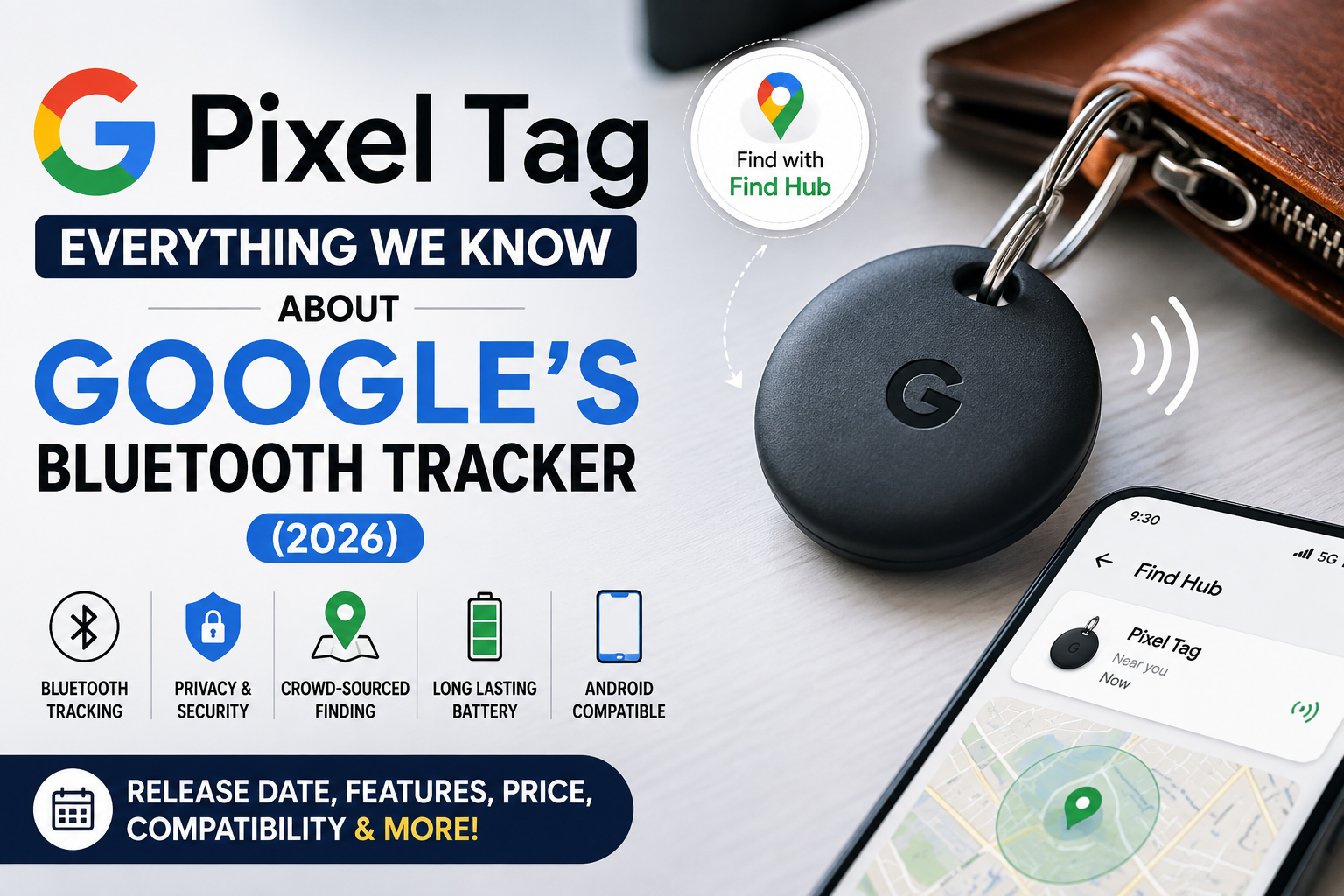

Pixel Tag: Everything We Know About Google’s Upcoming Bluetooth Tracker (2026)
Losing everyday items is something almost everyone experiences. Whether it’s a misplaced set of keys, a forgotten backpack, or luggage that disappears somewhere between airports, finding lost belongings can quickly become frustrating. Over the past few years, Bluetooth items, like the latest Google Pixel Tag trackers, have become one of the most useful smart accessories, allowing users to locate valuables using their smartphones.
Apple helped popularise this category with AirTag, while companies like Tile, Chipolo, and Samsung have continued improving their own tracking devices. Now, Google appears ready to enter the market with its own dedicated tracker—the latest Google Pixel tag.
Although Google has not officially unveiled the device, multiple reports and leaks have fuelled growing interest among Android users. If the rumours prove accurate, Pixel Tag could become Google’s first official Bluetooth tracking accessory designed specifically for Android devices and integrated with Google’s expanding Find Hub network.
In this comprehensive guide, we’ll explore everything currently known about Pixel Tag, including how it may work, expected features, supported technologies, privacy protections, possible release timeline, compatibility, and what it could mean for Android users.
This article separates confirmed information from industry speculation, helping readers understand what to expect without confusing rumours with official announcements.
What Is a Pixel Tag?
‘Pixel Tag’ is the rumoured name of Google’s upcoming Bluetooth item tracker.
If released, it would function similarly to other Bluetooth tracking devices by helping users locate everyday belongings through Google’s location network.
Potential uses include tracking:
- House keys
- Wallets
- Backpacks
- Luggage
- Camera equipment
- Bicycles
- Pets (with appropriate accessories)
- Remote controls
- Laptop bags
- Travel gear
The device is expected to pair with Android phones through Google’s ecosystem, allowing owners to view an item’s last known location, trigger a sound, or receive location updates from nearby Android devices participating in Google’s crowdsourced finding network.
Unlike GPS trackers that require cellular connectivity, Bluetooth trackers rely on nearby devices to anonymously detect and report their location.
Why Is Everyone Talking About the Pixel Tag?
Interest around Pixel Tag has increased for several reasons.
1. Google Has Never Released Its Own Tracker
Despite offering one of the world’s largest mobile operating systems, Google has never introduced an official Bluetooth tracker under the Pixel brand.
Many Android users have relied on third-party products instead.
A first-party solution could offer deeper integration with Android than existing alternatives.
2. Google’s Find Hub Network Has Matured
Google’s location-finding ecosystem has evolved significantly.
Originally focused on locating lost phones, tablets, and Wear OS watches, the platform now supports compatible Bluetooth trackers from multiple manufacturers.
The network has also expanded globally, making it more practical for recovering lost items in public places.
3. Growing Demand for Smart Tracking Accessories
Bluetooth trackers are no longer niche gadgets.
People increasingly use them to monitor:
- Travel luggage
- Valuable electronics
- Photography gear
- School backpacks
- Office equipment
- Vehicle keys
As travel and remote work continue to grow, so does the demand for reliable item tracking.
What Problem Does Pixel Tag Aim to Solve?
Many people waste valuable time searching for misplaced belongings inside their homes or workplaces.
Common scenarios include:
- Forgetting where keys were placed
- Leaving a backpack in a coffee shop
- Misplacing luggage during travel
- Losing expensive camera equipment
- Forgetting a wallet at a restaurant
Traditional Bluetooth trackers already address these issues, but Android users often lack a deeply integrated solution comparable to Apple’s ecosystem.
Pixel Tag could fill that gap.
How Bluetooth Item Trackers Work
To understand Pixel Tag, it’s helpful to first understand how Bluetooth trackers operate.
Unlike GPS devices, Bluetooth trackers consume very little power.
Instead of communicating directly with satellites, they use nearby smartphones.
The process generally works like this:
- The tracker broadcasts an encrypted Bluetooth signal.
- Nearby Android devices detect the signal.
- Those devices anonymously send the location to Google’s servers.
- The owner opens the Find Hub app.
- The item’s latest location appears on a map.
The owner never knows which nearby phone detected the tracker, and participating phones do not learn the identity of the item’s owner.
This privacy-focused approach allows millions of Android devices to help locate lost belongings without revealing personal information.
Understanding Google’s Find Hub Network
One of the biggest reasons Pixel Tag has generated excitement is Google’s expanding Find Hub network.
This network functions as a crowdsourced location system powered by Android devices.
Instead of depending on GPS inside the tracker itself, nearby Android phones can anonymously detect compatible trackers and securely relay their approximate location.
Imagine losing your backpack at an airport.
Even if you’re miles away, another traveller carrying an Android phone could unknowingly pass near your Pixel tag.
Their phone could securely send an encrypted location update to Google’s network.
When you check the Find Hub app, you will see the backpack’s latest known location.
The entire process happens automatically without requiring interaction from the other person.
Devices Expected to Support Pixel Tag
Although Google hasn’t confirmed compatibility, Pixel Tag will likely support a wide range of Android devices.
Possible supported devices include:
- Google Pixel smartphones
- Samsung Galaxy phones
- Motorola devices
- Nothing Phone
- OnePlus smartphones
- Xiaomi phones
- Oppo devices
- Vivo smartphones
- Android tablets
- Selected Chromebooks
Support will likely depend on Android version and Google Play Services availability rather than brand alone.
Expected Hardware Design
While Google has not officially revealed the hardware, industry speculation suggests Pixel Tag may feature a compact, lightweight design optimised for portability.
Possible design characteristics include:
Circular Body
Many Bluetooth trackers use a small circular shape that fits easily on keyrings or inside bags.
Pixel Tag may follow a similar approach for everyday convenience.
Durable Construction
Users often attach trackers to frequently handled items.
A durable outer shell could help protect against scratches, drops, and daily wear.
Water Resistance
Many competing trackers offer protection against splashes or brief water exposure.
If Pixel Tag follows industry trends, some level of water resistance would be expected.
Replaceable or Long-Life Battery
Battery life is one of the most important features of Bluetooth trackers.
Many existing products operate for approximately one year before requiring a battery replacement.
Google could adopt a similar approach or explore rechargeable battery technology.
How Setup May Work
If Pixel Tag integrates with Android similarly to other Pixel accessories, setup could be extremely straightforward.
A typical process might look like this:
Step 1
Remove the tracker from its packaging.
Step 2
Pull the battery activation tab.
Step 3
Bring the tracker close to an Android phone.
Step 4
A setup notification automatically appears.
Step 5
Tap Connect.
Step 6
Assign the tracker a name.
Examples:
- Car Keys
- Office Backpack
- Travel Suitcase
- Camera Bag
Step 7
Choose an icon.
Step 8
Finish setup.
The tracker would then appear inside Google’s Find Hub application.
Expected Connectivity Technologies
Several wireless technologies may be included.
Bluetooth Low Energy (BLE)
BLE forms the foundation of nearly every modern item tracker.
Advantages include:
- Extremely low battery usage
- Fast pairing
- Reliable short-range communication
- Wide compatibility
Ultra-Wideband (UWB)
One feature many Android users hope to see is ultra-wideband.
UWB enables highly precise directional tracking.
Instead of simply showing that an item is nearby, compatible phones can display the following:
- Exact direction
- Distance
- Arrow guidance
- Real-time movement
This makes finding lost items inside a room significantly easier.
However, UWB requires compatible hardware in both the phone and tracker, so its inclusion remains unconfirmed.
NFC
Near Field Communication could allow someone who finds a lost Pixel Tag to tap it with their phone and access contact information provided by the owner.
This feature is already common among competing trackers.
Expected Smart Features
Google could introduce several software features beyond simple location tracking.
Ring the tracker.
If your keys are somewhere in the house, you could play a loud sound directly from the tracker.
Even if hidden under cushions, the audio could help locate it quickly.
Last Known Location
Instead of searching blindly, users may be able to view where the tracker was last detected.
This is especially useful for forgotten bags or luggage.
Separation Alerts
Some trackers notify users when they leave important belongings behind.
Possible examples include:
- Leaving your wallet at a café
- Forgetting luggage at the airport
- Walking away from your backpack
Such alerts could reduce accidental losses before they become major problems.
Shared Tracking
Families often share access to important belongings.
Google may allow multiple trusted users to locate the same tracker.
Possible shared items include:
- Family car keys
- Travel luggage
- Pet carriers
- Office equipment
Integration with the Pixel Ecosystem
If Pixel Tag becomes part of Google’s Pixel lineup, integration may extend beyond basic tracking.
Potential ecosystem features include:
- Google Assistant support
- Quick Pair setup
- Pixel Watch compatibility
- Android Auto integration
- Smart home routines
- Cross-device synchronization
These integrations could make the tracker feel like a natural extension of Google’s broader hardware ecosystem.
Security by Design
Privacy concerns have become one of the biggest challenges for Bluetooth trackers.
Manufacturers must balance convenience with safeguards that prevent misuse.
Google has already worked with other technology companies to support industry standards aimed at reducing unwanted tracking.
Possible protections include the following:
- Unknown tracker alerts
- Automatic detection of unfamiliar trackers traveling with someone
- Encrypted location reporting
- Anonymous crowdsourced finding
- Owner verification
- Anti-stalking safeguards
These measures are intended to help ensure that tracking accessories are used for locating personal belongings rather than monitoring people without their consent.
Potential Everyday Uses
Pixel Tag could fit into many daily routines.
At Home
- Find misplaced keys
- Locate TV remotes
- Track children’s backpacks
At Work
- Monitor laptop bags
- Keep track of presentation equipment
- Locate office keys
While Traveling
- Follow checked luggage
- Keep tabs on passports (using an attached holder)
- Track camera gear
Outdoor Activities
- Hiking backpacks
- Bicycle accessories
- Sports equipment
Students
- School bags
- Dorm room keys
- Laptop sleeves
Who Might Benefit Most from Pixel Tag?
If Google’s tracker launches with the expected features, it could appeal to several types of users:
| User Type | Potential Benefit |
|---|---|
| Frequent Travelers | Track luggage and travel bags |
| Students | Find backpacks and keys |
| Families | Share access to commonly used items |
| Professionals | Keep track of work equipment |
| Photographers | Monitor camera bags and gear |
| Cyclists | Attach to bikes or accessories |
| Pet Owners | Track carriers or collars (where appropriate) |
| Everyday Users | Reduce time spent searching for misplaced belongings |
Early Expectations vs. Reality
It’s important to distinguish between confirmed information and speculation.
At the time of writing:
Confirmed
- Google has expanded its Find Hub ecosystem.
- Compatible Bluetooth trackers already work with Google’s network.
- Industry reports indicate Google is developing its own tracker.
Not Yet Officially Confirmed
- Final product name
- Official specifications
- Battery type
- Price
- Release date
- UWB support
- Color options
- Hardware design
- Retail availability
Until Google makes a formal announcement, these details remain subject to change.
Pixel Tag vs. Apple AirTag: Which Tracker Could Be Better?
Whenever Google introduces a first-party tracker, comparisons with Apple’s AirTag will be unavoidable. AirTag has become one of the most recognised Bluetooth trackers thanks to its seamless integration with Apple’s ecosystem and its large Find My network.
Pixel Tag, if released, would aim to deliver a comparable experience for Android users rather than directly copying Apple’s approach.
Below is a feature comparison based on current expectations and officially available ecosystem capabilities. Since Pixel Tag has not yet been announced, some details remain speculative.
| Feature | Pixel Tag (Expected) | Apple AirTag |
|---|---|---|
| Platform | Android | Apple |
| Tracking Network | Google Find Hub | Apple Find My |
| Bluetooth | Yes | Yes |
| Ultra-Wideband | Expected but unconfirmed | Yes |
| Unknown Tracker Alerts | Expected | Yes |
| Precision Finding | Possible | Yes |
| Lost Mode | Likely | Yes |
| Shared Tracking | Expected | Available |
| Voice Assistant | Google Assistant | Siri |
| Smart Home Integration | Google Home ecosystem | Apple Home ecosystem |
For Android users, the biggest advantage of Pixel Tag would likely be native integration without relying on third-party applications.
Pixel Tag vs Tile
Tile has been one of the pioneers of Bluetooth tracking for years.
Unlike Apple or Google, Tile operates independently, making it compatible with both Android and iPhone.
However, Tile’s crowdsourced network is significantly smaller than the billions of Android devices Google could potentially leverage.
Tile Advantages
- Multiple hardware designs
- Long-established product lineup
- Cross-platform compatibility
- Replaceable batteries on several models
Pixel Tag Potential Advantages
- Native Android integration
- Automatic pairing
- Larger crowdsourced detection network
- Google ecosystem features
- Easier setup
If Google fully utilises Android’s global reach, Pixel Tag could dramatically increase the chances of recovering lost items compared to trackers with smaller user bases.
Pixel Tag vs Samsung Galaxy SmartTag: A Comparison
Samsung already offers SmartTag devices, but they work best within Samsung’s own ecosystem.
Pixel Tag may offer broader Android compatibility.
SmartTag Strengths
- Excellent for Galaxy phones
- SmartThings integration
- Automation features
Pixel Tag Potential Strengths
- Works across many Android brands
- Google Assistant compatibility
- Wider Android ecosystem support
- Simplified setup using Google services
For users who don’t own Samsung devices, Pixel Tag could become the more appealing option if it supports a broad range of Android phones.
Pixel Tag vs Chipolo
Chipolo has partnered with Google’s Find Hub network and already offers compatible Bluetooth trackers.
Pixel Tag would likely compete directly with Chipolo by providing first-party Google hardware.
Chipolo Benefits
- Lightweight design
- Loud speaker
- Existing compatibility with Google’s network
Pixel Tag Potential Improvements
- Deeper Pixel integration
- Faster setup
- Better software optimization
- Exclusive Android features
- Possible UWB support
Could Pixel Tag Become the Best Tracker for Android?
Several factors could determine its success.
Large Device Ecosystem
Android powers billions of devices worldwide.
A tracker connected to this ecosystem could provide location updates from a vast network of participating phones.
Native Software Experience
Instead of installing third-party apps, users could manage everything through Google’s built-in services.
This creates a cleaner and more consistent experience.
Frequent Software Updates
Google regularly updates Android and its Pixel devices.
Pixel Tag could benefit from ongoing feature improvements, security enhancements, and expanded compatibility over time.
How Google’s Find Hub Network Could Work in Daily Life
Imagine these situations.
Scenario 1: Lost Keys at Home
You misplaced your keys somewhere inside the house.
Instead of searching every room, you open the Find Hub app and play a sound on the tracker.
Within seconds, you hear it ringing under a couch cushion.
Scenario 2: Backpack Left at School
You accidentally leave your backpack behind after class.
Later that day, another Android phone comes within Bluetooth range.
Without revealing anyone’s identity, the phone securely helps update the backpack’s location.
When you open Find Hub, you can see where it was recently detected.
Scenario 3: Airport Luggage
Your checked suitcase doesn’t appear on the baggage carousel.
If your luggage contains a Pixel Tag, nearby Android devices moving through the airport could anonymously help report its approximate location.
Instead of wondering whether the bag is lost, you’d have a better idea of where it was last detected.
Scenario 4: Camera Equipment
Professional photographers often carry expensive gear.
Attaching a tracker to a camera bag may provide additional peace of mind during travel or large events.
Privacy Features That Matter
Bluetooth trackers are incredibly useful, but they also raise important privacy concerns.
Manufacturers now prioritise protections that reduce the risk of misuse.
Google has supported industry-wide standards designed to improve user safety across Android and iOS.
Encrypted Location Updates
Location information should be encrypted before it’s transmitted.
This helps prevent unauthorised parties from viewing tracking data.
Anonymous Crowdsourcing
Nearby Android devices that detect a tracker should not know:
- Who owns the tracker
- What item is being tracked
- Why the tracker is nearby
Similarly, the tracker’s owner should not know which phone detected it.
This mutual anonymity strengthens privacy.
Unknown Tracker Detection
Modern tracking ecosystems can notify users if an unfamiliar tracker appears to be moving with them over time.
These alerts are intended to help people identify trackers they don’t own.
Anti-Stalking Measures
One of the most important industry developments has been the introduction of anti-stalking protections.
Possible safeguards include:
- Automatic safety notifications
- Audible alerts from unidentified trackers
- Options to disable unknown trackers
- Guidance for locating suspicious devices
- Clear instructions for removing batteries (if applicable)
These protections are designed to discourage misuse while preserving the legitimate benefits of item tracking.
Expected Tracking Accuracy
Bluetooth trackers are not GPS devices.
Understanding this distinction helps set realistic expectations.
Indoors
Performance depends on:
- Walls
- Furniture
- Bluetooth interference
- Building layout
Precision may improve if ultra-wideband support is included.
Outdoors
Open spaces generally provide stronger Bluetooth communication.
If many Android devices are nearby, location updates may occur more frequently.
Rural Areas
In less populated regions, tracker updates could be less frequent because fewer participating devices may pass nearby.
Busy Cities
Dense urban environments with many Android phones could provide more regular location updates, increasing the chances of finding a lost item.
Battery Life Expectations
Battery performance is one of the biggest considerations for Bluetooth trackers.
Although Google hasn’t confirmed specifications, users will likely expect the following:
- Several months to over a year of typical use
- Low-power Bluetooth communication
- Battery status monitoring
- Low battery notifications
Whether Google chooses a replaceable coin-cell battery or a rechargeable design remains unknown.
Durability Considerations
People attach trackers to items that experience daily wear and tear.
Potential durability features may include:
Scratch Resistance
Frequent contact with keys and metal objects can damage plastic surfaces.
A durable finish would help reduce visible wear.
Water Resistance
Rain, accidental splashes, and damp conditions are common.
Some degree of water resistance would improve reliability.
Temperature Resistance
Travellers often expose luggage to varying weather conditions.
A well-designed tracker should operate across a broad temperature range.
Everyday Use Cases
Travelers
A tracker can help monitor:
- Checked baggage
- Carry-on luggage
- Passport holders
- Travel backpacks
Office Workers
Useful for tracking:
- Laptop bags
- Office keys
- Presentation equipment
- Work backpacks
Students
Helpful for:
- School bags
- Dorm keys
- Sports equipment
- Musical instruments
Families
Parents may choose to attach trackers to shared items, like the following:
- Family vehicle keys
- Emergency kits
- Strollers
- Picnic bags
Small Business Owners
Businesses managing physical equipment may benefit from tracking the following:
- Toolboxes
- Camera kits
- Inventory containers
- Delivery equipment
Could a pixel tag work internationally?
If Google’s Find Hub network continues expanding, international compatibility could become one of Pixel Tag’s strongest advantages.
Frequent travellers may appreciate the ability to locate belongings across countries where Android devices participate in the network.
However, actual performance would depend on regional availability, local regulations, and network participation.
Accessibility Features
Google often emphasises accessibility across its products.
Potential accessibility features for Pixel Tag could include the following:
- Voice guidance
- Screen reader compatibility
- Haptic feedback
- High-contrast interface
- Simple setup flow
- Easy device management
These features could make tracking more convenient for a wider range of users.
Tips for Getting the Most from a Bluetooth Tracker
Regardless of the brand, users can improve their experience by following a few best practices:
Attach It Securely
Use a quality keyring, holder, or luggage loop to prevent accidental detachment.
Keep Software Updated
Install Android and Google Play Services updates to benefit from new features and security improvements.
Name Trackers Clearly
Instead of generic labels like “Tag 1”, choose names such as the following:
- House Keys
- Office Backpack
- Travel Suitcase
- Camera Gear
This makes identification easier when managing multiple trackers.
Check Battery Status Regularly
If the tracker uses a replaceable battery, replace it before it becomes fully depleted.
Enable Notifications
Allow location alerts and safety notifications to stay informed if an item is left behind or if an unfamiliar tracker is detected.
Potential Limitations
Even the best Bluetooth trackers have practical limitations:
- They are not real-time GPS trackers.
- Location updates depend on nearby compatible devices.
- Performance may vary in remote areas.
- Thick walls and metal structures can reduce Bluetooth range.
- Very crowded radio environments may affect signal quality.
Understanding these limitations helps users set realistic expectations.
Common Myths About Bluetooth Trackers
Myth: They use GPS satellites directly.
Reality: Most Bluetooth trackers rely on nearby participating devices rather than built-in GPS.
Myth: They constantly reveal your location.
Reality: Modern tracking systems are designed with encryption and privacy protections that limit access to location information.
Myth: They’re only useful while travelling.
Reality: Many people use trackers every day to find keys, wallets, bags, and other frequently misplaced items.
Myth: Only premium users need them.
Reality: Anyone who regularly misplaces important belongings can benefit from a Bluetooth tracker.
Who Should Consider Pixel Tag?
If Google launches the Pixel Tag with the expected feature set, it could appeal to the following:
| User | Why It May Be Useful |
|---|---|
| Android enthusiasts | Native ecosystem integration |
| Frequent travelers | Track luggage and travel gear |
| Families | Share access to common items |
| Students | Locate backpacks and keys |
| Professionals | Monitor work equipment |
| Photographers | Protect valuable gear |
| Cyclists | Track bikes or accessories |
| Everyday users | Reduce time spent searching for misplaced belongings |
Expected Price of Pixel Tag
One of the biggest unanswered questions is pricing. As of now, Google has not officially announced the Pixel Tag or confirmed how much it might cost. However, industry trends provide a reasonable basis for estimating where it could fit in the market.
Bluetooth trackers are generally positioned as affordable accessories rather than premium smart devices. Pricing often depends on hardware features, battery technology, and ecosystem integration.
Estimated Price Range
| Package | Estimated Price (USD) |
|---|---|
| Single Pixel Tag | $25–$39 |
| Two-Pack | $45–$69 |
| Four-Pack | $79–$119 |
If Google includes advanced technologies such as Ultra-Wideband (UWB), the price may be closer to the higher end of the range. If it focuses on Bluetooth-only tracking, it could compete more aggressively on price.
Possible Release Timeline
Google has not announced an official launch date.
Based on Google’s typical hardware release schedule, many observers expect any Pixel-branded accessories to be introduced alongside other Pixel hardware at a future launch event. However, this remains speculation until Google confirms its plans.
Possible scenarios include the following:
- Announcement during a Pixel hardware event
- Availability shortly after launch
- Limited regional rollout before wider expansion
- Global availability through the Google Store and authorized retailers
Until an official announcement is made, readers should treat any rumoured release dates cautiously.
Where Could the Pixel Tag Be Sold?
If released, Pixel Tag would likely be available through Google’s existing retail channels.
Potential purchase locations may include:
- Google Store
- Major electronics retailers
- Mobile carrier stores
- Online marketplaces
- Authorized Google partners
Regional availability could vary depending on market demand and Google’s distribution strategy.
Accessories That May Be Available
Bluetooth trackers are often paired with accessories that make them easier to attach to everyday items.
Possible accessories include:
- Silicone keychain holders
- Leather key rings
- Luggage straps
- Adhesive mounts
- Bike mounts
- Pet collar attachments (for identifying pets, not live GPS tracking)
- Protective cases
Third-party accessory manufacturers would likely expand the selection if the Pixel Tag became popular.
How to Choose the Right Bluetooth Tracker
The best tracker depends on how you plan to use it. Before buying, consider these questions:
Which smartphone do you use?
A tracker designed for your phone’s ecosystem usually provides the smoothest experience.
What items do you lose most often?
Your answer will determine whether you need one tracker or a multi-pack.
Do you travel frequently?
Frequent travellers may value a large crowdsourced finding network.
Do you need precision finding?
If room-level directional guidance matters, look for support for ultra-wideband (UWB) if available.
How important is battery maintenance?
Some users prefer replaceable batteries, while others may prefer rechargeable designs.
Tips for Using Pixel Tag Effectively
To get the most value from any Bluetooth tracker:
Give Every Tracker a Clear Name
Examples include:
- Home Keys
- Office Keys
- Camera Backpack
- Carry-On Bag
- Laptop Sleeve
Specific names make it easier to identify the correct tracker at a glance.
Check Battery Status Regularly
If the tracker uses a replaceable battery, monitor its charge level and replace it before it runs out.
Keep Bluetooth Enabled
Bluetooth is essential for communication between your phone and the tracker. Disabling it may reduce functionality.
Install Software Updates
Updates can improve:
- Stability
- Security
- Compatibility
- Battery optimization
- New features
Use Secure Attachments
A tracker is only useful if it stays attached to the item you’re tracking. Choose sturdy key rings, loops, or cases designed for daily use.
Advantages of Pixel Tag
If Google’s rumoured tracker launches with the expected capabilities, it could offer several benefits.
Native Android Experience
Instead of relying on third-party apps, users could manage everything within Google’s ecosystem.
Large Crowdsourced Network
Android’s global user base may help improve the chances of locating lost items in busy public areas.
Simple Setup
Google’s Quick Pair technology could make initial configuration fast and user-friendly.
Ecosystem Integration
Pixel Tag may work seamlessly with the following:
- Pixel phones
- Android tablets
- Wear OS smartwatches
- Google Assistant
- Google Home services
Security Focus
Google has already supported industry-wide anti-stalking standards, and similar protections would likely be included in any first-party tracker.
Potential Drawbacks
Until official specifications are released, there are still uncertainties.
Possible limitations include the following:
- No official launch confirmation
- Unknown battery design
- Unknown Bluetooth range
- Unknown UWB support
- Unknown pricing
- Unknown international rollout schedule
Additionally, like other Bluetooth trackers, Pixel Tag would not replace a dedicated GPS tracker for real-time vehicle or fleet tracking.
Pixel Tag Use
Track:
- House keys
- TV remotes
- Wallets
- Garage door remotes
Travel
Track:
- Checked luggage
- Carry-on bags
- Camera cases
- Travel backpacks
Office
Track:
- Laptop bags
- Work keys
- Equipment cases
- Projector bags
Students
Track:
- School bags
- Sports gear
- Musical instruments
- Dorm keys
Outdoor Activities
Track:
- Hiking backpacks
- Cycling accessories
- Camping equipment
- Picnic gear
Security and Responsible Use
Bluetooth trackers should always be used responsibly and legally.
They are intended to help locate personal belongings—not to monitor or track people without their knowledge or consent.
When using a tracker:
- Respect privacy laws in your region.
- Avoid placing trackers on someone else’s property without permission.
- Pay attention to safety alerts generated by your device.
- Report any unfamiliar tracker notifications if you believe they are suspicious.
Responsible use helps preserve the benefits of these devices while reducing the risk of misuse.
Frequently Asked Questions
What is a pixel tag?
‘Pixel Tag’ is the rumoured name for Google’s possible Bluetooth item tracker designed for Android users. As of this writing, Google has not officially announced the product.
Is Pixel Tag officially confirmed?
Google has not formally unveiled the Pixel Tag. Most publicly available information comes from industry reports, supply-chain leaks, and references discovered before launch.
Will Pixel Tag work with all Android phones?
If Google releases the device, compatibility is expected to extend to many Android phones that support the required version of Android and Google Play Services. Official compatibility details have not yet been published.
Does Pixel Tag use GPS?
Bluetooth trackers generally do not include continuous GPS tracking. Instead, they use Bluetooth signals and a crowdsourced finding network to help locate lost items.
Will Pixel Tag support ultra-wideband?
There is no official confirmation. If included, UWB could enable more precise, room-level directional finding on compatible devices.
Can Pixel Tag help find luggage?
Yes, a Bluetooth tracker can help you locate luggage by reporting its last known location through nearby participating devices. However, it should not be considered a substitute for airline baggage tracking or a live GPS locator.
How long might the battery last?
Google has not shared battery specifications. Most Bluetooth trackers are designed to operate for many months before requiring a battery replacement or recharge, depending on the design.
Will iPhone users be able to use Pixel Tag?
There is no official information regarding iPhone compatibility. Since the Pixel Tag is expected to integrate with Google’s Android ecosystem, its full feature set would likely be optimised for Android devices.
Is Pixel Tag waterproof?
No official durability rating has been announced. Water resistance, if included, would be confirmed only after Google releases the product.
Can multiple people share one tracker?
Google has not confirmed this feature, but shared access is common in modern tracking ecosystems and may be included.
Expert Perspective
Google has spent years expanding its hardware ecosystem beyond smartphones. Products such as Pixel phones, Pixel Watch, Pixel Buds, and Pixel Tablet demonstrate the company’s focus on building a connected experience for Android users.
A first-party Bluetooth tracker would be a logical addition to that ecosystem. Rather than introducing a completely new category, it would strengthen Google’s existing services by helping users manage both their devices and their everyday belongings through a unified platform.
Success, however, will depend on several factors:
- Competitive pricing
- Broad Android compatibility
- Reliable crowdsourced finding
- Strong privacy protections
- Long battery life
- Simple user experience
If Google delivers in these areas, Pixel Tag could become a compelling choice for Android users looking for an integrated tracking solution.
Who Should Wait for the Pixel Tag?
Waiting may make sense if you:
- Prefer first-party Google accessories
- Already use Pixel devices
- Want deeper Android integration
- Value potential ecosystem features
- Are not in immediate need of a Bluetooth tracker
On the other hand, if you need a tracker today, there are already several established options compatible with Google’s Find Hub network.
Read More: Pixel 11 Pro: Everything You Need to Know About Google’s Next Flagship Phone
Final Verdict
Although Pixel Tag remains an unannounced product at the time of writing, the growing interest surrounding it reflects a broader demand for a seamless Android-native tracking experience.
Google has already laid much of the foundation through its expanding Find Hub network and ongoing work on privacy-focused location technologies. If Pixel Tag becomes an official product, it has the potential to complement the Pixel ecosystem while giving Android users another option for keeping track of everyday essentials.
That said, it is important to separate expectations from confirmed facts. Key details—including hardware specifications, pricing, battery technology, ultra-wideband support, release timing, and regional availability—have not yet been officially confirmed by Google.
For now, the latest Google Pixel Tag is best viewed as a promising possibility rather than a finalised product. As more information becomes available through official announcements, consumers will be able to make a more informed decision about whether it meets their needs.
If Google combines dependable tracking performance, thoughtful privacy safeguards, and straightforward Android integration, Pixel Tag could become one of the most significant additions to the Bluetooth tracker market and a strong competitor in the growing ecosystem of smart item finders.
Key Takeaways
- Pixel Tag is widely rumoured but has not been officially announced by Google.
- It is expected to be a Bluetooth-based item tracker designed for Android users.
- The device would likely integrate with Google’s Find Hub network for crowdsourced location updates.
- Potential features include Quick Pair, encrypted location reporting, anti-stalking protections, and possibly ultra-wideband support.
- Final specifications, pricing, release date, and availability remain unconfirmed.
- If launched, Pixel Tag could offer Android users a more integrated alternative within Google’s ecosystem.