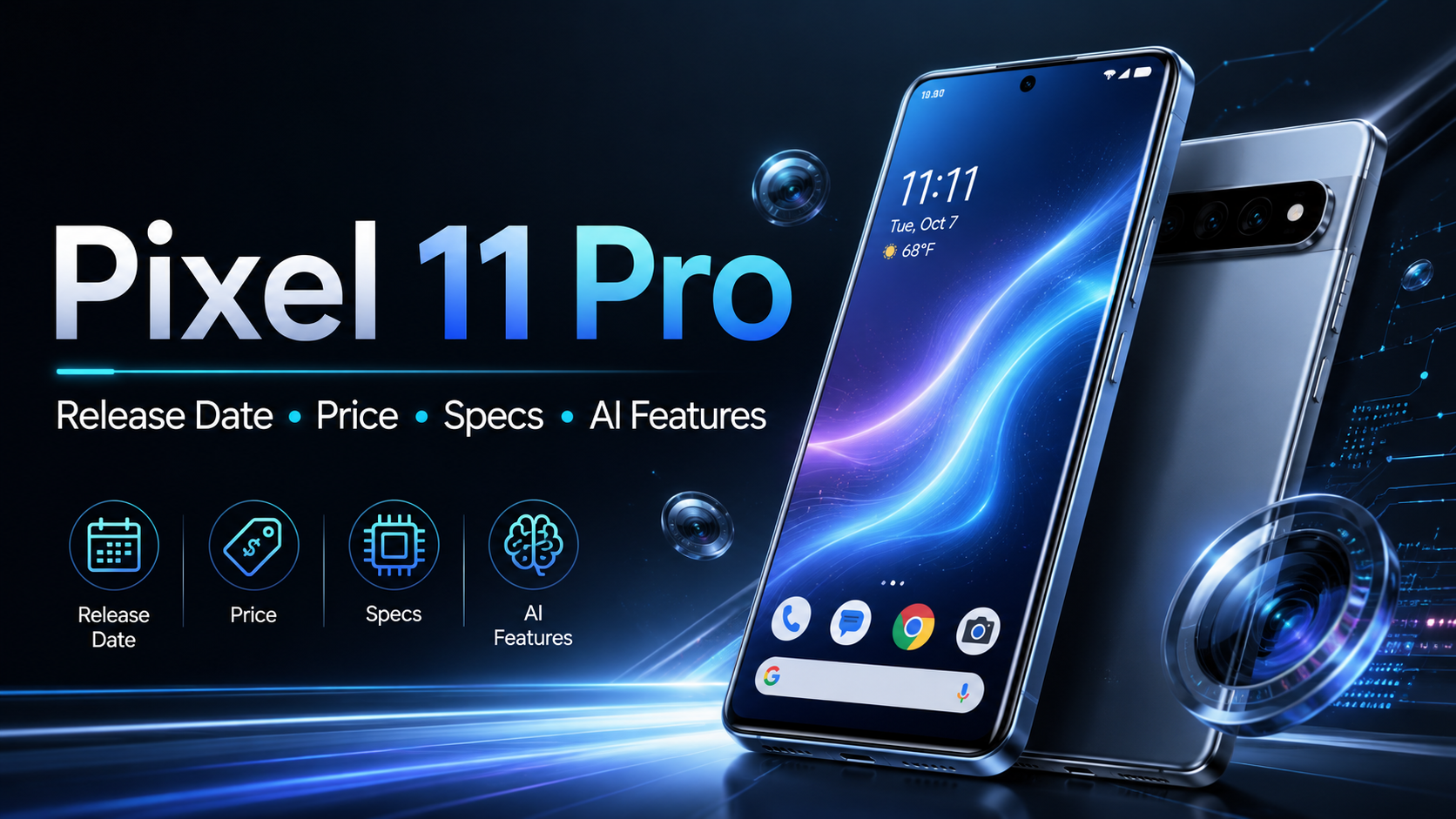

Pixel 11 Pro: Everything We Know So Far About Google’s Next Flagship Smartphone (2026 Guide)
Disclaimer: This article is based on officially announced information where available, combined with credible industry reports, supply-chain insights, and reputable leaks. Features and specifications may change before Google’s official announcement.
Pixel 11 Pro: Everything We Know So Far About Google’s Next Flagship Smartphone
Google’s Pixel lineup has steadily evolved from a niche Android alternative into one of the most influential smartphone families on the market. While the company may not sell as many devices as Samsung or Apple, Pixel phones often introduce software innovations and AI-powered experiences that later become industry trends.
Now, attention is turning toward the Pixel 11 Pro, Google’s upcoming premium flagship. Although the company has yet to reveal every detail officially, reports from industry analysts, technology publications, and supply-chain sources have painted an increasingly clear picture of what users might expect.
From a redesigned camera system and upgraded Tensor processor to new artificial intelligence capabilities and refined software experiences, the Pixel 11 Pro appears to focus on meaningful improvements instead of dramatic cosmetic changes.
Whether you’re considering upgrading from an older Pixel device or comparing flagship smartphones before your next purchase, this comprehensive guide covers everything currently known about Google’s next-generation premium smartphone.
Quick Overview of the Pixel 11 Pro
| Feature | Expected Details |
|---|---|
| Device | Google Pixel 11 Pro |
| Operating System | Android 17 |
| Processor | Google Tensor G6 |
| Display | OLED LTPO 120Hz |
| Refresh Rate | Up to 120Hz |
| AI Features | Advanced Gemini integration |
| Rear Cameras | Triple Camera System |
| Front Camera | Improved Selfie Camera |
| Battery | Larger capacity than previous generation |
| Charging | Faster wired and wireless charging |
| Security | Titan Security + Face Unlock + Fingerprint |
| Launch Window | Expected August 2026 |
Why the Pixel 11 Pro Is Generating So Much Attention
Every new Pixel generation brings expectations that extend beyond hardware upgrades. Google uses the Pixel series to showcase the latest version of Android while introducing new AI-powered features that often become exclusive selling points.
This year, anticipation is even higher for several reasons.
First, artificial intelligence continues to reshape the smartphone experience. Google has invested heavily in on-device AI, cloud intelligence, and personalised assistance. Many industry observers believe the Pixel 11 Pro could represent Google’s biggest leap in practical AI features yet.
Second, smartphone buyers have become more selective. Instead of upgrading every year, consumers now expect meaningful improvements in battery life, camera performance, software longevity, and overall value.
Finally, competition in the flagship smartphone market has intensified. Apple, Samsung, OnePlus, Xiaomi, and other manufacturers continue raising the bar, making the Pixel 11 Pro one of Google’s most important smartphone releases in recent years.
Expected Release Date
Google has established a fairly consistent launch schedule for its flagship Pixel smartphones over the past several years.
Rather than announcing devices during spring or early summer, the company typically unveils new flagship models toward the second half of the year.
Industry reports suggest that the Pixel 11 Pro is likely to follow this familiar pattern.
Expected Timeline
| Event | Estimated Time |
|---|---|
| Official Announcement | August 2026 |
| Pre-orders Begin | Same Week |
| Retail Availability | Late August 2026 |
| Global Rollout | Following Weeks |
Although Google has not confirmed these dates, multiple reports point toward an August unveiling.
Expected Pricing
Pricing is one of the biggest questions surrounding every flagship smartphone launch.
The Pixel series has traditionally positioned itself below Apple’s highest-end Pro models while remaining competitive with Samsung’s Galaxy S Ultra lineup.
If Google maintains this strategy, the Pixel 11 Pro may continue offering flagship specifications without reaching the highest price tier in the market.
Estimated US Pricing
| Storage | Expected Price |
|---|---|
| 128GB | Around $999 |
| 256GB | Around $1,099 |
| 512GB | Around $1,219 |
| 1TB | Around $1,399 |
Actual pricing may vary depending on regional taxes, carrier promotions, and launch offers.
Design: Familiar Yet More Refined
Google appears to be following an approach that emphasises refinement rather than complete redesign.
Instead of dramatically changing the phone’s appearance, the Pixel 11 Pro is expected to improve upon the design language introduced in previous Pixel generations.
Potential refinements may include:
- Slimmer bezels
- Stronger aluminum frame
- More durable glass
- Improved ergonomics
- Better weight distribution
- Higher durability rating
- Enhanced water resistance
This strategy makes sense because the Pixel camera bar has become one of Google’s strongest design identities.
Rather than abandoning that recognisable look, Google may simply polish the overall experience.
Premium Build Quality
Modern flagship buyers expect premium materials.
The Pixel 11 Pro is expected to include the following:
- Aerospace-grade aluminum frame
- Gorilla Glass protection
- Matte glass rear panel
- Premium finish
- Improved scratch resistance
- Better fingerprint resistance
These upgrades are less about appearance and more about long-term durability.
A phone that feels premium after two or three years of daily use often delivers more value than one that only looks impressive on launch day.
Display: A Smoother and Brighter Viewing Experience
The display remains one of the most important parts of any smartphone, and Google is expected to make meaningful improvements.
Rumours suggest the Pixel 11 Pro will feature an advanced LTPO OLED display with adaptive refresh technology.
Expected highlights include:
- 6.7-inch OLED display
- LTPO technology
- Up to 120Hz refresh rate
- HDR support
- Improved outdoor brightness
- Better color accuracy
- Lower power consumption
Adaptive refresh rates help conserve battery life by lowering the refresh rate when users read static content and increasing it during gaming or scrolling.
Better Outdoor Visibility
One complaint users occasionally have with smartphones is visibility under direct sunlight.
Reports indicate Google may significantly improve maximum brightness on the Pixel 11 Pro.
Benefits could include:
- Easier navigation outdoors
- Better photo previewing
- Improved HDR playback
- More comfortable reading in bright environments
These improvements may seem small individually, but together they contribute to a noticeably better daily experience.
Tensor G6: Google’s Next-Generation AI Processor
One of the biggest expected upgrades is the arrival of Google’s new Tensor G6 chipset.
Unlike processors that focus solely on benchmark scores, Tensor chips are designed around machine learning and artificial intelligence.
That means users often notice improvements in real-world tasks rather than synthetic performance tests.
Expected advantages include the following:
- Faster image processing
- Improved voice recognition
- Better translation features
- Enhanced security
- Smarter photography
- Faster AI responses
- More efficient power management
Google continues to prioritise intelligent computing instead of chasing benchmark records alone.
What Makes Tensor Different?
Many flagship processors compete primarily on raw speed.
Google takes a slightly different approach.
Tensor processors are optimised for:
AI Photography
The camera can analyse lighting, faces, colours, and movement almost instantly to produce natural-looking photos.
Voice Processing
Speech recognition becomes faster and more accurate.
Live Translation
Conversations in different languages become smoother through on-device processing.
Smart Assistance
Personalised suggestions can be processed more quickly while keeping more information on the device.
Security
Dedicated hardware helps protect sensitive information and biometric authentication.
Performance Expectations
Although benchmark numbers often dominate headlines, everyday performance matters more for most users.
The Pixel 11 Pro is expected to provide noticeable improvements in the following:
- Faster app launches
- Smoother multitasking
- Better thermal efficiency
- Improved gaming stability
- Reduced background battery drain
- Faster AI processing
- Enhanced camera responsiveness
Instead of focusing only on peak performance, Google appears to be aiming for a consistently smooth user experience throughout the day.
Memory and Storage
Premium smartphones increasingly require larger amounts of memory to support AI workloads, multitasking, and advanced photography.
The Pixel 11 Pro is expected to offer generous RAM configurations alongside multiple storage options.
Possible configurations include:
| RAM | Storage Options |
|---|---|
| 12GB | 128GB |
| 12GB | 256GB |
| 16GB | 512GB |
| 16GB | 1TB |
Higher RAM capacities can improve multitasking, especially as Android continues adding more AI-powered background features.
AI Takes Center Stage
Artificial intelligence is expected to become the defining feature of the Pixel 11 Pro.
Rather than introducing AI solely for marketing purposes, Google has consistently focused on features that solve everyday problems.
Potential AI-powered improvements may include:
- Smarter call assistance
- Better spam filtering
- Enhanced photo editing
- Automatic writing suggestions
- Improved document summarization
- Context-aware reminders
- Faster search across apps
- More natural voice interactions
Many of these features could work directly on the device, reducing dependence on cloud processing while improving privacy and responsiveness.
Gemini Integration Could Become Even Smarter
Google’s Gemini ecosystem has expanded rapidly across Android devices, and the Pixel 11 Pro is expected to serve as its most advanced showcase yet.
Users may see deeper integration with daily tasks, such as:
- Planning trips
- Managing schedules
- Organizing notes
- Drafting emails
- Summarizing conversations
- Searching files
- Creating reminders
- Answering contextual questions
Instead of acting as a standalone chatbot, Gemini could become a proactive assistant woven throughout the operating system.
First Impressions: What the Pixel 11 Pro Appears to Offer
Based on current information, Google’s upcoming flagship seems focused on refinement rather than reinvention.
Instead of chasing flashy gimmicks, the company appears to be investing in the areas that influence everyday use the most:
- More intelligent AI experiences
- Faster Tensor processing
- Improved display quality
- Better battery efficiency
- Premium construction
- Enhanced software optimization
- Stronger long-term performance
While many details remain unofficial until Google’s formal announcement, the Pixel 11 Pro is shaping up to be one of the most interesting Android flagships of 2026, especially for users who value clean software, computational photography, and AI-driven productivity.
In the next section, we’ll explore the expected camera upgrades, the rumoured Glow feature, battery improvements, charging technology, Android 17 enhancements, gaming performance, connectivity upgrades, and how the Pixel 11 Pro could compare with competing flagship smartphones.
Pixel 11 Pro: Camera Upgrades, AI Features, Battery Life, Android 17, and Flagship Comparisons
Note: The information below combines publicly available reports, industry expectations, and historical Pixel trends. Final specifications may differ when Google officially introduces the Pixel 11 Pro.
Camera System: Google’s Biggest Strength Could Get Even Better
For years, Google’s Pixel smartphones have earned a reputation for delivering excellent photography without relying solely on massive camera sensors. Instead, Google has focused on computational photography, using advanced software and machine learning to enhance every image.
The Pixel 11 Pro is expected to continue that philosophy while introducing hardware refinements and more capable AI-powered image processing.
Rather than chasing extremely high megapixel counts for marketing purposes, Google is likely to focus on producing photos with realistic colours, balanced dynamic range, and consistent image quality in nearly every lighting condition.
Expected Rear Camera Setup
Although Google has not confirmed the final hardware configuration, current reports suggest the Pixel 11 Pro may include a versatile triple-camera system.
| Camera | Expected Purpose |
|---|---|
| Main Wide Camera | Everyday photography |
| Ultra-Wide Camera | Landscapes and group photos |
| Telephoto Camera | Optical zoom and portrait photography |
This combination gives users flexibility without making the camera interface overly complicated.
Improved Computational Photography
The hardware captures the image, but Google’s software does much of the work afterwards.
Expected improvements include:
- Better HDR processing
- Faster Night Sight capture
- More accurate skin tones
- Improved white balance
- Reduced motion blur
- Better edge detection
- Enhanced portrait separation
- More natural color science
Instead of dramatically changing the look of Pixel photos, Google usually focuses on making images appear more realistic and consistent.
Better Low-Light Photography
Low-light performance has long been one of the Pixel family’s strongest advantages.
The Pixel 11 Pro could improve further through the following:
Smarter Noise Reduction
AI can identify image noise without sacrificing fine details.
Faster Exposure Processing
Users may spend less time waiting while Night Sight processes an image.
Improved Handheld Stability
Advanced software could reduce blur caused by small hand movements.
Better Shadow Recovery
Dark areas may retain more detail while avoiding unnatural brightness.
These refinements can make nighttime photography more dependable without requiring professional camera knowledge.
Zoom Photography Could See Major Improvements
Telephoto cameras have become increasingly important as smartphone buyers expect versatile photography options.
The Pixel 11 Pro may improve zoom performance by combining optical hardware with Google’s Super Res Zoom technology.
Potential benefits include the following:
- Sharper distant subjects
- Better wildlife photography
- Improved sporting event photos
- Cleaner digital zoom
- More detailed architectural images
Rather than relying exclusively on digital cropping, AI may reconstruct fine details more effectively than previous generations.
AI Photo Editing Becomes Even Smarter
Google has invested heavily in AI-powered editing tools, and the Pixel 11 Pro could expand these capabilities significantly.
Expected editing tools include:
- Intelligent object removal
- Background cleanup
- Reflection reduction
- Sky enhancement
- Portrait lighting adjustments
- Better facial restoration
- Automatic composition suggestions
- One-tap image enhancement
These tools are designed to simplify editing without requiring users to learn professional software.
Video Recording Improvements
Photography often receives the most attention, but video quality continues to improve across flagship smartphones.
The Pixel 11 Pro is expected to introduce enhancements such as the following:
- Better video stabilization
- Improved HDR video
- More accurate autofocus
- Cleaner audio recording
- Better low-light video capture
- Reduced rolling shutter
- Improved cinematic effects
Content creators, vloggers, and social media users may benefit from these refinements.
The Rumored Pixel Glow Feature
One of the most talked-about rumours surrounding the Pixel 11 Pro is a new feature referred to as Pixel Glow.
While Google has not officially confirmed its purpose, reports suggest it could introduce a more interactive visual experience powered by AI.
Possible applications include:
- Dynamic notification lighting
- AI-generated visual feedback
- Personalized animations
- Assistant interactions
- Charging indicators
- Smart reminders
- Context-aware visual effects
If implemented thoughtfully, Pixel Glow could become more than a cosmetic addition by making notifications and AI interactions easier to understand at a glance.
Android 17: Built for AI
The Pixel 11 Pro is expected to launch with Android 17 out of the box.
Google typically uses Pixel devices to showcase the newest version of Android before it reaches other manufacturers.
Android 17 may place greater emphasis on the following:
- Personalization
- AI integration
- Privacy controls
- Performance optimization
- Improved multitasking
- Enhanced accessibility
- Better battery management
- Smarter automation
Instead of introducing dramatic interface changes, Android 17 is expected to refine the overall user experience.
Smarter Everyday Features
Google continues to focus on features that simplify routine tasks.
Users may see improvements in:
Voice Commands
More natural conversations with the built-in assistant.
Smart Replies
Better suggestions inside messaging applications.
Context Awareness
Your phone could better understand your schedule, habits, and preferences.
AI Search
Finding documents, photos, notes, or emails may become faster and more accurate.
Battery Life: Designed to Last Longer
Battery performance is one of the most important considerations for smartphone buyers.
While official battery specifications remain unknown, expectations point toward both a larger battery and better efficiency.
Factors contributing to improved endurance may include:
- Tensor G6 efficiency improvements
- LTPO display technology
- Smarter background app management
- Adaptive battery optimization
- More efficient AI processing
These improvements work together to extend battery life throughout a typical day.
Expected Battery Performance
Although real-world usage varies, many users may reasonably expect:
| Activity | Estimated Performance |
|---|---|
| General Use | Full-day battery life |
| Video Streaming | Several continuous hours |
| Social Media | Excellent endurance |
| Gaming | Improved over previous generation |
| Video Calls | Better efficiency |
Actual results will depend on brightness levels, network conditions, installed apps, and personal usage habits.
Faster Charging
Charging technology continues evolving across flagship smartphones.
The Pixel 11 Pro could include improvements such as the following:
- Faster wired charging
- Improved wireless charging
- Better thermal management
- Optimized battery health algorithms
Google has traditionally prioritised battery longevity rather than pursuing the industry’s fastest charging speeds.
Wireless Charging Convenience
Premium smartphone buyers increasingly expect reliable wireless charging.
Expected features include:
- Qi wireless charging
- Reverse wireless charging
- Improved charging efficiency
- Better compatibility with accessories
Reverse wireless charging could allow users to recharge earbuds, smartwatches, or other compatible devices.
Security Remains a Priority
Google has consistently emphasised smartphone security.
The Pixel 11 Pro is expected to combine hardware and software protections.
Likely features include:
- Titan security architecture
- Secure boot
- Encrypted storage
- Automatic security updates
- Face Unlock
- Under-display fingerprint sensor
- Theft protection improvements
Combined with Android’s security framework, these features help protect personal information and sensitive data.
Connectivity Upgrades
Modern flagship smartphones serve as productivity devices, making fast connectivity essential.
The Pixel 11 Pro may support the following:
- 5G connectivity
- Wi-Fi 7
- Bluetooth 6
- NFC
- Ultra-Wideband (UWB)
- Dual eSIM support
- USB-C connectivity
These technologies improve wireless performance, faster file transfers, and accessory compatibility.
Gaming Performance
Although Pixel phones are not marketed primarily as gaming devices, each generation becomes more capable.
The Tensor G6 processor may provide improvements in:
- Stable frame rates
- Better heat management
- Reduced throttling
- Faster graphics rendering
- Improved touch responsiveness
- Better battery efficiency during gaming
Casual gamers and competitive mobile players alike may notice smoother gameplay during extended sessions.
Pixel 11 Pro vs Pixel 10 Pro
Many Pixel owners will naturally wonder whether the new model justifies an upgrade.
| Feature | Pixel 10 Pro | Pixel 11 Pro (Expected) |
|---|---|---|
| Processor | Tensor G5 | Tensor G6 |
| Software | Android 16 | Android 17 |
| AI Features | Advanced | More deeply integrated |
| Display | Premium OLED | Brighter LTPO OLED |
| Camera Processing | Excellent | Further refined |
| Battery Efficiency | Strong | Improved |
| Security | Excellent | Enhanced |
While the overall design philosophy may remain familiar, the improvements appear focused on daily usability rather than dramatic visual changes.
Pixel 11 Pro vs Samsung Galaxy S Series
Samsung remains Google’s biggest Android competitor in the premium smartphone segment.
Pixel 11 Pro Advantages
- Clean Android experience
- Faster software updates
- Excellent computational photography
- Deep AI integration
- Minimal pre-installed software
Samsung Advantages
- Larger hardware ecosystem
- More extensive customization
- Brighter displays on some models
- Broader accessory support
- Mature multitasking features
The choice often depends on whether users prioritise Google’s software-first experience or Samsung’s feature-rich ecosystem.
Pixel 11 Pro vs iPhone
Apple continues to dominate the premium smartphone market, making comparisons inevitable.
Pixel Strengths
- Native Android experience
- AI-powered features
- Flexible camera software
- Google ecosystem integration
- Real-time translation tools
iPhone Strengths
- Strong ecosystem integration
- Excellent app optimization
- Long-term performance consistency
- Seamless connectivity with Apple devices
- High-quality video recording
Both devices appeal to different user preferences rather than directly replacing one another.
Software Support Expectations
Software longevity has become increasingly important when choosing a flagship smartphone.
Google has expanded update commitments in recent years, and the Pixel 11 Pro is expected to continue that trend.
Users can reasonably expect the following:
- Multiple Android version upgrades
- Regular security patches
- Feature Drops introducing new capabilities
- Ongoing AI improvements
- Long-term optimization
Extended software support helps maximise the value of a premium smartphone over several years.
Everyday Experience: Small Improvements That Matter
Not every upgrade grabs headlines, but small refinements often have the biggest impact on daily use.
Areas where users may notice subtle improvements include:
- Faster fingerprint recognition
- Smoother scrolling
- Better speaker tuning
- Improved vibration feedback
- More responsive haptics
- Faster camera launch
- Better multitasking
- Cleaner animations
These enhancements contribute to a polished experience that feels refined throughout the day.
Looking Ahead
The Pixel 11 Pro appears to build on Google’s strengths instead of reinventing the formula. Improved photography, deeper AI integration, enhanced battery efficiency, Android 17, and a more capable Tensor G6 processor could make it one of Google’s most balanced flagship smartphones to date.
In the final part of this guide, we’ll examine the Pixel 11 Pro’s biggest advantages and potential drawbacks, identify who should consider upgrading, explore buying recommendations, answer more than 20 frequently asked questions, and conclude with a comprehensive verdict to help you decide whether Google’s latest flagship deserves a place on your shortlist.
Pixel 11 Pro: Pros, Cons, Buying Advice, FAQs, and Final Verdict
Pixel 11 Pro Pros and Cons
Every flagship smartphone comes with strengths and trade-offs. While the Pixel 11 Pro appears to be one of Google’s most polished devices yet, it’s important to consider both sides before making a purchasing decision.
Expected Advantages
1. Outstanding AI Experience
Google continues to lead the Android ecosystem in artificial intelligence. From smarter voice assistance to intelligent photo editing and contextual suggestions, AI is expected to play an even bigger role in the Pixel 11 Pro.
2. Excellent Camera Performance
Rather than focusing only on hardware specifications, Google emphasises image quality through computational photography. This approach has consistently produced natural-looking photos across a variety of lighting conditions.
3. Clean Android Experience
Unlike many Android manufacturers that heavily customise the operating system, Pixel devices offer a streamlined interface with minimal pre-installed software. This creates a faster, cleaner, and more intuitive experience.
4. Fast Software Updates
Pixel smartphones typically receive Android updates before most other Android devices, giving users quicker access to new features, security improvements, and bug fixes.
5. Premium Build Quality
Expected improvements to the frame, display protection, and overall construction could make the Pixel 11 Pro feel even more refined and durable.
6. Better Battery Efficiency
The combination of Tensor G6, Android 17 optimisation, and LTPO display technology should contribute to longer battery life during everyday use.
Potential Drawbacks
No smartphone is perfect, and prospective buyers should also consider possible limitations.
Higher Starting Price
Premium hardware usually comes with premium pricing. Buyers looking for a budget-friendly device may find Google’s flagship less appealing.
Incremental Design Changes
Those expecting a dramatic redesign may be disappointed if Google continues refining its existing design language instead of introducing a completely new look.
Gaming May Not Lead the Industry
Although Tensor processors continue improving, some competing flagship chipsets still prioritise maximum gaming performance and benchmark scores.
Availability
Pixel smartphones are not officially available in every country, which can affect warranty coverage, repair services, and regional pricing.
Who Should Buy the Pixel 11 Pro?
The Pixel 11 Pro is expected to appeal to users who prioritise software quality, intelligent features, and reliable camera performance over flashy specifications.
It may be an excellent choice for:
- Photography enthusiasts
- Android fans
- Professionals
- Students
- Content creators
- Frequent travelers
- Remote workers
- Google Workspace users
- Anyone who values long-term software support
Its balance of AI, photography, and clean software makes it suitable for a wide range of users.
Who Might Want to Skip It?
The Pixel 11 Pro may not be the ideal choice for everyone.
You might consider other options if you:
- Prefer Apple’s ecosystem
- Want the absolute fastest gaming hardware
- Need expandable storage
- Prefer phones with integrated stylus support
- Are looking for a more affordable smartphone
Understanding your own priorities is often more important than choosing the phone with the longest specification sheet.
Buying Guide: Is the Pixel 11 Pro Worth Waiting For?
If you’re currently using an older smartphone, waiting for the Pixel 11 Pro could make sense.
Consider Waiting If You Own the Following:
- Pixel 8
- Pixel 8 Pro
- Pixel 9
- Pixel 9 Pro
- Pixel 10
- Older Android flagship
- A phone that no longer receives software updates
The expected improvements in AI, software optimisation, and battery efficiency could make upgrading worthwhile.
You May Not Need to Upgrade If:
- You recently purchased a Pixel 10 Pro.
- Your current flagship already meets your daily needs.
- You rarely use advanced camera or AI features.
- Budget is your primary concern.
Flagship smartphones now evolve more gradually, so skipping one generation can often provide better long-term value.
Tips Before Buying
Before purchasing any premium smartphone, keep these practical recommendations in mind:
Compare Storage Options
Choose enough storage for your long-term needs. High-resolution photos, 4K videos, and AI-generated content can quickly consume available space.
Consider Trade-In Programs
Google and participating retailers often offer trade-in discounts that reduce the effective purchase price.
Wait for Early Reviews
Professional reviews and long-term user experiences provide valuable insights into battery life, camera consistency, and software stability.
Look for Launch Promotions
Retailers may include free accessories, store credit, or discounted wearables during the initial launch period.
Buy From Authorized Sellers
Purchasing through official channels helps ensure warranty coverage and genuine accessories.
Expected Accessories
Although final details remain unconfirmed, buyers can reasonably expect a wide range of compatible accessories.
Popular options may include:
- Protective cases
- Tempered glass screen protectors
- Wireless chargers
- Fast USB-C chargers
- USB-C cables
- Magnetic mounts
- Wireless earbuds
- Smartwatches
- Portable power banks
- Camera tripods
- Bluetooth controllers
Choosing high-quality accessories can enhance both the longevity and everyday usability of your smartphone.
Frequently Asked Questions (FAQs)
1. What is the Pixel 11 Pro?
The Pixel 11 Pro is Google’s upcoming premium flagship smartphone expected to launch with Android 17 and the next-generation Tensor G6 processor.
2. When will the Pixel 11 Pro be released?
Current reports suggest an announcement during August 2026, although Google has not officially confirmed the schedule.
3. What processor will it use?
It is expected to feature Google’s Tensor G6 chipset.
4. Will it support AI features?
Yes. AI is expected to be one of the phone’s biggest selling points, with deeper integration across photography, productivity, and everyday tasks.
5. Will the Pixel 11 Pro have a better camera?
Reports indicate improvements in image processing, low-light performance, zoom quality, and AI-assisted editing.
6. What operating system will it run?
Android 17 is expected to come pre-installed.
7. Will it support wireless charging?
Current expectations suggest both wireless and reverse wireless charging support.
8. Will battery life improve?
Efficiency improvements in hardware and software are expected to provide better battery endurance than previous models.
9. Is the Pixel 11 Pro waterproof?
While official specifications are pending, flagship Pixel phones generally include strong water and dust resistance ratings.
10. Will it support 5G?
Yes, 5G connectivity is widely expected.
11. How many cameras will it have?
Industry expectations point toward a triple rear camera system.
12. Will it have Face Unlock?
Face Unlock and an under-display fingerprint sensor are both expected.
13. Is the Pixel 11 Pro good for gaming?
It should offer smooth gaming performance, although some competing flagship processors may deliver higher benchmark scores.
14. Will storage be expandable?
There is currently no indication that expandable microSD storage will be included.
15. Does Google provide long-term software support?
Google has expanded its software support commitments in recent years, and similar long-term support is expected for the Pixel 11 Pro.
16. Will it include Gemini AI?
Deeper Gemini integration is widely anticipated.
17. Will charging be faster?
Reports suggest improvements in charging speed, though exact specifications remain unknown.
18. Is it worth upgrading from a Pixel 10 Pro?
For users who value AI improvements and software refinements, the upgrade could be worthwhile. Others may prefer waiting another generation.
19. Will it be available globally?
Availability will vary by region, depending on Google’s official launch markets.
20. Should I wait for the Pixel 11 Pro?
If you’re planning to buy a premium Android phone in 2026, waiting for Google’s official announcement is a sensible approach before making a final decision.
Pixel 11 Pro at a Glance
| Category | Expected Experience |
|---|---|
| Design | Premium and refined |
| Display | Bright LTPO OLED with 120Hz refresh rate |
| Performance | Smooth everyday usage powered by Tensor G6 |
| Cameras | Excellent computational photography |
| AI | Deep Gemini integration and smarter features |
| Battery | Improved efficiency and all-day endurance |
| Software | Android 17 with long-term updates |
| Security | Strong hardware and software protection |
| Overall Value | High for users invested in the Google ecosystem |
Expert Take
The smartphone market has matured, and buyers increasingly value polished experiences over dramatic annual changes. Rather than chasing headline-grabbing specifications, Google appears focused on delivering meaningful improvements where users notice them most.
If expectations hold true, the Pixel 11 Pro could offer:
- Smarter artificial intelligence
- More capable cameras
- Better battery management
- Refined software
- Improved security
- Strong long-term support
These areas align closely with how people use their phones every day, making the overall experience potentially more important than raw benchmark numbers.
Final Verdict
The Pixel 11 Pro is shaping up to be one of the most compelling Android flagships of 2026. While much of the current information is based on credible reports and industry expectations, the overall direction is clear: Google is doubling down on artificial intelligence, software refinement, and computational photography rather than making flashy hardware changes.
For users who appreciate a clean Android experience, reliable cameras, fast software updates, and intelligent productivity features, the Pixel 11 Pro could become one of the year’s strongest flagship options.
That said, it’s wise to wait for Google’s official announcement before making a purchasing decision. Final pricing, hardware details, regional availability, and exclusive software features may differ from current expectations.
Whether you’re upgrading from an older Pixel device or exploring alternatives to other flagship phones, the Pixel 11 Pro is certainly a smartphone worth watching in 2026.