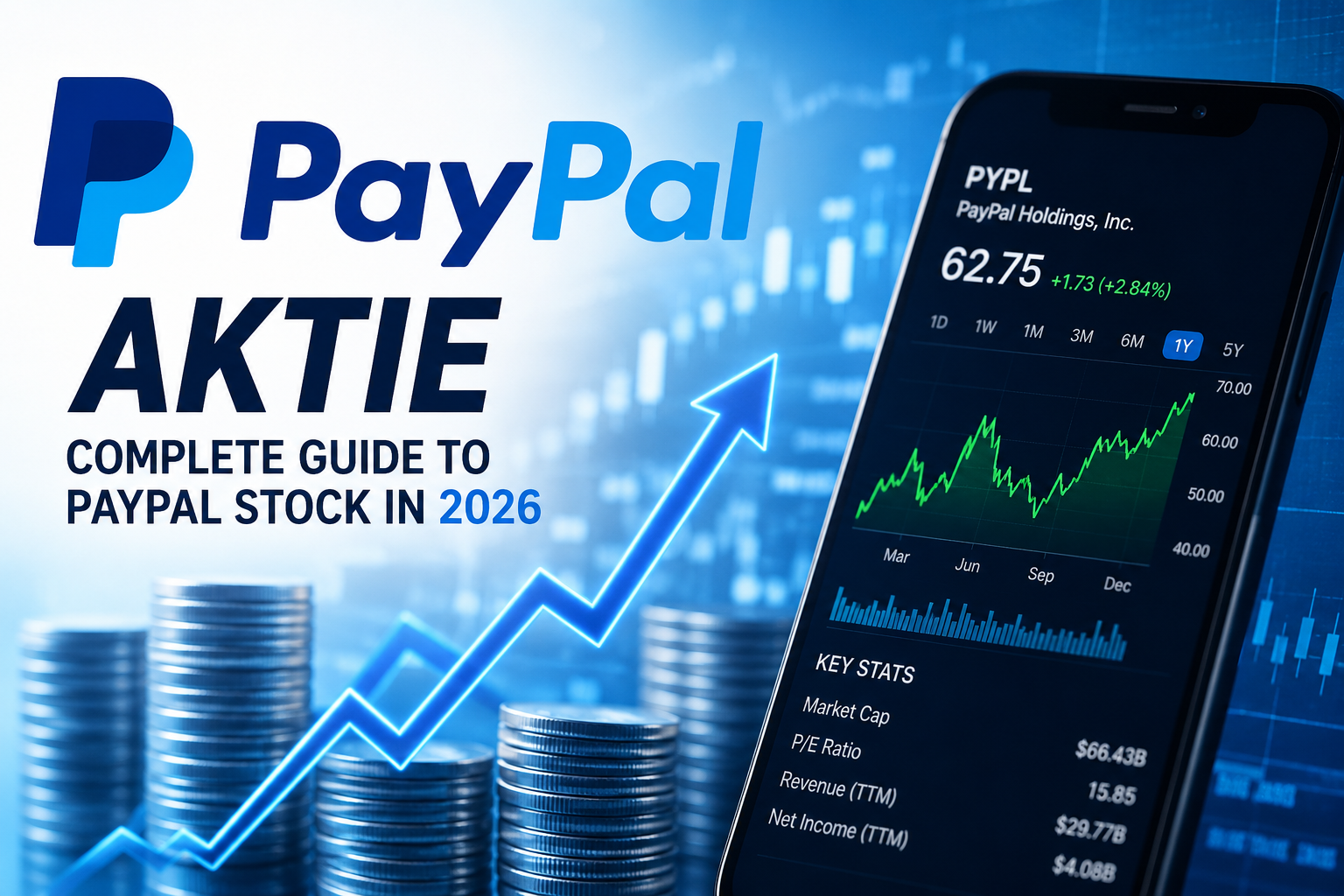

PayPal Aktie: Complete Investment Guide, Stock Analysis & Forecast for 2026
The digital payments industry has transformed the way people shop, transfer money, and manage finances. Among the companies that helped drive this transformation, PayPal remains one of the most recognised names worldwide. Whether you’re paying for an online purchase, sending money to family, or running an eCommerce business, chances are you’ve interacted with PayPal in some way.
Recently, however, the conversation surrounding PayPal Aktie has shifted beyond its payment platform. Investors are increasingly asking questions about the company’s future, valuation, competitive position, and reports of potential acquisition interest.
If you’ve searched for PayPal aktie, you’re probably looking for answers to questions like:
- Is PayPal stock a good investment?
- Why has PayPal’s share price been so volatile?
- What does the recent takeover speculation mean?
- Can PayPal return to its former growth trajectory?
- Should long-term investors consider buying the stock?
This guide answers those questions in plain English while helping both beginner and experienced investors understand what makes PayPal one of the most closely watched fintech companies in the world.
What Does “PayPal Aktie” Mean?
The word “Aktie” is the German term for stock or share.
Although millions of investors in Germany, Austria, and Switzerland search for “PayPal Aktie”, the company itself is an American corporation listed on the NASDAQ Stock Market under the ticker symbol
PYPL
When people search for PayPal Aktie, they usually want information about:
- Share price performance
- Company fundamentals
- Future growth prospects
- Earnings
- Analyst opinions
- Dividend policy
- Risks
- Buy or sell recommendations
Even though the search term originates from German-speaking markets, PayPal is a global company with customers in over 200 markets, making it relevant to investors worldwide.
PayPal at a Glance
| Category | Details |
|---|---|
| Company | PayPal Holdings, Inc. |
| Stock Symbol | PYPL |
| Exchange | NASDAQ |
| Industry | Financial Technology (FinTech) |
| Headquarters | San Jose, California |
| Founded | 1998 |
| Spin-Off | Became independent from eBay in 2015 |
| Primary Business | Digital Payments |
Over the past two decades, PayPal has evolved from a simple online payment processor into a broad financial technology ecosystem serving consumers, merchants, freelancers, and enterprises.
Its platform supports:
- Online checkout
- Peer-to-peer transfers
- International payments
- Merchant payment processing
- Buy Now, Pay Later services
- Digital wallets
- Business payment solutions
Millions of businesses rely on PayPal every day because it simplifies payments while helping reduce fraud and improve customer trust.
Why Is PayPal So Popular?
One reason PayPal has remained relevant for decades is its simplicity.
Instead of entering card information every time you shop online, customers can simply log into their PayPal account and complete transactions within seconds.
For businesses, PayPal offers:
- Faster checkout
- Global payment acceptance
- Fraud protection
- Easy integrations
- Multiple payment options
- Mobile-friendly experiences
Consumers appreciate the convenience, while merchants value higher conversion rates and access to international customers.
This two-sided ecosystem has long been one of PayPal’s biggest competitive strengths.
The Evolution of PayPal
Understanding PayPal’s history helps investors appreciate why the company remains important despite growing competition.
Early Growth
PayPal gained popularity during the rapid growth of online marketplaces in the early 2000s.
It became one of the preferred payment methods for online auctions because buyers and sellers needed a trusted intermediary.
eBay Acquisition
PayPal’s success attracted eBay, which acquired the company to strengthen its marketplace payments.
For years, PayPal became closely associated with eBay purchases.
Becoming Independent Again
Years later, PayPal separated from eBay and returned to being an independent public company.
This independence allowed management to pursue partnerships with thousands of retailers instead of focusing primarily on eBay.
The strategy expanded PayPal’s addressable market significantly.
Modern FinTech Expansion
Today’s PayPal looks very different from the company investors knew a decade ago.
Its ecosystem now includes products and services such as:
- Venmo
- PayPal Checkout
- Business payments
- Merchant financing
- Buy Now, Pay Later
- Cryptocurrency services (in select markets)
- Digital wallets
- International transfers
Rather than being just another payment button, PayPal has become a complete digital commerce platform.
How Does PayPal Make Money?
Many new investors assume PayPal earns money by simply moving funds between users.
In reality, its revenue comes from several different sources.
1. Transaction Fees
This is the company’s largest revenue stream.
Businesses pay fees whenever customers complete purchases using PayPal.
Generally, higher payment volume means more revenue.
2. Merchant Services
PayPal provides businesses with tools for:
- Online checkout
- Subscription billing
- Payment processing
- Fraud detection
- Invoice management
These services create recurring business revenue.
3. Buy Now, Pay Later
PayPal allows eligible customers to split purchases into instalments.
The company earns revenue through merchant relationships and financing activities, depending on the product and market.
4. International Payments
Cross-border transactions typically generate higher fees than domestic payments.
Because PayPal operates globally, international commerce represents an important source of revenue.
5. Value-Added Financial Services
Additional services include:
- Working capital for merchants
- Business loans
- Currency conversion
- Digital wallet features
- Payment APIs
- Enterprise commerce tools
Diversification helps reduce dependence on any single revenue source.
Why Investors Follow PayPal Stock Closely
PayPal sits at the intersection of several rapidly evolving industries.
These include:
- FinTech
- Artificial Intelligence
- Digital Commerce
- Mobile Payments
- Cross-Border Payments
- Online Shopping
- Embedded Finance
Because these markets continue expanding worldwide, PayPal often attracts long-term investors looking for exposure to digital financial services.
What Makes PayPal Different from Traditional Banks?
Banks primarily focus on:
- Deposits
- Loans
- Mortgages
- Savings accounts
PayPal focuses on making digital payments easier.
Its technology allows consumers and businesses to:
- Send money
- Receive payments
- Shop online
- Pay internationally
- Manage digital wallets
Rather than replacing banks entirely, PayPal often complements existing financial institutions.
PayPal’s Competitive Landscape
No company dominates digital payments forever.
Today’s fintech market is far more competitive than it was a decade ago.
Major competitors include:
| Competitor | Primary Strength |
|---|---|
| Apple Pay | Mobile ecosystem |
| Google Pay | Android integration |
| Stripe | Developer-focused payment infrastructure |
| Block (Square) | Small business ecosystem |
| Adyen | Enterprise payment solutions |
| Shopify Payments | Integrated eCommerce payments |
Each competitor focuses on different customer segments, making the industry highly dynamic.
Why Did PayPal Stock Become More Volatile?
Investors have witnessed significant price swings in recent years.
Several factors contributed:
Slowing Growth
Following extraordinary digital adoption during the pandemic, growth naturally normalised.
Markets often react negatively when fast-growing companies begin expanding more slowly.
Rising Competition
New payment platforms entered the market.
Consumers gained additional payment choices.
Merchants also began integrating multiple payment providers rather than relying on one.
Economic Conditions
Higher interest rates, inflation concerns, and cautious consumer spending affected many technology companies, including PayPal.
Investor Expectations
Companies that once traded at premium valuations often face pressure when earnings growth slows.
PayPal has experienced this adjustment alongside many other technology businesses.
Why Is PayPal Back in the Headlines?
One of the biggest recent developments has been reports of acquisition interest.
According to multiple news reports, payments company Stripe and private equity firm Advent International have reportedly made an offer to acquire PayPal. The reported proposal values the company at more than $53 billion, although no transaction has been completed or officially confirmed by the companies involved.
If such a deal were ever finalised, it could become one of the largest acquisitions in the financial technology sector.
Why Would Someone Want to Buy PayPal?
Although PayPal faces increasing competition, it still possesses valuable assets.
Potential strategic attractions include the following:
Massive User Base
Millions of consumers already trust PayPal.
Building that level of customer recognition from scratch would take years.
Merchant Relationships
PayPal works with businesses ranging from small startups to global enterprises.
These relationships represent significant long-term value.
Global Infrastructure
Operating payment systems across numerous countries requires licenses, compliance systems, and extensive technical infrastructure.
These assets can be difficult and expensive to replicate.
Trusted Brand
Consumers continue recognising PayPal as one of the most established online payment brands.
Brand trust remains a competitive advantage in financial services.
Could a Takeover Actually Happen?
At this stage, investors should distinguish between reported interest and completed transactions.
Large acquisitions typically require:
- Negotiations
- Financing
- Regulatory review
- Shareholder considerations
- Board approval
Until those steps occur, any reported offer remains uncertain. Investors should avoid making decisions based solely on takeover speculation.
Why Investors Should Focus on Fundamentals
While takeover rumors can create short-term excitement, long-term investors generally pay closer attention to factors such as:
- Revenue growth
- Profitability
- Free cash flow
- Active users
- Merchant adoption
- Innovation
- Competitive positioning
- Management execution
These indicators often have a greater influence on a company’s long-term value than short-lived market speculation.
Key Takeaways
PayPal remains one of the world’s most recognised digital payment companies, but its investment story has evolved. Rather than being viewed solely as a high-growth fintech stock, it is now evaluated on its ability to innovate, defend market share, improve profitability, and adapt to a rapidly changing payments landscape.
Recent reports of takeover interest have renewed investor attention, but the long-term outlook will continue to depend on PayPal’s business performance rather than speculation alone.
Understanding PayPal’s Stock Performance
Every publicly traded company experiences cycles of growth, corrections, and recovery. PayPal is no exception.
Since becoming an independent company in 2015, PayPal has gone through several distinct phases that have shaped investor sentiment.
Phase 1: Strong Expansion
After separating from eBay, PayPal gained greater flexibility to partner with online retailers, payment providers, and financial institutions. Investors rewarded this broader growth strategy, and the company’s stock climbed steadily over several years.
Several factors supported this momentum:
- Rapid growth in online shopping
- Increasing adoption of digital wallets
- Expansion into international markets
- Higher transaction volumes
- Rising consumer confidence in online payments
At the time, PayPal was widely viewed as one of the leaders in financial technology.
Phase 2: Pandemic-Driven Acceleration
The COVID-19 pandemic dramatically changed consumer behaviour.
People began ordering groceries, electronics, clothing, and services online at unprecedented levels. Businesses that had never accepted online payments rushed to build digital shopfronts.
PayPal benefited from this global shift because it already had an established payment infrastructure.
Key drivers during this period included:
- Increased eCommerce activity
- More peer-to-peer payments
- Higher merchant adoption
- Growth in contactless payment preferences
- Expansion of digital financial services
Investors anticipated that these trends would continue indefinitely, leading to exceptionally high expectations.
Phase 3: Market Correction
As economies reopened, consumer spending patterns began to normalize.
Growth remained positive, but it slowed compared to the extraordinary pace experienced during the pandemic.
For many technology companies, including PayPal, slower growth combined with changing economic conditions led to lower market valuations.
Contributing factors included:
- Higher interest rates
- Inflation concerns
- Reduced discretionary spending
- Increased competition
- More cautious investor sentiment
This correction reminded investors that even successful businesses can experience periods of slower expansion.
What Drives PayPal’s Revenue?
Revenue is one of the first metrics investors examine when evaluating any business.
Although PayPal offers many products, most of its revenue still depends on payment activity across its network.
Several factors influence revenue growth:
Payment Volume
The more money processed through PayPal’s platforms, the greater the opportunity to generate transaction-related revenue.
This includes:
- Consumer purchases
- Business transactions
- International transfers
- Mobile payments
- Subscription payments
Growing payment volume often reflects increasing platform usage.
Merchant Growth
Businesses remain the backbone of PayPal’s ecosystem.
Each new merchant that integrates PayPal creates opportunities for recurring payment activity.
Large enterprise customers may process millions of transactions annually, while small businesses contribute through consistent daily usage.
Consumer Engagement
Revenue doesn’t depend only on acquiring new users.
Existing customers who use PayPal more frequently can significantly increase payment volume over time.
Examples include:
- Online shopping
- Bill payments
- Freelance income
- Subscription services
- International purchases
Higher engagement often produces better long-term results than simply increasing account numbers.
International Commerce
Cross-border payments generally produce higher fees than domestic transactions.
As international online commerce continues to grow, PayPal remains well positioned to benefit from businesses selling products worldwide.
Key Financial Metrics Investors Watch
When researching PayPal Aktie, investors often focus on a combination of financial indicators rather than on a single number.
Revenue Growth
Consistent revenue growth demonstrates that customers continue using the platform.
Even moderate, sustainable growth can be attractive when supported by healthy profitability.
Operating Margin
Operating margin measures how efficiently a company converts revenue into operating profit.
Improving margins may indicate:
- Better cost control
- Higher operational efficiency
- Successful automation
- Improved pricing power
Companies with expanding margins often attract long-term investors.
Free Cash Flow
Free cash flow represents the cash remaining after operating expenses and capital investments.
Strong cash generation allows companies to:
- Invest in innovation
- Repurchase shares
- Reduce debt
- Pursue acquisitions
- Expand internationally
Many experienced investors consider free cash flow one of the most important indicators of financial health.
Active Accounts
PayPal regularly reports the size and activity of its user base.
While total account growth is important, investors increasingly pay attention to user engagement and transaction frequency rather than account numbers alone.
A smaller but highly active customer base may generate more value than a larger group of infrequent users.
Transactions Per Active Account
This metric reflects how often customers use PayPal’s services.
Higher transaction frequency suggests:
- Strong customer loyalty
- Everyday usage
- Successful product integration
- Healthy ecosystem engagement
Why Profitability Matters More Than Ever
In previous years, investors often prioritised rapid growth over profits.
Today, market expectations have shifted.
Many shareholders now prefer companies that balance growth with sustainable earnings.
For PayPal, this means focusing on:
- Operational efficiency
- Expense management
- Higher-margin services
- Long-term profitability
Companies capable of delivering both growth and earnings tend to receive stronger investor confidence.
SWOT Analysis of PayPal
A SWOT analysis helps investors evaluate a company’s overall competitive position.
Strengths
Globally Recognized Brand
PayPal remains one of the most trusted names in online payments.
Its reputation helps reduce friction during online checkout and encourages customer confidence.
Large Merchant Network
Millions of businesses accept PayPal, creating a strong network effect.
The more merchants that participate, the more useful the platform becomes for consumers.
Diversified Product Portfolio
PayPal’s ecosystem extends beyond simple payment processing.
Its services include:
- Digital wallets
- Merchant solutions
- Peer-to-peer transfers
- Buy Now, Pay Later
- International payments
- Payment APIs
- Business financing
Diversification helps reduce dependence on any single product.
Global Presence
Operating across numerous countries gives PayPal access to international commerce opportunities that many regional competitors cannot easily match.
Weaknesses
Competitive Pressure
The digital payments market has become increasingly crowded.
Consumers now have access to many alternative payment methods.
Slower Growth Compared to Earlier Years
As PayPal has matured, maintaining extremely high growth rates has become more challenging.
Investors often compare current performance with earlier years, creating higher expectations.
Dependence on Online Commerce
Although PayPal continues expanding into new areas, a significant portion of its business remains connected to online shopping activity.
Changes in consumer spending can therefore influence transaction volumes.
Opportunities
Artificial Intelligence
AI has the potential to improve:
- Fraud detection
- Customer service
- Risk assessment
- Personalized shopping experiences
- Payment optimization
Smarter automation could improve efficiency while reducing operational costs.
Small Business Expansion
Millions of small businesses worldwide continue moving online.
Providing payment solutions, invoicing tools, and financing products represents an ongoing growth opportunity.
International Markets
Many emerging economies continue adopting digital payments.
As internet access and smartphone usage expand, PayPal may benefit from increased digital commerce.
Enterprise Solutions
Large organizations increasingly require sophisticated payment infrastructure.
Enterprise services often generate recurring revenue while strengthening long-term customer relationships.
Threats
Intense Competition
PayPal competes against technology companies, financial institutions, startups, and specialized payment providers.
Competition continues driving innovation across the industry.
Cybersecurity Risks
Financial platforms remain attractive targets for cybercriminals.
Maintaining secure systems requires continuous investment.
Regulatory Changes
Financial technology companies operate under evolving regulations worldwide.
Compliance requirements may affect operational costs or product availability in certain regions.
Economic Slowdowns
Reduced consumer spending may lower payment volumes, especially during periods of economic uncertainty.
PayPal’s Competitive Advantages
Despite increasing competition, PayPal continues to possess several advantages that are difficult to replicate.
Brand Trust
Consumers often choose payment methods they already know and trust.
Years of brand recognition give PayPal an important competitive edge.
Network Effects
Merchants want payment methods customers already use.
Customers prefer payment methods accepted by merchants.
This creates a self-reinforcing ecosystem that supports long-term growth.
Technology Infrastructure
Building secure global payment systems requires substantial investment.
PayPal’s existing infrastructure enables rapid transaction processing across multiple markets.
Merchant Relationships
Businesses that integrate PayPal into their websites may continue using the platform for years because switching payment systems can require technical resources and operational changes.
The Role of Artificial Intelligence
Artificial intelligence is expected to influence nearly every aspect of digital payments.
Potential applications include:
Fraud Prevention
Machine learning systems can identify suspicious transactions more quickly than traditional rule-based methods.
Customer Support
AI-powered assistants may provide faster responses while improving customer satisfaction.
Personalized Commerce
AI can recommend payment methods, financing options, and promotional offers based on customer behavior.
Operational Efficiency
Automation can reduce manual processes and improve productivity across multiple departments.
Key Risks Investors Should Understand
Every investment carries risk.
Before purchasing PayPal Aktie, investors should consider several important challenges.
Changing Consumer Preferences
Payment habits evolve quickly.
Companies must continuously innovate to remain relevant.
Technological Disruption
New financial technologies may reshape the competitive landscape faster than expected.
Valuation Risk
Even excellent businesses can produce disappointing investment returns if purchased at excessively high valuations.
Investors should evaluate both company fundamentals and stock price.
Market Volatility
Technology stocks often experience larger price swings than more defensive industries.
Long-term investors should be prepared for periods of volatility.
Long-Term Growth Drivers
Despite challenges, PayPal continues benefiting from several long-term trends.
These include:
- Increasing digital commerce
- Mobile payment adoption
- International online shopping
- Growth in subscription businesses
- Digital financial services
- Expansion of cloud-based commerce
- Continued decline of cash transactions in many markets
These structural changes may continue supporting demand for digital payment solutions over the coming years.
Investor Takeaways
When evaluating PayPal Aktie, it’s important to look beyond short-term headlines.
Strong companies are often judged not only by quarterly earnings but also by their ability to adapt, innovate, and maintain customer trust over time.
PayPal continues to operate in an industry with significant long-term potential, but investors should carefully balance opportunities against competitive and economic risks.
Rather than focusing solely on share price movements, long-term investors may benefit from monitoring operational performance, product innovation, profitability, and management’s execution of its broader strategy.
Is PayPal Aktie Undervalued or Overvalued?
One of the most common questions investors ask is whether PayPal stock is currently undervalued or overvalued.
There isn’t a single answer because valuation depends on several factors, including:
- Revenue growth expectations
- Profit margins
- Cash flow generation
- Market sentiment
- Interest rates
- Industry competition
- Future innovation
Rather than relying on a single metric, experienced investors compare PayPal with similar fintech and payment companies while considering its long-term growth potential.
How Investors Value PayPal
Professional investors typically evaluate PayPal using several approaches instead of focusing solely on its current share price.
Price-to-Earnings (P/E) Ratio
The P/E ratio compares a company’s stock price with its earnings.
A relatively high P/E may indicate that investors expect stronger future growth, while a lower P/E may suggest slower growth expectations—or a potentially attractive valuation if the company’s fundamentals remain strong.
Price-to-Free Cash Flow
Many long-term investors pay close attention to free cash flow because it reflects the cash a company generates after covering operating and capital expenses.
Healthy free cash flow gives management flexibility to:
- Invest in new products
- Improve technology
- Repurchase shares
- Reduce debt
- Pursue acquisitions
Revenue Growth
Companies with consistent revenue expansion often receive higher market valuations.
Investors monitor not only how much revenue grows but also whether that growth is sustainable over several years.
Profitability Trends
Growing profits can sometimes matter more than rapid revenue growth.
Businesses that improve operational efficiency while maintaining healthy revenue often create long-term shareholder value.
Does PayPal Pay a Dividend?
A common question among new investors is whether PayPal distributes dividends.
At present, PayPal has generally focused on reinvesting its cash into business operations, innovation, strategic initiatives, and share repurchase programs rather than paying regular dividends.
For income-focused investors, this may be a drawback.
However, growth-oriented investors often prefer companies that reinvest profits to expand their business and strengthen their competitive position.
Share Buybacks Explained
Instead of paying dividends, many technology companies choose to repurchase their own shares.
Share buybacks can:
- Reduce the total number of outstanding shares
- Increase earnings per share over time
- Demonstrate management’s confidence in the business
- Return value to shareholders in an indirect way
However, buybacks are most effective when shares are purchased at reasonable valuations and when the company maintains a strong financial position.
Factors That Could Drive Future Growth
PayPal operates in an industry that continues to evolve rapidly.
Several long-term trends could influence its future performance.
Continued Growth in Digital Payments
Consumers increasingly prefer digital payment methods over cash.
Whether shopping online, paying bills, or sending money to friends, electronic payments have become part of everyday life.
As this trend continues globally, payment companies may benefit from increased transaction volumes.
Expansion of eCommerce
Online shopping continues expanding across multiple industries.
Small businesses, large retailers, subscription services, and digital marketplaces all require secure payment infrastructure.
PayPal remains well positioned to serve this growing ecosystem.
Artificial Intelligence
AI could reshape digital payments in several ways.
Potential applications include:
Smarter Fraud Detection
Machine learning systems can identify suspicious behavior faster than traditional methods.
Personalized Customer Experiences
AI can recommend payment options, financing offers, and checkout improvements based on user preferences.
Better Risk Management
Advanced analytics may improve credit decisions and transaction monitoring.
Operational Efficiency
Automation can streamline internal processes, reducing costs while improving customer support.
Merchant Solutions
Businesses increasingly seek integrated financial tools rather than standalone payment processing.
Providing invoicing, analytics, financing, subscriptions, and payment management through a single platform may strengthen customer relationships.
Challenges PayPal Must Navigate
Despite attractive opportunities, investors should also recognize several ongoing challenges.
Intense Competition
The digital payments industry remains highly competitive.
Companies continually introduce new features, pricing models, and technologies to attract merchants and consumers.
Maintaining market share requires constant innovation.
Regulatory Environment
Financial technology companies operate under complex regulations that vary across countries.
Compliance requirements may increase costs or affect the introduction of new products.
Economic Conditions
Consumer spending influences payment volume.
Economic slowdowns can reduce online shopping activity, affecting transaction growth.
Cybersecurity
Protecting financial information remains one of the industry’s highest priorities.
Ongoing investment in cybersecurity is essential to maintain customer trust.
Is PayPal Aktie Suitable for Long-Term Investors?
The answer depends on an investor’s goals, risk tolerance, and investment strategy.
PayPal may appeal to investors who:
- Believe digital payments will continue growing.
- Prefer established fintech companies over early-stage startups.
- Are comfortable with moderate stock price volatility.
- Focus on long-term business fundamentals.
- Want exposure to global eCommerce trends.
It may be less suitable for investors who:
- Require regular dividend income.
- Prefer low-volatility investments.
- Have a short investment horizon.
- Are uncomfortable with technology-sector risks.
As with any investment, diversification remains important.
Questions Every Investor Should Ask Before Buying PayPal Stock
Before investing, consider asking yourself:
- Do I understand PayPal’s business model?
- Am I investing for the long term?
- How does PayPal compare with its competitors?
- Is the current valuation reasonable?
- What are the company’s biggest growth opportunities?
- What risks could affect future performance?
- Does this investment fit my overall portfolio?
Answering these questions can help you make more informed investment decisions.
Common Mistakes New Investors Make
Avoiding common pitfalls can improve long-term investment outcomes.
Chasing Headlines
News about acquisitions, partnerships, or market rumors can create excitement.
However, long-term investment decisions should be based on business fundamentals rather than speculation.
Ignoring Valuation
Even a high-quality company can become a poor investment if purchased at an excessively high price.
Overlooking Competition
The payments industry changes quickly.
Investors should regularly evaluate how PayPal compares with existing and emerging competitors.
Reacting Emotionally
Short-term market fluctuations are common.
Long-term investors often benefit from maintaining discipline rather than reacting to every price movement.
Practical Tips for Researching PayPal Aktie
If you’re considering PayPal as an investment, make it a habit to review:
- Quarterly earnings reports
- Annual reports
- Investor presentations
- Management commentary
- Product announcements
- Industry trends
- Competitor developments
- Broader economic conditions
Looking at multiple sources provides a more balanced understanding than relying on a single news headline.
Frequently Asked Questions
What is PayPal Aktie?
“PayPal Aktie” refers to shares of PayPal Holdings, Inc., which trade on the NASDAQ under the ticker symbol PYPL.
Is PayPal a technology company?
Yes. PayPal is generally classified as a financial technology (FinTech) company specializing in digital payment solutions.
Does PayPal operate internationally?
Yes. PayPal serves consumers and businesses in numerous countries and supports cross-border payments in many markets.
Does PayPal own Venmo?
Yes. Venmo is one of PayPal’s well-known peer-to-peer payment platforms.
Is PayPal profitable?
PayPal has historically generated significant revenue and cash flow, though investors should review the latest financial statements for current performance.
Does PayPal pay dividends?
Currently, PayPal does not have a regular dividend program.
What industry does PayPal compete in?
PayPal competes in digital payments, financial technology, online commerce, and payment processing.
Why is PayPal stock volatile?
Share prices may fluctuate due to earnings reports, economic conditions, competition, interest rates, and investor expectations.
Is PayPal only for online shopping?
No. PayPal also supports peer-to-peer payments, merchant services, subscriptions, invoicing, and various business payment solutions.
Can beginners invest in PayPal?
Yes. Beginners can invest in PayPal through a brokerage account, though it’s important to research the company and understand the risks before investing.
Does PayPal benefit from AI?
Artificial intelligence has the potential to improve fraud detection, customer support, payment optimization, and operational efficiency.
What makes PayPal different from traditional banks?
PayPal focuses primarily on digital payments and financial technology rather than traditional banking services like mortgages or savings accounts.
Is PayPal exposed to global eCommerce growth?
Yes. Increased online shopping and digital commerce can support higher payment volumes across PayPal’s network.
What should long-term investors monitor?
Key areas include revenue growth, profitability, cash flow, user engagement, innovation, competitive positioning, and management execution.
Is PayPal a high-risk investment?
Like all individual stocks, PayPal carries risks. Competition, regulation, economic conditions, and changing technology can all influence future performance.
Final Thoughts
PayPal has played a major role in shaping digital payments over the past two decades. While the company faces stronger competition and changing market dynamics than it did in its early years, it continues to operate one of the world’s most recognized payment platforms.
For investors researching paypal aktie, it’s important to look beyond short-term headlines or market speculation. A thoughtful investment decision should be based on the company’s financial health, strategic direction, competitive position, and long-term growth potential.
No investment is guaranteed to succeed, but understanding both the opportunities and the risks can help you build a more informed and balanced investment strategy.
As the payments industry continues to evolve through advancements in artificial intelligence, mobile commerce, and global digital transactions, PayPal’s ability to innovate and adapt will remain central to its future success.
Key Takeaways
| Topic | Summary |
|---|---|
| Company | PayPal Holdings, Inc. |
| Ticker Symbol | PYPL |
| Exchange | NASDAQ |
| Industry | Financial Technology (FinTech) |
| Primary Revenue | Payment processing and merchant services |
| Dividend | No regular dividend |
| Long-Term Focus | Digital payments, innovation, AI, global commerce |
| Key Risks | Competition, regulation, cybersecurity, economic conditions |
| Growth Drivers | eCommerce, AI, international expansion, merchant solutions |
Conclusion
For investors exploring paypal aktie, the company remains a significant player in the global fintech landscape. While its rapid-growth phase has matured, PayPal continues to benefit from strong brand recognition, a broad customer base, and ongoing demand for digital payment solutions.
Rather than focusing solely on short-term stock movements or takeover speculation, investors should evaluate PayPal through the lens of long-term fundamentals, financial performance, innovation, and its ability to adapt in a highly competitive market. A well-informed approach, combined with diversification and regular portfolio reviews, can help investors decide whether PayPal aligns with their individual financial goals and risk tolerance.