
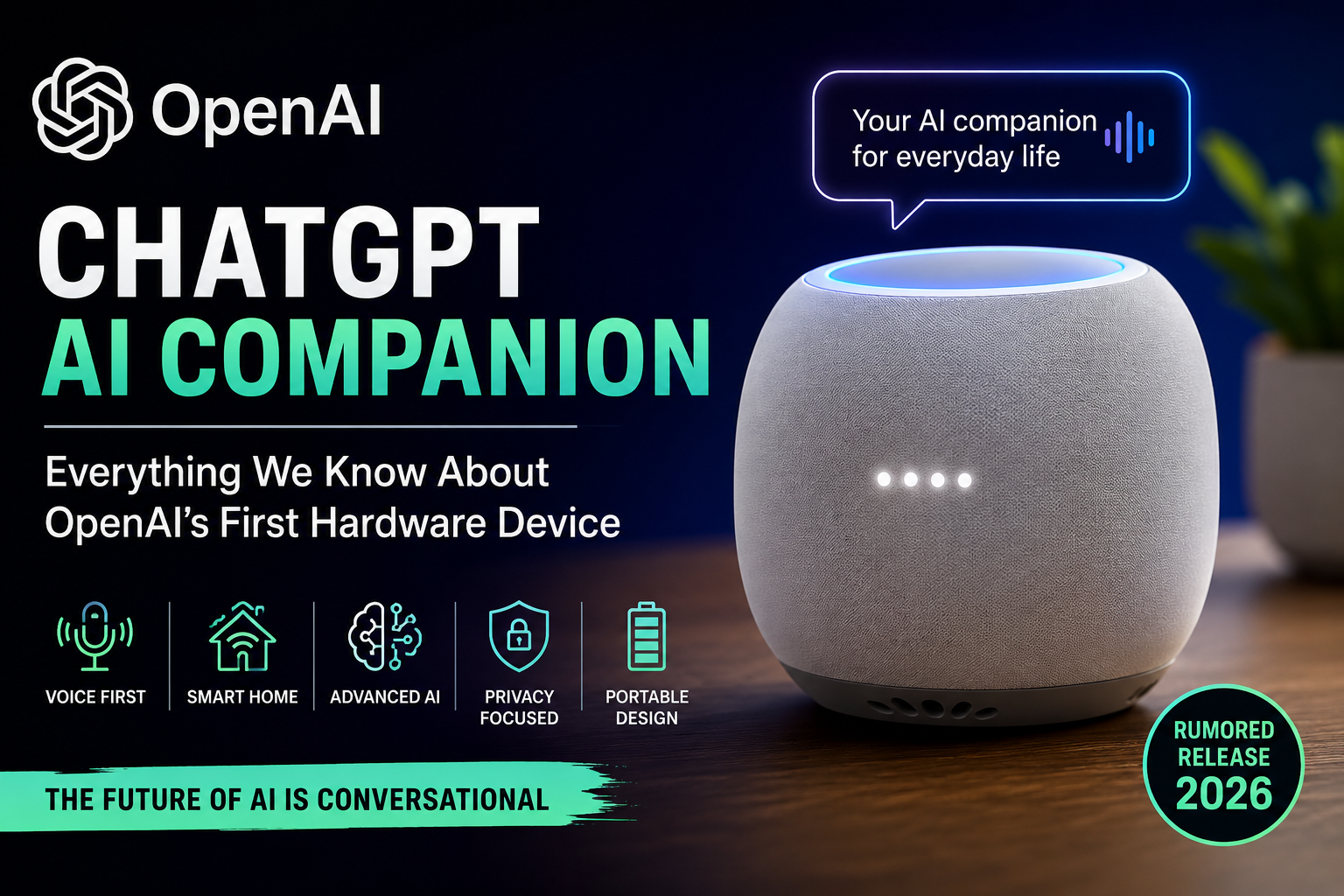

ChatGPT’s Next Big Leap? Why OpenAI’s Rumored AI Companion Could Redefine Personal Technology
ChatGPT’s Next Big Leap? Everything We Know About OpenAI’s First AI Companion Device
Artificial intelligence has transformed from a futuristic concept into an everyday reality. Millions of people now rely on ChatGPT for writing, coding, research, brainstorming, education, customer support, and countless daily tasks. In just a few years, AI has evolved from a browser-based chatbot into an intelligent assistant capable of understanding voice, images, files, and even real-time conversations.
Now, the next chapter may be about to begin.
Instead of asking users to open an app or visit a website, OpenAI reportedly wants AI to become something that naturally lives beside you throughout the day. Recent reports suggest the company is developing its first consumer hardware product—a portable, screen-free AI companion designed to deliver ChatGPT through voice-first interactions rather than a traditional display. The reported device could represent OpenAI’s biggest step yet toward making AI a seamless part of everyday life.
If these reports prove accurate, the question is no longer whether AI will become more personal.
The question is how people will interact with AI when screens are no longer the centre of the experience.
This article explores what this reported device could mean, why OpenAI appears interested in hardware, and how ChatGPT may evolve beyond smartphones and laptops.
Quick Overview
| Topic | Details |
|---|---|
| Primary Technology | ChatGPT-powered AI assistant |
| Device Type | Reported portable screenless speaker |
| Interaction Method | Voice-first AI conversations |
| Expected Use | Personal AI companion |
| Possible Features | Smart home control, messaging, contextual awareness, voice conversations |
| Target Audience | Consumers, professionals, students, families |
| Current Status | Reportedly under development |
Why This Matters
For decades, personal technology has followed a familiar pattern.
First came desktop computers.
Then laptops.
Then smartphones.
Later, smartwatches and wireless earbuds expanded how we interact with digital services.
Each generation reduced the distance between people and technology.
Artificial intelligence introduces a different challenge.
Rather than creating another screen, companies are trying to eliminate unnecessary interactions altogether.
Instead of:
- Opening an app
- Typing a question
- Reading results
- Closing the app
AI could simply become something you talk to naturally.
That’s the vision many technology companies are now pursuing.
ChatGPT already supports natural conversations that often feel closer to speaking with another person than using a traditional search engine. A dedicated AI device could make those conversations even more immediate by removing the need to unlock a phone or sit at a computer.
How ChatGPT Changed Artificial Intelligence
Before ChatGPT, AI often felt like a collection of isolated tools.
People used:
- Translation software
- Grammar correction apps
- Voice assistants
- Search engines
- Coding tools
Each served a single purpose.
ChatGPT changed expectations by combining many of these capabilities into one conversational interface.
Today users ask ChatGPT to do the following:
- Write emails
- Solve programming problems
- Explain science
- Generate business ideas
- Create travel itineraries
- Summarize meetings
- Learn new skills
- Practice interviews
- Analyze spreadsheets
- Brainstorm creative projects
Instead of switching between multiple applications, users increasingly expect one intelligent assistant to help across different tasks.
That shift has created new possibilities for AI hardware.
Why OpenAI May Be Moving Into Hardware
Software alone has made ChatGPT one of the world’s most recognised AI products.
So why build hardware?
Several reasons stand out.
1. Faster Access to AI
Even the best smartphone experience requires several steps.
You unlock the phone.
Find the app.
Wait for it to load.
Type or speak.
Review the answer.
Dedicated hardware could reduce those steps dramatically.
Simply asking a question aloud may become enough.
2. More Natural Conversations
Modern AI is becoming increasingly conversational.
Recent advancements in OpenAI’s voice technology allow AI to respond faster and more naturally than previous systems, making real-time spoken interactions feel much smoother.
A device built specifically for voice could deliver conversations that feel more fluid than using a smartphone application.
3. AI That Understands Context
Reports indicate the rumoured device could include cameras and environmental sensors to better understand its surroundings. Rather than responding only to spoken words, the system may be able to interpret context from the nearby environment, though OpenAI has not officially confirmed these capabilities.
Context changes everything.
Imagine asking:
“Where did I leave my keys?”
Instead of guessing, an AI companion that understands nearby surroundings could potentially assist more intelligently.
While this remains speculative, it demonstrates why hardware offers opportunities that software alone cannot.
The Reported Screenless Design
Perhaps the most surprising detail is what the device reportedly doesn’t include.
A screen.
That sounds strange in 2026.
After all, nearly every major consumer technology product revolves around displays.
Phones.
Tablets.
Laptops.
Televisions.
Smartwatches.
Even refrigerators now include screens.
OpenAI reportedly wants to challenge that assumption.
Instead of another display demanding your attention, the device could rely almost entirely on conversation.
That’s a bold design philosophy.
Why Remove the Screen?
Screens are incredibly useful.
They are also incredibly distracting.
Most people unlock their phones for one task.
Minutes later, they find themselves:
- Reading unrelated news
- Watching videos
- Checking notifications
- Scrolling social media
- Replying to messages they didn’t intend to answer
A voice-first AI companion aims to reduce friction.
Instead of opening another app, users simply ask a question.
The interaction begins.
The interaction ends.
Life continues.
This approach could make technology feel less intrusive while still providing immediate access to information.
A Different Kind of Smart Speaker
At first glance, many people compare the reported product to existing smart speakers.
That comparison is understandable.
However, early reports suggest OpenAI’s ambitions extend beyond playing music or setting timers. The rumoured device is described as a more conversational AI companion capable of leveraging ChatGPT while also supporting smart-home functions, messaging, and other everyday tasks.
Traditional smart speakers generally respond to simple commands.
Examples include:
- “Play jazz.”
- “Set a timer.”
- “Turn off the lights.”
- “What’s the weather?”
ChatGPT enables much richer conversations.
Imagine asking:
- Help me plan my vacation.
- Explain this legal document.
- Write tomorrow’s presentation.
- Teach my child multiplication.
- Compare mortgage options.
- Summarise today’s news.
- Help me prepare dinner using what’s in my refrigerator.
These interactions require reasoning rather than simple command execution.
That’s a major difference.
ChatGPT Is Becoming More Than a Chatbot
When ChatGPT launched, most users viewed it as an intelligent writing assistant.
Today it’s becoming something much larger.
People now rely on ChatGPT for:
Productivity
- Writing reports
- Drafting emails
- Research
- Scheduling
Education
- Homework assistance
- Language learning
- Test preparation
- Tutoring
Business
- Marketing
- Customer service
- Data analysis
- Strategy
Software Development
- Debugging
- Code generation
- Documentation
- Learning new programming languages
Personal Life
- Meal planning
- Fitness advice
- Travel planning
- Daily organization
Hardware could make these experiences available instantly rather than requiring users to reach for another device.
The Human Companion Concept
One of the most interesting ideas emerging from recent reports is that OpenAI reportedly views this product less as a conventional smart speaker and more as an AI companion designed to be present in the home.
That wording matters.
A companion is different from an assistant.
An assistant waits for commands.
A companion participates in daily life.
If future AI develops greater contextual awareness, long-term memory (where enabled), and more natural voice interaction, users may begin interacting with AI much like they interact with another person during routine activities.
While we’re not fully there yet, current advancements suggest the industry is moving steadily in that direction.
The Role of Jony Ive
Another reason this project has attracted significant attention is the reported involvement of renowned designer Jony Ive, the former Apple design chief. OpenAI acquired IO, the AI hardware startup associated with Ive, and reports indicate that LoveFrom and several former Apple engineers are contributing to the development effort.
Although no final product design has been revealed, Ive’s track record has led many industry observers to expect a strong emphasis on simplicity, premium materials, and intuitive user experiences.
That combination of advanced AI software and experienced hardware design is one reason expectations for the project are unusually high.
Why the AI Industry Is Watching Closely
Whether the reported device succeeds or not, it represents something larger than a single product.
It reflects a broader shift in how companies envision the future of computing.
Instead of asking:
“How do we improve smartphones?”
The new question becomes:
“Can AI become the primary interface between humans and technology?”
If the answer is yes, future devices may look—and behave—very differently from today’s gadgets.
ChatGPT’s Next Big Leap? Everything We Know About OpenAI’s First AI Companion Device
How the Reported ChatGPT Device Could Change Everyday Life
If the reported OpenAI hardware reaches consumers, it won’t simply introduce another gadget into an already crowded market.
Instead, it could encourage people to rethink how they interact with technology every hour of the day.
Today, digital interactions are intentional.
You decide to:
- Pick up your phone
- Unlock it
- Open an application
- Search for something
- Complete a task
A voice-first AI companion could make technology far more conversational.
Rather than thinking about apps, users may simply think about their goals.
For example:
Instead of opening three different apps to plan dinner, you could ask:
“I’m cooking for four people tonight. One guest is vegetarian, another has a peanut allergy, and I only have 45 minutes. Can you suggest a menu and shopping list?”
Instead of switching between weather, maps, and calendar apps, you might simply say the following:
“I have a meeting across town at 2 PM. When should I leave?”
The AI could combine multiple pieces of information into one helpful answer.
That shift—from managing apps to having conversations—may be one of the most significant changes AI brings to consumer technology.
From Smart Assistant to Intelligent Companion
Current digital assistants are useful, but they often rely on scripted interactions.
For example:
User: Set an alarm for 7 AM.
Assistant: Alarm set.
Simple.
Fast.
Predictable.
Now imagine something more advanced.
User: I have an early flight tomorrow.
Instead of only setting an alarm, an AI companion might respond:
- “Your flight departs at 8:30 AM.”
- “Traffic is expected to be heavier than usual.”
- “You’ll need about 35 minutes to reach the airport.”
- “Would you like me to remind you to check in online tonight?”
That’s no longer a single command.
It’s contextual assistance.
This type of interaction illustrates why conversational AI is attracting so much attention.
How ChatGPT Differs From Traditional Voice Assistants
Although comparisons to Alexa, Siri, and Google Assistant are inevitable, ChatGPT was built on a different foundation.
Rather than relying mainly on predefined commands, modern language models generate responses dynamically based on context and conversation history.
Here’s a high-level comparison:
| Feature | Traditional Voice Assistant | ChatGPT-Based AI |
|---|---|---|
| Command Recognition | Excellent | Excellent |
| Multi-Step Reasoning | Limited | Advanced |
| Natural Conversation | Basic | Highly conversational |
| Long Explanations | Limited | Strong |
| Creative Writing | Minimal | Excellent |
| Coding Assistance | Very Limited | Extensive |
| Business Planning | Limited | Strong |
| Learning & Tutoring | Basic | Comprehensive |
| Brainstorming | Limited | Advanced |
| Context Retention (within a session) | Limited | Much stronger |
This difference is why many users already turn to ChatGPT for tasks they would never ask a traditional smart speaker to handle.
Why a Screenless Device Could Be a Competitive Advantage
At first glance, removing the screen may seem like a disadvantage.
After all, displays are useful for:
- Reading
- Watching videos
- Viewing maps
- Editing documents
However, screens also compete for attention.
Many technology experts believe the next generation of computing should reduce distractions rather than increase them.
A voice-first companion encourages shorter, more focused interactions.
Instead of spending twenty minutes scrolling through unrelated content, users might complete the same task in two minutes through conversation.
Whether consumers embrace this idea remains to be seen, but it reflects a growing interest in “calm technology”—products designed to fit naturally into daily life instead of constantly demanding attention.
The Potential Role of Cameras and Sensors
According to recent reports, the rumoured device may include cameras and environmental sensors that help it better understand its surroundings. OpenAI has not officially detailed how these technologies would function or what privacy controls would accompany them.
If such features are included, they could enable capabilities such as the following:
Object Recognition
Users might ask:
“What is this plant?”
“What model of laptop is this?”
“Can you identify this tool?”
Visual Assistance
Imagine asking:
“Did I leave anything on the kitchen counter?”
or
“What colour shirt am I holding?”
Visual AI could provide answers without requiring users to upload photos manually.
Context Awareness
Instead of relying only on voice commands, AI might understand the following:
- Where you are
- What you’re looking at
- What task you’re trying to complete
This combination of vision and conversation could significantly expand what AI assistants can do.
Could This Replace Smartphones?
Probably not—at least not in the near future.
Smartphones remain incredibly versatile because they combine:
- Communication
- Photography
- Entertainment
- Navigation
- Banking
- Shopping
- Productivity
A dedicated AI companion would likely complement phones rather than replace them.
Think about how smartwatches evolved.
Most people still own smartphones.
The watch simply made certain tasks faster.
The same could happen with AI hardware.
Instead of replacing existing devices, it may become another convenient way to access ChatGPT.
The Privacy Questions Everyone Is Asking
Whenever a company introduces AI hardware with microphones—or potentially cameras—privacy becomes one of the biggest concerns.
Consumers will naturally ask questions such as the following:
- Is the device always listening?
- What information is stored?
- Who can access recordings?
- Can users delete their history?
- How much processing happens on the device versus in the cloud?
- Can microphones or cameras be disabled?
These questions don’t have complete answers yet because OpenAI has not publicly shared detailed product specifications or privacy policies for the reported device.
However, strong privacy protections will likely be critical to consumer trust if the product moves forward.
Why Trust Will Matter More Than Features
History shows that people often choose technology based not only on capability but also on confidence.
Users need to believe:
- Their conversations remain private.
- Sensitive information is protected.
- AI behaves predictably.
- Settings are easy to understand.
- Data controls are transparent.
Even the most advanced AI hardware could struggle if consumers feel uncertain about privacy.
For OpenAI, building trust may become just as important as building intelligence.
A New Market Is Emerging
The reported ChatGPT hardware isn’t entering an empty space.
It joins a rapidly evolving AI ecosystem that includes the following:
- Smart speakers
- AI-powered smartphones
- AI-enabled laptops
- Wearable devices
- Smart glasses
- Automotive assistants
Rather than competing with one category, OpenAI could be participating in the creation of an entirely new one: dedicated AI companions.
If that happens, other technology companies may accelerate similar projects of their own.
How Businesses Could Use an AI Companion
Although much of the discussion focuses on consumers, businesses could also benefit from conversational AI hardware.
Potential workplace uses include:
Meeting Support
Employees could ask for the following:
- Instant summaries
- Action items
- Follow-up reminders
- Calendar scheduling
Customer Service
Businesses might use AI companions to:
- Answer common questions
- Guide visitors
- Provide product information
- Assist with onboarding
Professional Research
Instead of searching across multiple websites, professionals could ask:
“Summarise today’s developments in renewable energy.”
or
“Compare the latest cybersecurity regulations affecting healthcare.”
The AI could provide organised, conversational responses.
Educational Opportunities
Students may be among the biggest beneficiaries of conversational AI.
Imagine asking:
“Explain quantum physics like I’m in middle school.”
Then following with:
“Now explain it using mathematics.”
Then:
“Give me five practice questions.”
The conversation adapts naturally.
Rather than presenting a single answer, ChatGPT can guide learners through increasingly advanced explanations.
A dedicated AI device could make this process even more accessible.
Healthcare Possibilities
While AI should never replace qualified medical professionals, it can assist people in understanding general health information.
Possible uses include:
- Explaining medical terminology
- Organizing questions for doctor appointments
- Medication reminders
- Wellness education
- Nutrition guidance
- Fitness planning
Any healthcare-related features would still need appropriate safeguards, and users should always seek professional medical advice for diagnosis or treatment.
Accessibility Benefits
Voice-first AI also has the potential to improve accessibility.
For individuals who have difficulty using traditional screens or keyboards, conversational interfaces may offer a more natural way to interact with technology.
Potential benefits include the following:
- Hands-free operation
- Voice-controlled information access
- Reading assistance
- Language translation
- Everyday task management
Making technology easier to use for a broader range of people could become one of AI’s most meaningful contributions.
The Competitive Landscape
OpenAI is not the only company investing heavily in AI-powered consumer experiences.
Several major technology firms continue to integrate advanced AI into their products, including smartphones, productivity software, search, and digital assistants.
Competition in this space is likely to drive the following:
- Faster innovation
- Better AI models
- Improved voice interaction
- Lower costs over time
- More consumer choice
Rather than one company dominating the market, the future will likely involve multiple AI ecosystems serving different user preferences.
Challenges OpenAI May Face
Launching innovative hardware is rarely easy.
Potential challenges include:
Pricing
Consumers will compare the device with smartphones, tablets, and smart speakers.
Pricing will strongly influence adoption.
Consumer Habits
Many people are comfortable using phones.
Changing long-established habits takes time.
Competition
Established technology companies already have extensive hardware experience.
Competing against mature ecosystems will require exceptional execution.
Battery Life
Portable AI devices need reliable battery performance.
Frequent charging could reduce convenience.
Connectivity
Users will expect dependable performance at home, while travelling, and in areas with varying network quality.
Privacy Expectations
As discussed earlier, trust will remain central to long-term success.
Why This Could Be the Beginning of Ambient Computing
Technology has steadily moved closer to users over the decades:
Desktop computer → Laptop → Smartphone → Smartwatch → Earbuds
The next step may be something even less intrusive.
Instead of interacting with technology directly, technology quietly supports users in the background.
This concept is often called ambient computing.
Rather than demanding constant attention, AI becomes available whenever needed—and fades into the background when it’s not.
A screenless AI companion fits naturally within that broader vision.
Key Takeaways
- ChatGPT-based hardware could shift user interactions from app-based workflows to natural conversations.
- A screenless, voice-first approach aims to reduce friction and make technology less distracting.
- Cameras and sensors, if included, could enable richer contextual understanding, though OpenAI has not confirmed implementation details.
- Privacy, transparency, and user trust are likely to be as important as technical capabilities.
- The reported device may complement smartphones rather than replace them.
- Businesses, educators, and accessibility-focused users could benefit from dedicated conversational AI hardware.
- The project reflects a broader move toward ambient computing, where AI becomes an ever-present yet unobtrusive assistant.
ChatGPT’s Next Big Leap? Everything We Know About OpenAI’s First AI Companion Device
The Future of AI Hardware: What Comes Next?
Artificial intelligence has already changed how people search for information, write documents, create software, and communicate. Yet, we’re still in the early stages of AI becoming an everyday companion.
For years, hardware innovation focused on making devices:
- Faster
- Smaller
- Lighter
- More powerful
The next wave of innovation may focus on making technology less visible.
Instead of constantly interacting with screens, people could rely on AI that understands speech, context, preferences, and daily routines.
If OpenAI’s reported hardware project succeeds, it may encourage an entirely new generation of AI-first devices designed around conversation rather than touchscreens.
What Could Future ChatGPT Devices Look Like?
Although OpenAI has not announced a product roadmap, it’s possible to imagine how AI hardware could evolve over the coming years.
Future generations might include:
Wearable AI
Small devices integrated into:
- Neckbands
- Earbuds
- Glasses
- Watches
These products could provide real-time assistance without requiring users to hold a device.
Home AI Hub
An AI companion placed in a home might help coordinate the following:
- Family schedules
- Grocery lists
- Home automation
- Entertainment
- Security reminders
Rather than acting as a simple smart speaker, it could become a central intelligence system for the household.
Workplace AI
Businesses may eventually deploy dedicated AI devices to support employees by:
- Summarizing meetings
- Tracking action items
- Managing documentation
- Assisting customer interactions
- Organizing internal knowledge
Travel Companion
Imagine travelling internationally with an AI that can:
- Translate conversations
- Explain local customs
- Navigate transportation systems
- Recommend nearby attractions
- Help manage travel itineraries
These scenarios demonstrate how conversational AI could become increasingly integrated into daily life.
Industries That Could Benefit
The impact of AI companions may extend well beyond personal productivity.
Education
Teachers and students could benefit from:
- Personalized tutoring
- Interactive lessons
- Homework explanations
- Language practice
- Study planning
Healthcare
Healthcare professionals may use AI to assist with:
- Administrative documentation
- Appointment preparation
- Educational resources
- Patient communication support
AI should complement—not replace—qualified medical expertise.
Small Business
Entrepreneurs often wear many hats.
A conversational AI could help with:
- Marketing ideas
- Customer emails
- Inventory planning
- Business research
- Financial organization
Creative Professionals
Writers, designers, developers, and marketers already use ChatGPT extensively.
Dedicated AI hardware could make creative collaboration even faster by enabling natural brainstorming throughout the day.
The Challenges Ahead
While the vision is exciting, success is far from guaranteed.
Several important challenges remain.
Consumer Expectations
Because ChatGPT has become so widely recognised, expectations for OpenAI’s first hardware product are exceptionally high.
Consumers will expect:
- Excellent voice quality
- Fast responses
- Reliable performance
- Long battery life
- Strong privacy protections
- Regular software updates
Meeting all of those expectations simultaneously is a difficult task.
Hardware Is Different From Software
Building successful software and building successful consumer hardware require different expertise.
Hardware introduces additional considerations such as the following:
- Manufacturing
- Supply chains
- Component sourcing
- Product durability
- Repairs
- Warranty support
- Global distribution
Even companies with decades of experience occasionally face hardware challenges.
AI Accuracy
Although ChatGPT continues to improve, AI systems can still make mistakes or provide incomplete answers.
Users should continue to:
- Verify important information.
- Use critical thinking.
- Consult professionals for legal, financial, or medical decisions.
- Treat AI as a helpful assistant rather than an infallible authority.
Responsible use will remain essential regardless of the device used.
Could This Change the Way We Search?
Traditional search engines return a list of links.
Users then decide:
- Which website to visit.
- Which article to read.
- Which information to trust.
Conversational AI offers a different experience.
Instead of presenting dozens of search results, it attempts to provide a direct, organised response while allowing follow-up questions.
For many everyday tasks, this conversational model may feel more natural than traditional search.
However, search engines remain valuable for:
- Discovering multiple perspectives
- Reading original reporting
- Accessing official documentation
- Comparing products
- Conducting in-depth research
Rather than replacing search entirely, conversational AI is likely to complement it.
Will AI Replace Smartphones?
This is one of the most common questions surrounding AI hardware.
The most realistic answer today is probably not.
Smartphones combine many essential functions into a single device, including:
- Camera
- Messaging
- Banking
- Maps
- Entertainment
- Mobile payments
- Photography
- Productivity
A dedicated AI companion is more likely to become an additional interface than a complete replacement.
Just as smartwatches enhanced smartphones without eliminating them, AI companions may extend how people interact with technology.
Should You Buy an AI Companion?
If such a product becomes available, whether it’s right for you will depend on your needs.
It may be a good fit if you:
- Frequently use ChatGPT.
- Prefer voice interactions.
- Want hands-free productivity.
- Enjoy experimenting with new technology.
- Work in creative or knowledge-based professions.
You may prefer to wait if you:
- Rarely use AI tools.
- Prefer traditional smartphone apps.
- Want to see long-term reviews first.
- Have significant privacy concerns that haven’t yet been addressed.
As with any first-generation hardware, early adopters may enjoy new capabilities while later buyers benefit from refinements in future versions.
Expert Perspective: Why This Matters
The reported OpenAI device is important not because it is another speaker.
It’s important because it represents a broader shift in computing.
For decades, software adapted to hardware.
Increasingly, hardware is being designed around AI.
That changes the priorities.
Instead of asking:
“How many apps can this device run?”
Companies may increasingly ask:
“How naturally can this device help people?”
That philosophical shift could influence technology for years to come.
Frequently Asked Questions (FAQs)
What is the rumoured ChatGPT device?
Reports suggest OpenAI is developing a portable, screenless AI companion designed primarily for voice-based interaction. The company has not officially confirmed the full specifications or launch details.
Is OpenAI building hardware?
According to multiple news reports, OpenAI is working on its first consumer hardware initiative with the involvement of former Apple design chief Jony Ive and other experienced hardware designers. Official product details remain limited.
Will the device have a screen?
Current reports describe it as a screenless device focused on natural voice interaction, though final specifications have not been officially announced.
Could it replace Amazon Alexa or Google Assistant?
If released, it would likely compete in some areas while offering more advanced conversational AI capabilities through ChatGPT. Whether it replaces existing assistants will depend on features, pricing, and user preferences.
Will it replace smartphones?
Probably not.
Instead, it is more likely to complement smartphones by making certain interactions faster and more conversational.
When will it be released?
OpenAI has not officially announced a public launch date.
Will it support smart-home devices?
Reports indicate smart-home functionality may be part of the vision, but OpenAI has not confirmed the final feature set.
Is ChatGPT becoming more than a chatbot?
Yes.
ChatGPT has evolved into a broad AI platform capable of helping with writing, coding, research, education, productivity, business tasks, and creative work. Continued advances in voice and multimodal AI suggest even broader applications in the future.
Final Thoughts
Artificial intelligence is entering a new phase.
The first chapter focused on software.
The next chapter may focus on experiences.
Instead of opening applications, users may simply start conversations.
Whether OpenAI’s reported hardware becomes a commercial success or not, it signals an important trend across the technology industry: AI is moving beyond the screen.
Consumers increasingly expect technology to be:
- Faster
- Simpler
- More natural
- More personal
- Less distracting
A dedicated AI companion aligns with those expectations.
At the same time, its success will depend on more than technical innovation. Privacy, transparency, affordability, and reliability will play equally important roles in determining whether people are ready to welcome AI into their homes in an entirely new way.
Conclusion
ChatGPT has already transformed how millions of people learn, work, and create. A dedicated AI companion could extend those capabilities into everyday life by making conversations with AI more immediate and intuitive.
While many details about OpenAI’s reported hardware remain unconfirmed, the broader direction is becoming clear: conversational AI is evolving from something people access through screens into something that could be available whenever they need it.
Whether you’re a student seeking a smarter study partner, a professional looking to streamline daily tasks, or simply someone curious about the future of technology, the emergence of AI-first hardware is a development worth watching.
The coming years will reveal whether voice-first AI companions become a niche product or the next major computing platform. Either way, they represent an exciting step in the continuing evolution of artificial intelligence.