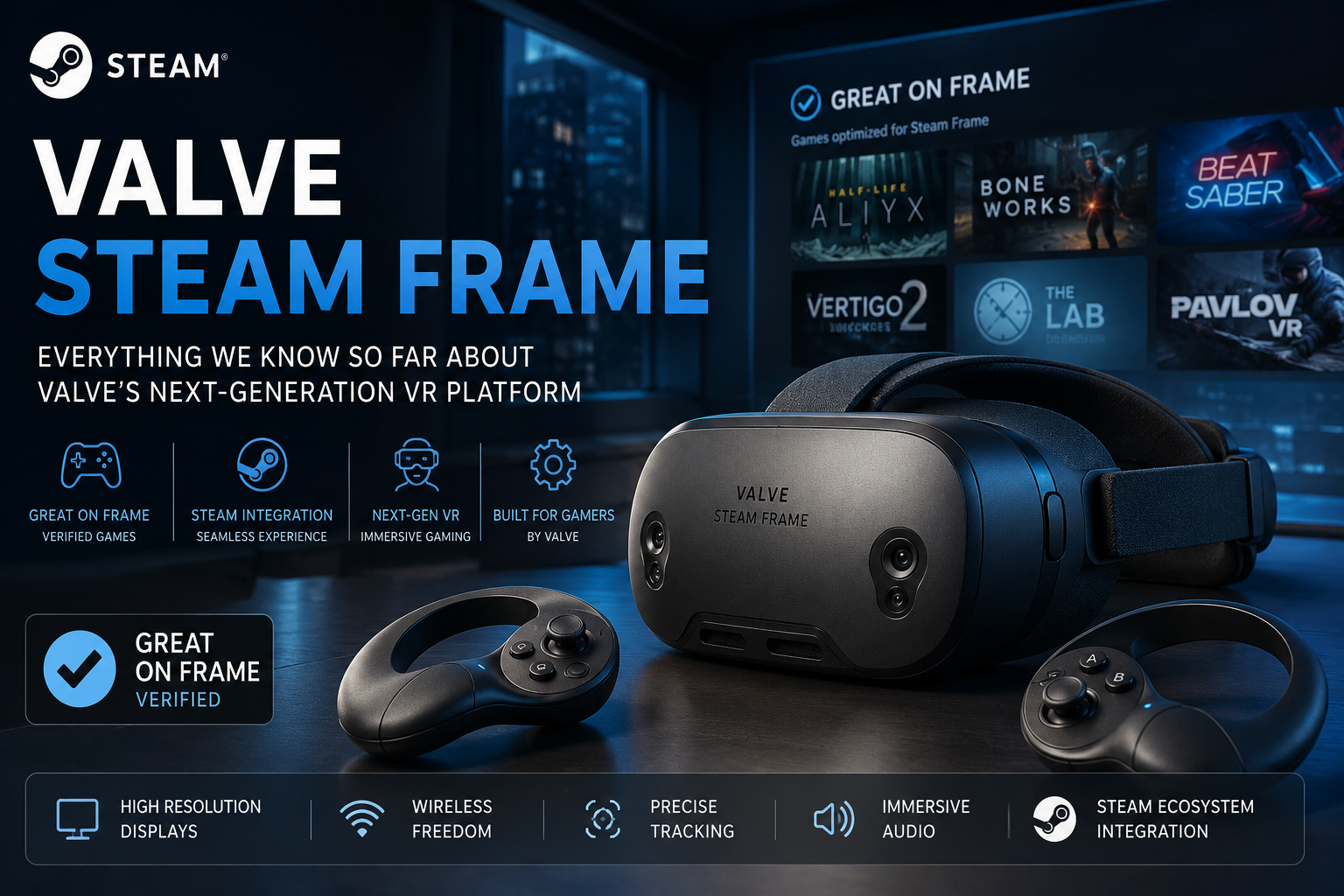

Valve Steam Frame: Everything We Know So Far About Valve’s Next-Generation VR Platform
valve steam frame Virtual reality has come a long way over the past decade. What was once considered an experimental technology has gradually become a serious platform for gaming, entertainment, education, fitness, and even professional work. While companies like Meta, Sony, HTC, and Pico have continued releasing new VR hardware, many PC gamers have been waiting for one company in particular to make its next move—Valve.
Valve has earned a reputation for creating products that prioritise user experience over marketing hype. From Steam, the world’s largest PC gaming platform, to the Steam Deck handheld gaming PC and the Valve Index headset, the company has consistently influenced the gaming industry in meaningful ways.
Now, attention has shifted toward Valve Steam Frame, a project that has generated enormous interest across the VR community. Although Valve has not officially revealed every detail, several recent developments—including new compatibility labels, verification programs, and Steam Store updates—strongly suggest that the company is preparing the ecosystem for its next-generation VR experience.
But what exactly is the Valve Steam Frame? Is it a new VR headset? How will it differ from existing devices? What does the new “Great on Frame” programme mean for gamers? And should PC gamers be excited?
This guide explores everything currently known about Valve Steam Framework while separating confirmed information from speculation. Whether you’re a long-time Steam user or someone considering your first VR headset, this article will help you understand why the gaming community is paying close attention.
What Is the Valve Steam Frame?
Valve SteamVR is widely believed to be Valve’s upcoming virtual reality platform designed to bring high-quality PC VR into a more modern, streamlined ecosystem.
Rather than simply releasing another headset, Valve appears to be building an entire experience that combines:
- Powerful VR hardware
- SteamOS integration
- Steam Store compatibility
- Game verification tools
- Improved user experience
- Better developer support
Instead of forcing players to guess whether a game works well on the device, Valve seems to be creating a system that clearly identifies compatible experiences before users purchase them.
This approach mirrors what Valve successfully introduced with the Steam Deck through its Steam Deck Verified program.
The goal appears simple:
Make VR easier, more reliable, and less confusing.
For years, one of the biggest frustrations in PC VR has been inconsistent compatibility. Some games perform flawlessly, while others require manual tweaking, community fixes, or controller remapping.
The Valve Steam Frame seems designed to reduce those frustrations.
Why Valve Is Returning to VR
Valve isn’t new to virtual reality.
The company helped shape modern PC VR with technologies that many developers still rely on today.
Its earlier contributions include the following:
- SteamVR
- Lighthouse tracking
- OpenVR
- Valve Index headset
- Advanced VR controllers
The Valve Index, released in 2019, quickly became one of the highest-rated premium VR headsets because of its
- Exceptional tracking
- High refresh rates
- Comfortable design
- Finger-tracking controllers
- Excellent visual quality
However, VR hardware has evolved dramatically since then.
Today’s users expect the following:
- Wireless connectivity
- Better displays
- Lighter headsets
- Longer battery life
- Easier setup
- Faster software updates
Valve now appears ready to modernise its VR platform to meet those expectations.
Why the Gaming Community Is Excited
Unlike many hardware companies that release new products every year, Valve typically spends years refining its ideas before launching them.
That slower approach has created a unique level of trust among PC gamers.
Whenever Valve prepares a new hardware release, expectations immediately rise because previous products have generally focused on long-term usability rather than short-term trends.
Several factors have fuelled excitement surrounding Valve Steam Frame:
1. Steam Already Powers PC Gaming
Steam remains the largest digital shopfront for PC games.
Millions of players already have:
- Existing game libraries
- Friends lists
- Achievements
- Cloud saves
- Workshop content
A Valve-built VR platform naturally fits within that ecosystem.
Instead of creating a separate marketplace, Steam Frame is expected to work alongside the platform users already know.
2. Steam Deck Changed Expectations
When the Steam Deck launched, many people questioned whether a handheld gaming PC could deliver a console-like experience.
Valve answered that challenge by introducing features such as the following:
- Steam Deck Verified
- Optimized controls
- Performance recommendations
- Compatibility ratings
Those improvements helped users understand exactly how games would perform before installation.
Many analysts believe Valve is now applying the same philosophy to VR.
3. Developers Benefit Too
A consistent compatibility system helps developers as much as players.
Instead of answering endless support questions about controller layouts or performance issues, developers can optimise their games for specific hardware targets.
That creates:
- Better reviews
- Happier players
- Fewer refunds
- Lower support costs
Everyone benefits from clearer compatibility standards.
Understanding the “Great on Frame” Program
One of the most interesting developments surrounding Valve Steam Frame is the appearance of a new compatibility label known as Great on Frame.
While simple on the surface, this feature could significantly improve how players discover VR games.
Instead of wondering whether a title will provide a good experience, users can immediately identify games that meet Valve’s compatibility standards.
The program appears designed to highlight games that deliver an excellent overall experience on Steam Deck hardware.
Although Valve has not publicly detailed every testing requirement, compatibility labels generally evaluate areas such as:
- Controller support
- Performance consistency
- User interface readability
- Comfort
- Stability
- Input compatibility
- Overall gameplay experience
For players, this means less guesswork before making a purchase.
Why Compatibility Labels Matter
Compatibility labels may sound like a small feature, but they solve one of VR’s biggest problems.
Imagine purchasing a VR game only to discover:
- Menus are difficult to read.
- Motion controls don’t work correctly.
- Performance constantly stutters.
- Button mappings feel awkward.
- Important features are missing.
These issues often lead to disappointment and refund requests.
A reliable compatibility programme helps users avoid those situations.
Instead of relying solely on reviews, players receive guidance directly from the platform itself.
Steam Frame Verification Explained
Another important addition is Valve’s expanding verification system.
Many gamers are already familiar with Steam Deck Verified.
Steam Frame appears to follow a similar philosophy.
Instead of simply asking:
“Does this game launch?”
Valve seems to evaluate the following:
- Does it control properly?
- Does it maintain expected performance?
- Is the interface usable?
- Does it provide a comfortable VR experience?
- Are important features fully supported?
Games meeting these standards can receive verification that gives players greater confidence before purchasing.
Possible Verification Categories
Although Valve hasn’t officially confirmed every category, a verification system could include assessments such as the following:
| Category | What It Could Evaluate |
|---|---|
| Performance | Stable frame rates |
| Controls | Proper VR controller support |
| Interface | Readable menus and HUD |
| Comfort | Motion experience |
| Tracking | Reliable controller tracking |
| Audio | Spatial audio compatibility |
| Setup | Easy initial configuration |
These evaluations make purchasing decisions much easier.
How Steam Frame Could Improve the Steam Store
Finding quality VR games can sometimes feel overwhelming.
Thousands of titles exist across different genres, quality levels, and hardware requirements.
Valve’s newer compatibility tools may simplify the shopping experience by allowing users to filter games based on:
- Verified compatibility
- Performance expectations
- Recommended hardware
- Supported controllers
- Player ratings
- Gameplay features
This makes it easier for newcomers to discover games that are more likely to provide a polished experience.
A Better Experience for First-Time VR Users
VR can still feel intimidating for people purchasing their first headset.
Questions often include:
- Will my PC run this game?
- Does my headset support it?
- Will the controls work?
- Is setup complicated?
- Will I experience motion sickness?
Valve’s growing compatibility ecosystem appears designed to answer many of those questions before users even click the Buy button.
That could make VR far more approachable for beginners.
How Valve’s Steam Frame Could Fit Into the Steam Ecosystem
One of Valve’s greatest strengths has always been ecosystem integration.
Instead of creating isolated products, Valve tends to build devices that naturally connect with existing Steam services.
If Steam Frame follows that philosophy, users may benefit from features such as the following:
Unified Game Library
Players could access their VR-compatible titles alongside traditional PC games without maintaining separate shopfronts.
Cloud Saves
Progress may sync automatically across supported devices, allowing users to continue their games without manually transferring files.
Friends and Social Features
Steam’s established friends list, chat system, multiplayer invites, and community features could remain fully integrated into the VR experience.
Workshop Support
For games that support mods, Steam Workshop integration could continue to provide easy access to community-created content, extending replay value for many VR titles.
Automatic Updates
Valve’s existing update infrastructure may ensure that games, drivers, and system software stay current with minimal user intervention.
Together, these features could help create a familiar experience for existing Steam users while lowering the learning curve for newcomers.
Why This Matters for the Future of PC VR
The virtual reality industry has matured significantly, but challenges remain. Hardware has improved, yet software consistency and user experience still vary from game to game.
Valve’s recent moves suggest the company isn’t just preparing new hardware—it is working toward a more reliable ecosystem where players can quickly identify games that deliver the best experience.
If successful, this approach could:
- Make buying VR games less confusing.
- Encourage developers to optimise their titles.
- Improve confidence for first-time VR buyers.
- Strengthen Steam’s position as the leading PC gaming platform.
- Raise the overall quality standard for PC VR experiences.
For gamers, that’s arguably just as important as introducing faster processors or sharper displays.
Valve Steam Frame: Everything We Know So Far About Valve’s Next-Generation VR Platform
Expected Hardware Features of Valve Steam Frame
Although Valve has not officially announced the complete specifications for Steam Frame, the company’s recent software preparations and industry discussions suggest that its next-generation VR platform is being designed with modern PC gaming expectations in mind.
Today’s VR users want more than just higher resolution. They expect a headset that is comfortable for long gaming sessions, easy to set up, and capable of delivering consistent performance without constant troubleshooting.
If Valve follows the design philosophy seen in products like the Steam Deck and Valve Index, Steam Frame is likely to prioritise the overall user experience rather than focusing on one standout specification.
Some of the areas enthusiasts expect Valve to improve include:
- Sharper displays
- Better optical lenses
- Lower overall weight
- Improved heat management
- More efficient power usage
- Faster software updates
- Easier controller pairing
- Better wireless capabilities
Rather than chasing marketing numbers, Valve has traditionally emphasised practical improvements that players notice during everyday use.
Display Technology Could Be a Major Upgrade
Display quality has become one of the most important aspects of any VR headset.
A clearer image improves immersion while also reducing eye strain during longer play sessions.
Modern VR displays generally focus on improving several areas:
Higher Resolution
Higher-resolution panels produce sharper text and cleaner visuals.
Benefits include:
- Easier menu navigation
- Better distant object visibility
- More detailed environments
- Reduced pixelation
Higher Refresh Rates
Refresh rate refers to how many times the display updates every second.
Higher refresh rates can provide:
- Smoother movement
- Better responsiveness
- Reduced motion blur
- More comfortable gameplay
Competitive VR games especially benefit from smoother visuals.
Improved Lens Design
The lenses inside a VR headset significantly influence image quality.
Modern lens improvements can reduce the following:
- Edge distortion
- Light glare
- Color fringing
- Blurry peripheral vision
Comfortable viewing often depends as much on the optics as the display itself.
Comfort Could Become a Bigger Priority
Anyone who has spent several hours in VR understands how important comfort can be.
A headset may have excellent specifications, but if it feels heavy or uncomfortable, players are less likely to use it regularly.
Valve has previously paid close attention to ergonomics, and many users hope Steam Frame continues that trend.
Possible comfort improvements may include:
- Better weight distribution
- Softer face cushions
- Improved ventilation
- Adjustable straps
- Balanced battery placement
- Reduced headset pressure
These seemingly small refinements can dramatically improve the overall experience.
Inside-Out vs. External Tracking
Tracking technology determines how accurately the headset and controllers detect movement.
There are generally two approaches used in VR systems.
External Tracking
This method relies on dedicated sensors placed around the room.
Advantages include:
- Extremely accurate positioning
- Reliable controller tracking
- Excellent room-scale performance
Possible drawbacks:
- Longer setup time
- Additional hardware
- Less portability
Inside-Out Tracking
Inside-out tracking uses cameras built directly into the headset.
Advantages include:
- Easier setup
- Portable design
- No external sensors required
Possible drawbacks:
- Tracking quality depends on lighting conditions.
- Certain controller positions may temporarily fall outside camera view.
Many modern headsets have adopted inside-out tracking because it simplifies the overall experience.
Valve’s final approach remains unconfirmed, but many gamers expect the company to balance precision with convenience.
Controller Design Could Continue Valve’s Innovation
The original Valve Index controllers introduced individual finger tracking, offering a more natural way to interact with virtual environments.
Future controllers could potentially expand on that concept by improving the following:
- Grip detection
- Trigger precision
- Battery efficiency
- Haptic feedback
- Hand comfort
- Wireless connectivity
More realistic hand interactions can make VR experiences feel significantly more immersive.
SteamOS Integration Could Be One of the Biggest Advantages
One of the most interesting aspects surrounding Valve’s Steam Frame is its potential integration with SteamOS.
SteamOS has evolved considerably since the launch of the Steam Deck.
Instead of acting as a traditional desktop operating system, SteamOS focuses on gaming first.
Potential benefits include the following:
- Faster boot times
- Simplified navigation
- Automatic updates
- Better hardware optimization
- Improved controller compatibility
A dedicated gaming operating system often reduces unnecessary background processes, allowing hardware resources to focus on gameplay.
Why SteamOS Matters
Operating systems play a larger role than many gamers realise.
Poor software optimisation can affect:
- Loading times
- Battery life
- System responsiveness
- Stability
- Driver compatibility
Valve controls both Steam and SteamOS, allowing the company to optimise software and hardware together.
That integration could help create a smoother VR experience than relying entirely on third-party operating systems.
Improved Game Discovery
As VR libraries continue growing, finding high-quality games becomes increasingly challenging.
Steam Frame’s compatibility system may help players quickly identify experiences that meet Valve’s recommended standards.
Potential filters could include:
| Filter | Purpose |
|---|---|
| Great on the frame | Optimized experience |
| Verified | Fully supported |
| Controller Support | Compatible controllers |
| Multiplayer | Online functionality |
| Seated Play | Comfortable seated gaming |
| Standing Play | Room-scale compatible |
These filters could reduce the amount of research players perform before purchasing games.
Better Support for Developers
Developers benefit when hardware expectations are clearly defined.
Instead of optimising for dozens of unknown hardware combinations, they can focus on meeting Valve’s published compatibility requirements.
Possible developer advantages include:
- Clear testing guidelines
- Better performance targets
- Easier certification
- Improved customer satisfaction
- Fewer compatibility complaints
A standardised platform generally creates a healthier ecosystem for both creators and players.
Wireless VR Could Become More Important
One of the biggest trends in recent VR hardware has been wireless gaming.
Removing cables improves immersion by allowing players to move naturally throughout virtual environments.
Wireless VR offers several advantages:
- Greater freedom of movement
- Cleaner gaming spaces
- Easier room-scale experiences
- Reduced cable management
However, wireless systems must also minimise the following:
- Input latency
- Signal interruptions
- Image compression
- Battery consumption
Valve’s experience with networking and software optimisation may help address these challenges.
Performance optimisation matters more than raw power.
Consumers often focus on processor specifications.
In practice, software optimisation frequently has a greater impact on the user experience.
Valve has repeatedly demonstrated that efficient software can maximise existing hardware capabilities.
Performance optimisation involves areas such as the following:
- Frame consistency
- Memory management
- Graphics scaling
- Background process reduction
- Driver optimization
Stable gameplay often feels better than occasional bursts of maximum performance.
Graphics Quality in Modern VR
Graphics continue improving every generation, but VR presents unique technical challenges.
The system must render separate images for each eye while maintaining high frame rates.
Future improvements could include:
- Better lighting
- Sharper textures
- Improved shadows
- Advanced reflections
- Enhanced environmental detail
At the same time, maintaining smooth performance remains essential.
Valve has historically balanced visual quality with gameplay stability.
Audio Could Remain a Signature Feature
Audio plays a larger role in VR than many new users expect.
Directional sound helps players understand where objects, enemies, or teammates are located.
Valve previously received praise for the off-ear speaker design used in the Valve Index.
Potential audio improvements may include:
- Better spatial positioning
- Richer bass response
- Improved microphone quality
- Reduced sound leakage
- Enhanced voice communication
Good audio contributes significantly to immersion without requiring players to wear separate headphones.
Accessibility Features Could Expand
Gaming has become increasingly inclusive over the past several years.
Modern VR platforms benefit from accessibility options that accommodate different player needs.
Useful accessibility features may include:
- Adjustable text size
- One-handed control options
- Color adjustments
- Motion comfort settings
- Subtitle customization
- Controller remapping
Providing more customisation helps a broader range of players enjoy VR comfortably.
How Valve’s Steam Frame Could Compare to Other VR Platforms
The VR market already includes several well-known options, each with its own strengths. While official specifications for the Valve Steam Deck remain under wraps, it is helpful to compare the platform’s expected direction with existing devices.
| Feature | Valve Steam Frame (Expected) | Standalone VR Headsets | Console VR Systems |
|---|---|---|---|
| Primary Focus | PC VR ecosystem | Standalone gaming | Console gaming |
| Game Library | Steam ecosystem | Platform-specific | Console-exclusive |
| Compatibility Labels | Expected | Limited | Limited |
| Steam Integration | Native | No | No |
| PC Gaming Support | Expected | Varies | Limited |
| Developer Ecosystem | Steam-based | Platform-specific | Console-based |
This comparison is based on Valve’s ecosystem strategy rather than confirmed hardware specifications.
Why Existing Steam Users May Benefit the Most
Millions of gamers already use Steam daily.
For these users, Steam Frame could provide a familiar experience without requiring them to build a new game library from scratch.
Potential benefits include the following:
- Existing Steam account
- Familiar user interface
- Friends list integration
- Cloud saves
- Community discussions
- Achievements
- Wishlist support
That continuity could make switching to VR much easier than joining an entirely new ecosystem.
The Importance of Long-Term Software Support
Hardware is only one part of a successful gaming platform.
Regular software updates can extend a device’s lifespan by improving stability, adding new features, and optimising performance over time.
Valve has shown a strong commitment to supporting its products through ongoing updates. Steam itself receives frequent improvements, and Steam Deck users have benefited from continuous enhancements since launch.
If Steam Frame follows a similar path, users may see the following:
- New compatibility updates
- Expanded game verification
- Performance improvements
- Bug fixes
- Interface refinements
- Additional quality-of-life features
Long-term support is often a deciding factor for gamers investing in premium hardware.
Why Valve’s Ecosystem Strategy Stands Out
Many technology companies build hardware first and improve the software later.
Valve has often taken the opposite approach by strengthening the surrounding ecosystem before introducing new products.
Recent additions such as compatibility labels and expanded verification suggest that Valve is preparing the Steam platform itself—not just the hardware.
This ecosystem-first strategy could make the transition to Steam Frame smoother for both players and developers.
Instead of launching with a fragmented experience, Valve appears focused on ensuring that games, shopfront tools, and compatibility information work together from day one.
Valve Steam Frame: Everything We Know So Far About Valve’s Next-Generation VR Platform
Expected Release Date for Valve Steam Frame
One of the biggest questions surrounding Valve Steam Frame is simple:
When will it actually launch?
At the time of writing, Valve has not officially announced a final release date for Steam Frame. However, recent updates to the Steam platform—including the introduction of the “Great on Frame” compatibility program and new game verification labels—suggest that Valve is actively preparing its software ecosystem before the hardware becomes available.
Historically, Valve has preferred to reveal products only after much of the development work is complete. Rather than announcing hardware years in advance, the company typically focuses on polishing the product and supporting software before making it widely available.
This cautious approach has helped Valve avoid many of the launch issues that affect first-generation hardware from other manufacturers.
Although the exact launch window remains unknown, many industry observers believe that the recent Steam Store updates are an indication that the project is moving closer to public release.
Why Valve Takes Its Time
Valve has never been known for rushing hardware.
Instead, the company generally prioritises the following:
- Software stability
- Long-term reliability
- Ecosystem readiness
- User experience
- Developer support
This strategy often results in longer development cycles, but it also allows Valve to refine products before they reach consumers.
For VR enthusiasts, that could mean a more polished experience on launch day.
Expected Pricing
Valve has not confirmed pricing for Steam Frame.
Because the hardware specifications remain officially undisclosed, any specific price estimate would be speculation.
Several factors will likely influence the final cost:
- Display technology
- Processing hardware
- Controller design
- Wireless capabilities
- Included accessories
- Manufacturing costs
- Regional availability
Rather than focusing on the lowest possible price, Valve has historically aimed to deliver strong value relative to the features offered.
As more official information becomes available, prospective buyers will be able to compare Steam Frame with other premium VR options on the market.
What Games Could Be Available?
The success of any gaming platform depends largely on its software library.
One of Steam Frame’s biggest strengths is the possibility of integrating with the existing Steam ecosystem.
Steam already offers thousands of VR-compatible titles across a wide range of genres, including:
- Action
- Adventure
- Racing
- Flight simulation
- Sports
- Horror
- Puzzle
- Educational experiences
- Social VR
- Rhythm games
If Valve continues expanding compatibility through its verification programme, players may find it easier to identify games that provide the best overall experience on Steam Frame.
How the “Great on Frame” Label Could Help Players
Buying VR games can sometimes feel uncertain.
Screenshots and trailers do not always reveal how well a title performs on specific hardware.
The Great on Frame label could simplify that process by helping users identify games that meet Valve’s recommended standards.
Potential benefits include the following:
- Greater purchasing confidence
- Less time researching compatibility
- Fewer unexpected technical issues
- Better overall user satisfaction
For new VR users, this guidance could make entering the ecosystem much less intimidating.
Who Should Consider Buying the Valve Steam Deck?
Steam Frame may appeal to several different types of gamers.
PC Gaming Enthusiasts
Players who already use Steam regularly may appreciate having their VR experience integrated into the platform they already know.
Existing VR Owners
Users looking to upgrade older hardware may be interested in improved compatibility, software optimisation, and ecosystem integration.
First-Time VR Buyers
If Valve succeeds in simplifying setup and game discovery, Steam Frame could become an attractive option for people purchasing their first VR headset.
Developers
Developers may benefit from standardised compatibility testing and clearer optimisation targets, making it easier to deliver consistent experiences.
Who Might Want to Wait?
Although excitement is growing, waiting can sometimes be the smarter decision.
You may prefer to hold off if:
- You already own a VR headset that meets your current needs.
- You’re waiting for official specifications.
- You’re comparing multiple VR platforms.
- Pricing will influence your buying decision.
- You prefer reading long-term user reviews before purchasing.
Being patient allows buyers to make informed decisions once all official information is available.
Potential Advantages of Valve Steam Frame
Based on Valve’s recent direction and ecosystem updates, Steam Frame could offer several strengths.
1. Strong Steam Integration
Native access to the Steam ecosystem could create a seamless experience for existing PC gamers.
2. Improved Compatibility Information
Verification labels may reduce confusion when purchasing VR games.
3. Developer-Friendly Platform
Clear compatibility standards can help developers optimise games more efficiently.
4. Familiar User Experience
Millions of Steam users already understand the platform, reducing the learning curve.
5. Long-Term Software Updates
Valve has a strong history of improving software through regular updates.
Potential Challenges
No hardware launch is without challenges.
Possible hurdles could include:
- Competition from established VR platforms.
- Hardware pricing.
- Meeting high community expectations.
- Expanding the verified game catalogue.
- Ensuring smooth performance across diverse PC configurations.
Addressing these areas will be important for Steam Frame’s long-term success.
How Valve’s Steam Frame Could Influence the VR Industry
Whether Steam Frame becomes a massive commercial success or simply introduces new ideas, its impact may extend beyond one device.
If Valve’s compatibility initiatives prove effective, other companies could adopt similar systems.
That may encourage improvements across the entire VR industry, including:
- Better game optimization
- Clearer purchasing information
- Improved developer tools
- More consistent performance standards
- Enhanced user confidence
Healthy competition often benefits everyone.
Buying Tips Before Steam Frame Launches
If you’re considering purchasing Steam Frame after release, it’s worth preparing ahead of time.
Check Your PC Hardware
Ensure your system meets the expected performance requirements for modern VR gaming.
Review Your Available Space
Room-scale VR experiences require sufficient physical space for safe movement.
Monitor Official Announcements
Specifications, pricing, supported features, and availability should always be confirmed through Valve’s official channels.
Compare Multiple Options
Evaluate Steam Frame alongside other VR platforms to determine which best matches your gaming preferences and budget.
Quick Comparison Checklist
| Question | Why It Matters |
|---|---|
| Do you already use Steam? | Easier ecosystem integration |
| Do you primarily play PC games? | Steam Frame appears focused on PC VR |
| Are verified games important to you? | Compatibility labels reduce uncertainty |
| Do you value software updates? | Valve regularly improves its platforms |
| Will wireless features matter? | Consider your preferred play style |
Pros and Cons
| Pros | Cons |
|---|---|
| Strong Steam ecosystem integration | Official specifications are still limited |
| Game verification program | Release date not yet confirmed |
| Improved game discovery | Final pricing unknown |
| Developer-friendly platform | Hardware details remain undisclosed |
| Potential long-term software support | Early availability may vary by region |
Expert Perspective
Valve has rarely competed by simply matching industry trends.
Instead, the company often identifies areas where the user experience can be improved and builds solutions around those problems.
The introduction of compatibility labels and verification programmes suggests that Valve recognises one of VR’s biggest challenges: uncertainty.
Players want confidence that their games will work well.
Developers want clearer standards.
Steam Frame appears to address both.
Rather than focusing solely on raw hardware specifications, Valve seems to be investing in the surrounding ecosystem—an approach that could make VR more approachable for a broader audience.
Frequently Asked Questions (FAQs)
What is the Valve Steam Frame?
Valve Steam Frame is an upcoming VR-focused platform from Valve that appears to combine new hardware with enhanced Steam integration, compatibility labels, and game verification features. While many details remain unconfirmed, Valve is preparing the Steam ecosystem to support the platform.
Is Valve Steam Framework officially released?
No. As of now, Valve has not announced an official public release date for Steam Frame.
What is “Great on Frame”?
“Great on Frame” is a compatibility label that highlights games expected to provide an excellent experience on the Steam Deck platform, helping players identify optimised titles more easily.
Will Steam Frame support existing Steam games?
Steam already offers a large library of VR titles. Valve’s verification system is expected to help users identify games that work particularly well with Steam Frame.
Will Steam Frame replace the Valve Index?
Valve has not made any official announcement regarding the future of the Valve Index. Steam Frame should currently be viewed as a separate upcoming platform until Valve confirms additional details.
Is SteamFrame designed for beginners?
Based on recent platform updates, Valve appears to be making VR more accessible by improving compatibility information, game discovery, and the overall purchasing experience.
Should I wait for Steam Frame before buying another VR headset?
That depends on your needs. If you’re happy with your current setup, waiting for official specifications, pricing, and reviews may help you make a more informed decision.
Final Thoughts
Valve’s Steam Frame is shaping up to be one of the most closely watched developments in the PC VR space. Although many hardware details remain under wraps, Valve’s recent ecosystem updates—particularly around game compatibility and verification—show a clear commitment to improving the overall VR experience rather than focusing solely on hardware specifications.
For existing Steam users, the platform could provide a familiar environment with easier game discovery, stronger compatibility guidance, and long-term software support. For newcomers, it has the potential to lower the barriers that have traditionally made PC VR feel complex.
Until Valve shares official information about specifications, pricing, and availability, the smartest approach is to separate confirmed announcements from speculation. What is already clear, however, is that Valve is investing in the foundation of its next-generation VR ecosystem—and that foundation could play a significant role in shaping the future of PC virtual reality.