
Steam Machine: The Ambitious Bridge Between PC Gaming and Console Simplicity
Introduction
The gaming industry has long been divided between two major camps: PC gamers who value flexibility and performance, and console gamers who prefer convenience and simplicity. For years, manufacturers have tried to create a product that combines the strengths of both worlds without inheriting their weaknesses. The concept of a Steam Machine emerged from this challenge.
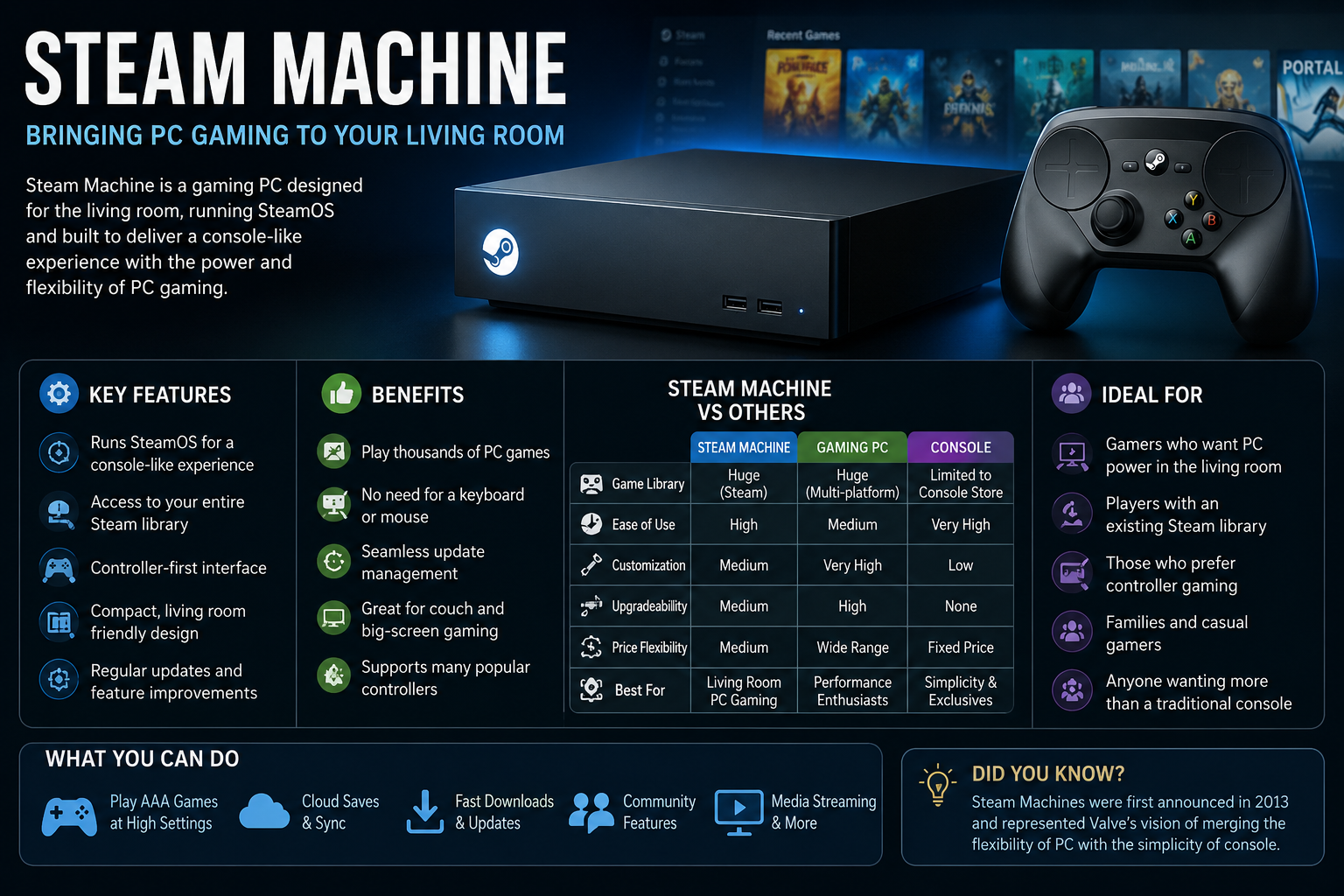
A Steam Machine is designed to offer a console-like experience while retaining many advantages associated with PC gaming. Instead of requiring users to build a gaming rig, install numerous drivers, manage complex settings, or sit at a desk, the Steam Machine aims to bring PC gaming into the living room in a more approachable format.
The idea is simple but powerful: allow players to access a vast PC game library from a compact device connected to a television, controlled primarily with a gamepad rather than a keyboard and mouse.
While the concept has evolved over time, interest in Steam Machines continues to grow as gaming hardware becomes more versatile and players seek alternatives to traditional gaming ecosystems.
This guide explores everything you need to know about Steam Machines, including their history, technology, advantages, challenges, gaming performance, future potential, and whether they represent the next major evolution in gaming.
What Is a Steam Machine?
A Steam Machine is a gaming-focused computer designed around Steam, one of the world’s largest digital gaming platforms.
Unlike a traditional gaming PC, a Steam Machine prioritises ease of use. The goal is to provide an experience that feels similar to turning on a console while maintaining access to PC gaming features.
Key characteristics often include the following:
- Compact form factor
- Living-room-friendly design
- Controller-first navigation
- Access to a large digital game library
- Support for modern gaming hardware
- Simplified software environment
- Reduced setup complexity
In essence, a Steam Machine attempts to answer a question many gamers have asked for years:
“Can PC gaming be as simple as console gaming?”
The Origins of the Steam Machine Concept
Why the Idea Was Created
Traditional gaming PCs offer enormous flexibility, but they can be intimidating for many users.
Common barriers include:
- Hardware compatibility concerns
- Driver updates
- System maintenance
- Component upgrades
- Technical troubleshooting
Meanwhile, consoles offer:
- Simplicity
- Predictable performance
- Easy setup
- Controller-based navigation
The Steam Machine concept emerged as an attempt to combine these strengths.
The vision was not to replace gaming PCs entirely. Instead, it sought to create a middle ground where users could enjoy PC gaming without feeling overwhelmed by technical complexity.
How Steam Machines Differ From Traditional PCs
Although Steam Machines are technically computers, their design philosophy differs significantly from standard gaming desktops.
| Feature | Steam Machine | Traditional Gaming PC |
|---|---|---|
| Setup Simplicity | High | Moderate |
| Controller Support | Primary Focus | Secondary |
| Living Room Use | Excellent | Depends on Setup |
| Upgradability | Limited to Moderate | Extensive |
| User Customization | Moderate | Very High |
| Ease of Navigation | Console-Like | Desktop-Oriented |
| Maintenance Requirements | Lower | Higher |
The primary distinction lies in user experience.
A gaming PC focuses on flexibility.
A Steam Machine focuses on accessibility.
The Importance of SteamOS
One of the most important elements behind the Steam Machine ecosystem is SteamOS.
SteamOS is designed specifically for gaming and aims to reduce unnecessary operating system overhead.
Benefits may include:
- Faster access to games
- Cleaner interface
- Controller-friendly navigation
- Reduced background processes
- Improved living-room usability
Instead of feeling like a traditional desktop computer, SteamOS attempts to create an environment centred entirely around gaming.
For many users, this software experience is what truly defines a Steam Machine.
Why Gamers Are Interested in Steam Machines
Several trends have fuelled renewed interest in Steam Machines.
1. Growing PC Game Libraries
Many gamers own hundreds of digital titles accumulated over years.
A Steam Machine offers a convenient way to access these libraries from a television without moving a desktop PC.
2. Rising Console Costs
Modern consoles are becoming increasingly expensive.
As hardware prices rise, some gamers begin considering alternatives that provide broader functionality.
3. Cross-Platform Gaming
Many players want flexibility across devices.
A Steam Machine can complement laptops, handheld systems, and desktops while maintaining access to the same game collection.
4. Controller-Based PC Gaming
Controller support has improved dramatically.
Many modern PC games now provide console-quality controller experiences, making a living-room-focused PC increasingly practical.
Key Hardware Components of a Steam Machine
Although configurations vary, Steam Machines generally rely on several critical components.
Processor (CPU)
The processor handles game logic, physics calculations, AI behaviour, and overall system responsiveness.
A stronger CPU generally leads to the following:
- Better frame rates
- Faster loading
- Improved multitasking
Graphics Processor (GPU)
The GPU is responsible for rendering visual content.
Gaming performance often depends heavily on graphics capability.
A powerful GPU enables the following:
- Higher resolutions
- Better textures
- Ray tracing support
- Higher frame rates
Memory (RAM)
RAM affects multitasking and game responsiveness.
Modern gaming systems typically benefit from generous memory capacity, especially when running demanding titles.
Storage
Fast storage improves the following:
- Boot times
- Loading screens
- Game installation speeds
- System responsiveness
Solid-state drives have become increasingly important for modern gaming experiences.
Steam Machine vs Console
One of the most common comparisons involves Steam Machines and consoles.
Advantages Over Consoles
Larger Game Library
PC platforms typically offer access to a wider variety of games.
Frequent Discounts
Digital marketplaces often feature aggressive sales.
Mod Support
Many PC games support user-created content.
Flexible Hardware
Some Steam Machines offer upgrade opportunities unavailable on consoles.
Productivity Potential
Unlike a traditional console, a Steam Machine may support additional computing tasks.
Advantages of Consoles
Lower Entry Cost
Consoles often launch at competitive prices.
Exclusive Games
Some titles remain tied to specific ecosystems.
Consistent Hardware
Developers can optimise specifically for one configuration.
Simplicity
Console experiences remain extremely streamlined.
Steam Machine vs Gaming PC
This comparison often depends on user priorities.
Choose a Steam Machine If:
- You want simplicity.
- You play primarily with controllers.
- You game in the living room.
- You dislike system maintenance.
- You want a console-like experience.
Choose a Gaming PC If:
- You need maximum performance.
- You enjoy customisation.
- You upgrade frequently.
- You use keyboard and mouse extensively.
- You perform productivity tasks.
Gaming Performance Expectations
Performance depends on hardware specifications, game optimisation, and display settings.
Factors affecting performance include:
- Resolution
- Texture quality
- Ray tracing settings
- Upscaling technologies
- CPU capability
- GPU capability
Modern gaming hardware increasingly relies on intelligent rendering techniques that improve frame rates while preserving visual quality.
As a result, many compact systems can deliver impressive gaming experiences despite relatively small physical footprints.
The Role of Controller-Centric Design
A major challenge in bringing PC gaming to televisions involves navigation.
Traditional PC interfaces assume the following:
- Keyboard input
- Mouse control
- Desktop usage
Steam Machines attempt to solve this problem through controller-first design.
Benefits include:
- Couch-friendly gaming
- Faster navigation
- Reduced complexity
- Better accessibility
This design philosophy helps make PC gaming approachable for a broader audience.
Benefits of a Living Room Gaming PC
Many players prefer gaming on large displays.
A Steam Machine is particularly appealing because it combines the following:
- Big-screen gaming
- PC game access
- Comfortable seating
- Simplified setup
For families and shared households, this can create a more social gaming experience compared to a desk-bound computer.
Common Challenges Facing Steam Machines
Despite their advantages, Steam Machines face several challenges.
Pricing Pressure
Balancing performance and affordability remains difficult.
Gamers often compare the following:
- Steam Machines
- Consoles
- Gaming laptops
- Custom PCs
Price comparisons can heavily influence purchasing decisions.
Market Positioning
Some consumers struggle to understand where Steam Machines fit.
Questions often include:
- Is it a console?
- Is it a PC?
- Is it both?
Clear messaging is essential.
Game Compatibility
Not every PC game is designed equally.
Controller support varies.
Optimisation varies.
User expectations must align with software capabilities.
The Appeal of Open Gaming Ecosystems
One of the strongest arguments in favour of Steam Machines is openness.
Open ecosystems often provide the following:
- More software freedom
- Broader hardware compatibility
- Greater user control
- Wider storefront access
Many gamers appreciate the flexibility associated with open platforms.
Who Should Buy a Steam Machine?
The ideal Steam Machine owner may be
Casual PC Gamers
Players who want PC gaming without complexity.
Console Players Seeking More Freedom
Users interested in larger game libraries and flexible ecosystems.
Living Room Enthusiasts
Gamers who prefer couch-based experiences.
Existing Steam Users
Players with extensive digital libraries.
Families
Households seeking a shared gaming device.
Steam Machine Use Cases
Single-Player Gaming
Ideal for immersive story-driven experiences.
Multiplayer Gaming
Supports online and local multiplayer experiences.
Family Entertainment
Can serve as a shared gaming platform.
Media Consumption
May also function as an entertainment hub.
Indie Gaming
Excellent access to independent titles unavailable on many consoles.
Advantages of Digital Game Ownership
Digital libraries provide several benefits:
- Instant access
- Cloud synchronization
- Remote downloads
- Frequent discounts
- Reduced physical storage requirements
Steam Machines leverage these strengths effectively.
Future Technologies That Could Benefit Steam Machines
Several emerging technologies may strengthen future Steam Machine designs.
AI-Assisted Rendering
Improves image quality and performance.
Advanced Upscaling
Enables higher resolutions with lower hardware demands.
Improved Storage Solutions
Faster loading experiences.
Cloud Integration
Enhanced flexibility across devices.
Better Controller Interfaces
More intuitive navigation systems.
Why the Steam Machine Concept Remains Relevant
Even as gaming hardware evolves, the core challenge remains unchanged:
People want powerful gaming experiences without unnecessary complexity.
Steam Machines continue to represent a compelling attempt to bridge this gap.
The demand for:
- Simplicity
- Performance
- Flexibility
- Accessibility
is stronger than ever.
As gaming becomes more mainstream, products that reduce technical barriers may become increasingly important.
Steam Machine Buying Checklist
Before purchasing, consider the following:
Hardware Performance
- CPU capability
- GPU capability
- Memory amount
- Storage size
Software Experience
- Operating system
- Controller support
- Interface quality
Game Library
- Preferred genres
- Compatibility needs
- Existing purchases
Budget
- Initial purchase cost
- Accessory requirements
- Long-term value
Frequently Asked Questions
What is a Steam Machine?
A Steam Machine is a gaming-focused computer designed to provide a console-like experience while maintaining access to PC gaming features and digital game libraries.
Is a Steam Machine a console?
Not exactly. It combines characteristics of both consoles and PCs, creating a hybrid gaming experience.
Can a Steam Machine replace a gaming PC?
For many gamers, yes. However, advanced users who require extensive customisation may still prefer a traditional gaming PC.
Do Steam Machines support controllers?
Yes. Controller support is a central part of the Steam Machine experience.
Are Steam Machines good for living-room gaming?
Absolutely. Their design is specifically intended for television-based gaming environments.
Can I play PC games on a Steam Machine?
That is one of its primary purposes. Steam Machines are built around access to PC gaming libraries.
Are Steam Machines beginner-friendly?
Generally yes. They are designed to reduce the complexity associated with traditional gaming PCs.
Will Steam Machines become more popular?
Their future depends on pricing, performance, software support, and consumer demand, but the concept continues to attract significant interest.
Final Thoughts
The Steam Machine represents one of the most interesting ideas in modern gaming. Rather than forcing players to choose between the flexibility of a PC and the convenience of a console, it attempts to combine the best aspects of both.
Its appeal lies not only in hardware specifications but also in its philosophy. The goal is to make PC gaming more accessible, more comfortable, and more approachable for everyday players.
Whether the Steam Machine ultimately becomes a dominant platform or remains a specialised alternative, its influence on the gaming industry is undeniable. The growing popularity of controller-first interfaces, living-room gaming experiences, and streamlined PC ecosystems demonstrates that the vision behind the Steam Machine continues to resonate with gamers around the world.
For players who want powerful gaming without unnecessary complexity, the Steam Machine remains a fascinating glimpse into the future of interactive entertainment.