
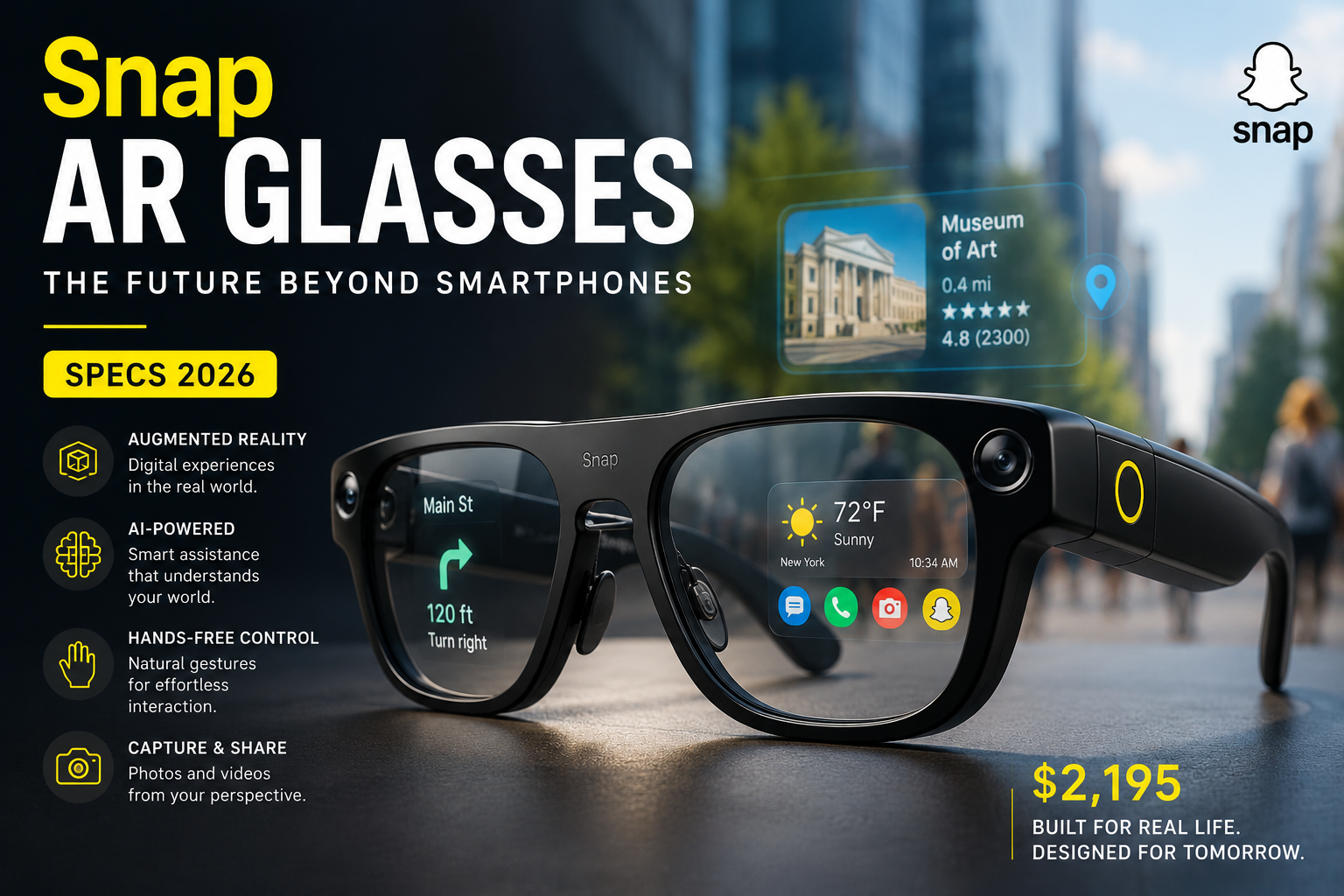

Snap AR Glasses: Can Snap’s New Specs Replace Smartphones in the AI Era?
Meta Title: Snap AR Glasses: Everything to Know About Snap Specs in 2026
Meta Description: Discover how Snap AR Glasses, called Specs, are changing augmented reality with AI, immersive experiences, and a bold vision beyond smartphones.
Focus Keyword: Snap AR Glasses
Secondary Keywords: Snap Specs, augmented reality glasses, AI smart glasses, Snap Specs 2026, AR wearable technology, future of smartphones, Snapchat AR glasses, smart glasses with AI
Snap AR Glasses: A Bold Vision for the Future of Computing
For nearly two decades, smartphones have been the center of our digital lives. We use them for communication, navigation, entertainment, shopping, work, and countless daily tasks. However, technology companies are increasingly exploring what comes after the smartphone.
One of the most ambitious attempts comes from Snap, the company behind Snapchat. In 2026, Snap officially introduced its consumer-focused augmented reality glasses known as Specs, marking a significant step toward wearable computing.
Unlike traditional smart glasses that primarily focus on photography or voice commands, Snap AR Glasses aim to blend digital information directly into the physical world. The company believes future computing experiences should be more natural, less distracting, and integrated into everyday life.
The launch has generated considerable attention because of its advanced technology, premium design ambitions, artificial intelligence capabilities, and a price tag of approximately $2,195. While many consumers are intrigued, others wonder whether these glasses represent the next computing revolution or simply another experimental gadget.
This article explores everything you need to know about Snap AR Glasses, including their features, technology, competitive position, potential impact, challenges, and what they may mean for the future of personal computing.
What Are Snap AR Glasses?
Snap AR Glasses, branded as Specs, are wearable augmented reality devices designed to overlay digital content onto the user’s view of the real world.
Instead of staring at a smartphone screen, users can see information directly through the lenses while remaining aware of their surroundings.
The glasses function as a standalone computing platform and are designed to support:
- Augmented reality experiences
- Artificial intelligence assistance
- Navigation
- Communication tools
- Interactive applications
- Entertainment experiences
- Productivity features
- Content creation
The idea is simple but powerful: bring digital experiences into the real world rather than pulling users into a screen.
Understanding Augmented Reality
Before discussing specs in detail, it’s important to understand augmented reality.
Augmented reality (AR) is a technology that places digital objects, information, or experiences on top of the physical world.
Examples include:
- Digital directions appearing on streets
- Virtual furniture displayed in your living room
- Interactive educational content
- Real-time language translation
- Sports performance guidance
- AI-generated information about objects you see
Unlike virtual reality (VR), which creates a completely digital environment, augmented reality enhances the real world instead of replacing it.
This distinction is central to Snap’s strategy.
The company believes people want technology that helps them engage with reality rather than escape from it.
The Evolution of Snap’s AR Journey
Snap’s investment in wearable technology did not happen overnight.
The company has spent years developing camera-based experiences and augmented reality technologies.
Its journey began with:
Early Snapchat Filters
Snap popularized face filters and interactive lenses, making augmented reality accessible to millions of users.
Spectacles
The company later launched Spectacles, smart glasses primarily focused on capturing photos and videos.
Although these devices generated attention, they never achieved mainstream adoption.
Developer-Focused AR Glasses
Subsequent generations introduced more advanced AR capabilities and were made available to developers and creators.
These versions allowed Snap to test technologies, gather feedback, and improve hardware.
Arrival of Consumer Specs
The launch of Specs represents Snap’s transition from experimental devices to a consumer-focused AR platform.
It is the culmination of years of research, software development, and hardware innovation.
Key Features of Snap AR Glasses
One reason Snap AR Glasses have attracted attention is their combination of multiple advanced technologies in a wearable form.
Let’s examine the major features.
Immersive Augmented Reality Display
The glasses feature transparent lenses capable of displaying digital content directly within the user’s field of view.
This allows virtual objects to appear naturally integrated into the surrounding environment.
Possible applications include:
- Navigation overlays
- Virtual workspaces
- Educational content
- Interactive gaming
- Real-time information displays
The goal is to make digital interactions feel more natural and less disruptive.
AI-Powered Assistance
Artificial intelligence is one of the biggest selling points of modern wearable devices.
Snap AR Glasses are designed to integrate AI-powered capabilities that can help users
- Answer questions
- Identify objects
- Provide contextual information
- Assist with tasks
- Generate recommendations
- Improve productivity
As AI technology continues advancing, these features could become increasingly valuable.
Hand Tracking and Gesture Controls
Instead of relying entirely on physical buttons, users can interact with the system through natural hand movements.
This creates a more intuitive experience.
Potential actions include:
- Selecting items
- Opening applications
- Manipulating virtual objects
- Drawing in space
- Navigating menus
Gesture-based interactions are expected to play a major role in future AR computing.
Spatial Computing Experiences
Spatial computing refers to technology that understands the user’s environment and places digital elements within physical space.
Snap AR Glasses support experiences where digital content remains anchored to real-world locations.
Examples include:
- Virtual whiteboards
- Collaborative workspaces
- Interactive games
- Educational simulations
This approach creates experiences that feel significantly more immersive than smartphone applications.
Video Capture Capabilities
Like previous Spectacles products, Specs include camera functionality.
Users can capture:
- Photos
- Videos
- First-person perspectives
- AR-enhanced content
This capability aligns naturally with Snap’s social media ecosystem.
Design and Comfort
One of the biggest challenges in wearable technology is balancing functionality with comfort.
Many advanced AR devices become bulky because of the following:
- Batteries
- Sensors
- Processors
- Displays
Snap claims its engineering efforts focused heavily on reducing size and weight while maintaining performance.
The result resembles oversized sunglasses rather than a traditional headset.
Although still larger than standard eyewear, the design attempts to make daily use more practical.
This is important because consumer adoption depends heavily on comfort and aesthetics.
People are unlikely to wear AR glasses regularly if they feel awkward or uncomfortable.
Battery Life Expectations
Battery technology remains one of the largest obstacles for wearable devices.
Advanced AR experiences require significant processing power.
Snap AR Glasses reportedly offer around four hours of operation before needing a recharge.
While this may not sound impressive compared to smartphones, it reflects the power demands of augmented reality systems.
The device includes a charging case that can extend usage throughout the day.
Future generations will likely focus heavily on battery improvements.
Why Snap Believes AR Glasses Are the Future
Snap’s leadership has repeatedly emphasized a vision that extends beyond smartphones.
The company’s argument is based on several observations.
Smartphones Create Constant Distractions
People spend hours every day looking at screens.
Notifications, messages, and social media often pull attention away from real-world experiences.
AR glasses could reduce this problem by presenting information more naturally.
Information Should Be Contextual
Instead of opening an app and searching for information, users could receive relevant details instantly based on what they are seeing.
This creates a more seamless interaction model.
Hands-Free Computing Is More Natural
Many tasks become easier when users do not need to hold a phone.
Examples include:
- Walking
- Cooking
- Exercising
- Repair work
- Shopping
Hands-free access could become a major advantage.
AI and AR Are a Powerful Combination
Artificial intelligence becomes significantly more useful when combined with visual context.
An AI assistant that can see what you see may provide better assistance than one limited to text input.
This combination could become one of the defining trends of future technology.
How Snap AR Glasses Compare to Meta Smart Glasses
Meta is currently one of Snap’s biggest competitors in wearable technology.
Meta’s smart glasses have gained attention due to their partnership with Ray-Ban.
Meta’s Strengths
- Strong brand recognition
- Lower pricing
- Growing AI ecosystem
- Fashion-focused design
Snap’s Strengths
- Full augmented reality capabilities
- More immersive experiences
- Strong AR development platform
- Deep expertise in camera technology
The key difference is that Snap focuses more heavily on true augmented reality rather than basic smart-glasses functionality.
Snap AR Glasses vs Apple Vision Pro
Many comparisons are also being made between Specs and Apple’s Vision Pro.
Apple Vision Pro
Advantages:
- Extremely powerful hardware
- Premium ecosystem
- Advanced spatial computing
Challenges:
- Expensive
- Heavy
- Less portable
Snap Specs
Advantages:
- More wearable design
- Lightweight form factor
- Designed for daily use
Challenges:
- Smaller ecosystem
- Limited battery life
- Higher consumer skepticism
Both companies are approaching the same future from different directions.
The Role of AI in Snap Specs
Artificial intelligence is becoming the foundation of modern computing.
For AR glasses, AI helps bridge the gap between the physical and digital worlds.
Potential use cases include:
Real-Time Object Recognition
The system can identify objects and provide useful information instantly.
Navigation Assistance
Directions can appear directly within the user’s field of view.
Language Translation
Future versions may translate signs, menus, and conversations in real time.
Personal Productivity
AI could summarize information, organize tasks, and assist with daily workflows.
Educational Experiences
Users could learn about locations, historical landmarks, and scientific concepts through contextual overlays.
Potential Everyday Uses
Many consumers wonder how they would actually use AR glasses.
Several practical applications already exist.
Navigation
Instead of checking a phone, directions appear naturally while walking.
Fitness
Users receive performance guidance during workouts.
Travel
Tourists can access contextual information about landmarks.
Shopping
Product details can appear instantly while browsing stores.
Education
Interactive learning becomes more engaging.
Remote Collaboration
Teams can share virtual workspaces from different locations.
Content Creation
Creators can record immersive experiences and share them online.
Challenges Facing Snap AR Glasses
Despite the excitement, several challenges remain.
High Price
At more than $2,000, Specs are significantly more expensive than mainstream smart glasses.
Price remains a major barrier to widespread adoption.
Consumer Habits
People are deeply accustomed to smartphones.
Changing behavior takes time.
Battery Limitations
Long-term adoption may depend on significant battery improvements.
Privacy Concerns
Wearable cameras often raise privacy questions.
Manufacturers must address public concerns about recording and data collection.
Competition
Snap faces competition from:
- Meta
- Apple
- Samsung
- Emerging AR startups
The race is becoming increasingly crowded.
Developer Ecosystem Could Be the Secret Weapon
One of Snap’s biggest advantages is its established AR creator community.
Thousands of developers already build AR experiences through Snap’s tools.
This ecosystem could help accelerate adoption.
Benefits include:
- Faster innovation
- More applications
- Diverse experiences
- Strong creator engagement
A successful platform requires more than hardware.
It requires compelling software and content.
Will Snap AR Glasses Replace Smartphones?
This is perhaps the most important question.
The answer today is probably no.
Smartphones remain
- Affordable
- Familiar
- Powerful
- Widely accepted
However, the long-term picture is more interesting.
Many experts believe computing platforms evolve gradually.
Desktop computers did not disappear when smartphones arrived.
Instead, users adopted multiple devices.
AR glasses may follow a similar path.
Initially, they will complement smartphones.
Over time, they could handle more tasks independently.
Eventually, they might become the primary computing device for many people.
But that transition will likely take years rather than months.
What the Launch Means for the Technology Industry
The launch of Snap AR Glasses signals a broader industry shift.
Major technology companies increasingly believe that:
- AI will transform computing
- Wearables will become more important
- Screens may become less central
- Context-aware experiences will grow
Snap’s investment demonstrates confidence that augmented reality will eventually become mainstream.
Even if the first generation achieves modest sales, it may represent an important step toward a larger transformation.
Future Improvements We Can Expect
Future generations of AR glasses will likely include:
Better Battery Life
Longer usage times remain a priority.
Smaller Designs
Hardware miniaturization will continue.
Improved Displays
Visual quality and field of view should improve.
More Advanced AI
Assistants will become smarter and more context-aware.
Lower Prices
As production scales, costs may decrease.
Expanded App Ecosystems
More developers will create experiences for AR platforms.
Expert Outlook for the AR Market
The augmented reality industry has experienced years of anticipation.
Many products promised revolutionary experiences but struggled to achieve mass adoption.
However, several trends suggest the market may finally be approaching a breakthrough:
- AI is becoming more capable.
- Hardware is becoming smaller.
- Display technology is improving.
- Consumers are increasingly comfortable with wearable devices.
While challenges remain, industry momentum appears stronger than ever.
Read More: Pranjali Awasthi AI Startup: How a Teen Founder Built a ₹100 Crore AI Company
Pranjali Awasthi AI Startup: How a Teen Founder Built a ₹100 Crore AI Company
Final Thoughts
Snap AR Glasses represent one of the most ambitious wearable technology launches in recent years.
With advanced augmented reality capabilities, AI integration, gesture controls, and immersive experiences, Specs offer a glimpse into what computing may look like beyond smartphones.
The high price and early-stage technology mean widespread adoption will not happen overnight. However, Snap’s commitment to augmented reality demonstrates a long-term vision that many technology leaders increasingly share.
Whether specs become a commercial success or simply an important stepping stone, they highlight a future where digital information is woven directly into our everyday surroundings.
The smartphone era transformed how people interact with technology. Snap believes the next chapter will be defined by augmented reality glasses that help users stay connected to both the digital and physical worlds at the same time.
As competition intensifies among Snap, Meta, Apple, Google, and other innovators, the race to build the next major computing platform is officially underway.
For consumers, developers, and investors alike, Snap AR Glasses may be one of the most fascinating technology stories to watch throughout 2026 and beyond.