
Samsung Flex Titanium Explained: The Future of Foldable Smartphones Begins Here
Introduction
Samsung Flex Titanium: For years, Samsung has remained the driving force behind the foldable smartphone revolution. While many smartphone brands have experimented with flexible displays, Samsung has consistently introduced new generations of Galaxy Fold and Galaxy Flip devices that pushed the category forward.
Yet even after several generations of innovation, foldable phones continued to face a familiar challenge.
The crease.
Although modern foldables became thinner, lighter, and more reliable than their predecessors, users still noticed the crease running through the middle of the display. It wasn’t always distracting, but it reminded everyone that foldable technology still had room to grow.
Now Samsung believes it has found one of the biggest answers yet.
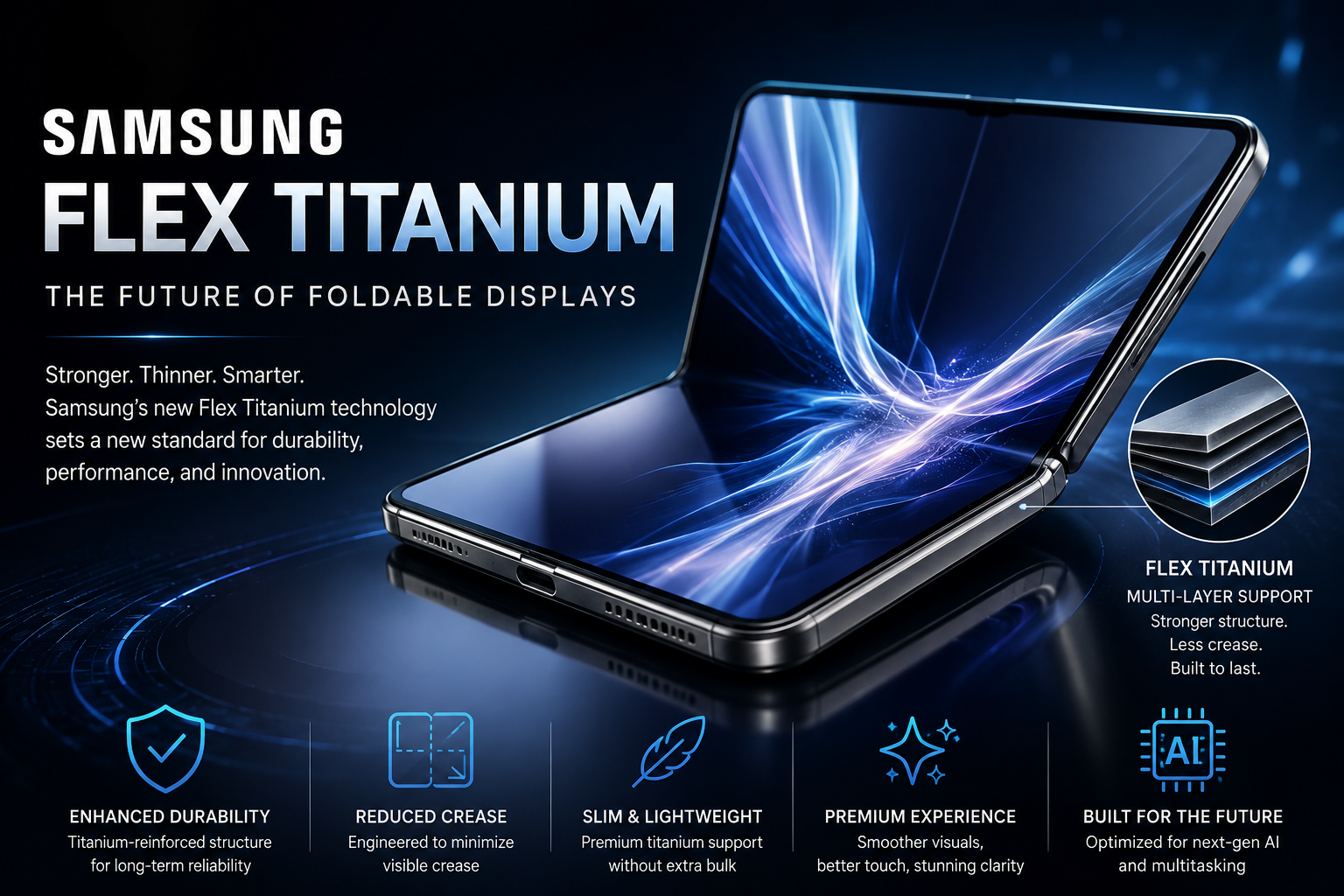
The company recently introduced Flex Titanium, a redesigned display structure created specifically for next-generation foldable Galaxy smartphones. Rather than simply improving screen durability, this technology focuses on multiple areas simultaneously—including structural strength, reduced crease visibility, slimmer construction, and long-term reliability. Samsung says the technology builds on everything it has learned from seven generations of foldable devices.
This development arrives at an important time.
Competition in premium smartphones is becoming more intense than ever. Consumers now expect foldable phones to deliver flagship performance without asking them to compromise on durability or everyday usability.
If Flex Titanium performs as promised, Samsung may once again raise the standard for the entire foldable smartphone industry.
Why Foldable Smartphones Matter More Than Ever
Not long ago, foldable phones were viewed as futuristic concepts.
They attracted technology enthusiasts who wanted something different, but many everyday consumers remained cautious. High prices, visible display creases, concerns about durability, and limited software optimisation prevented widespread adoption.
Today’s market looks very different.
Modern foldable devices now offer:
- Large tablet-sized displays
- Compact folding designs
- Better multitasking
- Improved cameras
- Faster processors
- Longer battery life
- AI-powered software experiences
Instead of replacing traditional smartphones, foldables are gradually becoming a premium category designed for people who want greater productivity without carrying multiple devices.
Samsung has played a central role in that transformation.
Each Galaxy Fold generation has introduced improvements in:
- Hinge engineering
- Display materials
- Water resistance
- Weight reduction
- Battery efficiency
- Camera systems
- Software optimization
Flex Titanium represents another major step in that journey.
Samsung Flex Titanium: Samsung’s Journey From the First Fold to Today
Understanding Flex Titanium becomes easier when looking at how Samsung’s foldable technology has evolved.
First Generation
The original Galaxy Fold demonstrated that folding OLED displays could become commercially viable.
It was groundbreaking.
It was also imperfect.
Early devices required careful handling, offered limited durability, and introduced an entirely new user experience that developers were still learning to support.
Second Generation
Samsung focused on reliability.
The company redesigned the hinge, strengthened internal components, and improved display protection.
Consumers gained greater confidence that foldables could survive everyday use.
Third Generation
Software became smarter.
Apps transitioned more smoothly between folded and unfolded modes.
Samsung also expanded multitasking features, allowing users to run multiple applications simultaneously.
Fourth Generation
Water resistance became available.
This represented an enormous engineering achievement because protecting moving mechanical parts from water intrusion is significantly more difficult than sealing a traditional smartphone.
Fifth Generation
Samsung introduced lighter designs with smaller hinge gaps.
The phones became easier to carry while feeling more premium in everyday use.
Sixth Generation
Display quality improved again.
Brightness increased.
Power efficiency improved.
The hinge became more refined.
The overall experience felt increasingly close to using a traditional flagship smartphone.
Seventh Generation
Samsung focused on refinement rather than dramatic redesigns.
Instead of reinventing the product, engineers concentrated on improving:
- User comfort
- Display quality
- AI integration
- Durability
- Productivity
This gradual progression eventually led to the development of Flex Titanium. According to Samsung, the new display architecture reflects lessons learned across seven generations of foldable innovation.
What Is Samsung Flex Titanium?
Flex Titanium is not simply a new display.
Instead, it represents a redesigned structural approach for Samsung’s foldable OLED technology.
Traditional foldable displays depend on multiple layers working together.
These include:
- OLED panel
- Protective layers
- Flexible support structures
- Adhesives
- Display reinforcement
- Mechanical hinge integration
Flex Titanium changes part of that internal architecture by incorporating titanium-based components beneath the OLED display to increase rigidity while maintaining flexibility. Samsung says this helps improve durability and reduce crease visibility without making the device bulky.
The goal isn’t merely stronger materials.
Instead, Samsung wants the display to
- Bend more naturally
- Distribute stress more evenly
- Resist long-term wear
- Maintain a flatter appearance
- Improve structural stability
That combination could significantly improve how foldable phones feel during everyday use.
Why Titanium?
Titanium has become one of the most interesting materials in consumer electronics.
Unlike aluminium or steel, titanium offers an unusual combination of properties:
| Property | Benefit |
|---|---|
| High strength | Better structural support |
| Lightweight | Helps reduce device weight |
| Corrosion resistance | Longer lifespan |
| Fatigue resistance | Better for repeated folding |
| Premium feel | Higher-end construction |
These characteristics explain why titanium has appeared in the following:
- Aerospace engineering
- Medical implants
- Professional tools
- Premium watches
- High-end smartphones
Samsung isn’t simply using titanium because it sounds impressive.
Instead, engineers appear to be using its mechanical characteristics to solve one of the biggest engineering challenges in foldable displays:
Repeated bending.
The Biggest Challenge of Foldable Displays
Imagine bending a sheet of paper.
Do it once.
Nothing happens.
Do it fifty times.
A visible crease appears.
Now repeat it thousands of times.
Eventually the paper weakens.
Foldable smartphone displays experience a similar mechanical challenge, except the materials involved are far more advanced.
Every time a foldable phone opens or closes, several display layers flex simultaneously.
Over months and years, these repeated movements place enormous stress on:
- Display films
- Adhesives
- Support structures
- Flexible OLED materials
Engineers must design displays that survive hundreds of thousands of folding cycles while maintaining the following:
- Brightness
- Color accuracy
- Touch responsiveness
- Structural integrity
Reducing this stress has always been one of Samsung’s primary goals.
Flex Titanium represents another attempt to distribute these forces more effectively.
Understanding the Folding Process
Many people imagine foldable displays simply bending in half.
The reality is much more complicated.
When a phone folds:
- The OLED panel flexes.
- Internal support layers compress.
- Other layers stretch.
- The hinge controls movement.
- Pressure shifts across the display.
- Every component must return to its original shape.
Even tiny imperfections in force distribution can eventually create the following:
- More visible creases
- Material fatigue
- Surface distortion
- Reduced durability
This explains why redesigning even one internal display layer can produce noticeable improvements.
How Flex Titanium Changes the Internal Structure
Samsung has explained that Flex Titanium introduces titanium-based structural components into the display assembly, replacing older polymer-based support in key areas. The company says this approach increases stiffness while keeping the display thin and flexible.
Instead of allowing stress to concentrate along one narrow fold line, the redesigned structure aims to spread mechanical forces across a broader area.
That could help achieve several goals simultaneously:
- Less crease visibility
- Better structural support
- Reduced long-term fatigue
- Greater consistency after repeated folding
Although consumers never see these internal layers, they can directly influence how premium a foldable phone feels.
Why the Crease Has Been So Difficult to Eliminate
The crease isn’t simply a cosmetic issue.
It’s a physical consequence of repeated bending.
Every flexible display develops some level of deformation over time.
The challenge is reducing it enough that users barely notice it.
Several factors influence crease visibility:
Display Thickness
Thicker materials resist bending differently than thinner materials.
Internal Support
Support structures determine how evenly pressure spreads.
Hinge Radius
Sharper bends generally increase stress.
Material Flexibility
Different materials compress and stretch at different rates.
Manufacturing Precision
Tiny variations during assembly can affect long-term durability.
Flex Titanium appears to address several of these engineering variables simultaneously rather than focusing on only one area.
Why This Matters to Everyday Users
Many consumers don’t care what materials sit beneath their display.
They care about the experience.
If Flex Titanium delivers as intended, users could notice benefits such as the following:
- A smoother-looking screen
- Greater confidence in daily use
- Improved long-term durability
- A thinner overall device
- Better premium feel
- Reduced visual distraction while watching videos
- A more seamless experience when reading, gaming, or multitasking
These practical improvements matter far more than the underlying engineering for most buyers.
Foldables Are Becoming Mainstream
Five years ago, foldables were niche devices.
Today, they’re becoming legitimate alternatives to traditional flagship smartphones.
Several factors have accelerated this shift:
- Better software optimization
- More powerful processors
- Improved cameras
- Longer-lasting batteries
- Greater durability
- AI-powered productivity features
Samsung’s latest display innovations suggest the company believes foldables are no longer experimental—they’re becoming a core part of the future smartphone market.
Samsung Flex Titanium Explained: The Future of Foldable Smartphones Begins Here
Engineering a Better Foldable Display
Creating a foldable smartphone is far more complicated than building a traditional slab-style device. A standard smartphone screen remains flat throughout its life, but a foldable display must repeatedly bend, straighten, and withstand daily handling without losing image quality or responsiveness.
Each opening and closing motion places stress on multiple layers:
- Ultra-thin glass (UTG)
- Flexible OLED panel
- Adhesive layers
- Protective coatings
- Internal support plates
- Hinge mechanism
These components must work together perfectly. If even one layer weakens over time, the user may notice changes such as:
- A deeper crease
- Uneven display reflections
- Reduced touch sensitivity
- Structural fatigue
- Cosmetic imperfections
Samsung’s Flex Titanium technology focuses on improving the internal support system so these layers experience more evenly distributed mechanical stress rather than concentrating pressure in one narrow area.
The Science Behind Stress Distribution
One of the biggest engineering challenges in foldable devices is controlling how force moves through the display.
Imagine pressing on the centre of a sheet of plastic.
If the pressure stays in one location, the material begins to deform.
If that force spreads across a wider area, the material experiences less concentrated strain.
This same principle applies to foldable displays.
During every fold:
- Some layers compress.
- Other layers stretch.
- The hinge guides movement.
- Internal supports manage force.
- Materials return to their original position.
The goal is not to eliminate stress—that would be impossible—but to distribute it more effectively.
By redesigning the support structure with titanium-based components, Samsung aims to improve this force distribution while keeping the display thin and flexible.
Why Reducing Stress Improves Longevity
Foldable displays don’t usually fail because of one dramatic event.
Instead, they experience gradual wear.
Repeated mechanical movement can eventually lead to:
- Material fatigue
- Minor structural deformation
- Increased crease visibility
- Adhesive aging
- Reduced uniformity
Lower stress means these effects develop more slowly.
This doesn’t necessarily mean users will notice dramatic changes immediately.
Instead, improvements are expected to become more valuable over years of ownership.
How Samsung Balances Strength and Flexibility
One common misconception is that making something stronger automatically makes it stiffer.
In engineering, that’s rarely the ideal solution.
A foldable display cannot simply become rigid.
It still has to bend thousands of times.
Samsung therefore faces two competing goals:
| Requirement | Challenge |
|---|---|
| Increase strength | Avoid making the display too stiff |
| Improve durability | Maintain flexibility |
| Reduce crease | Preserve folding motion |
| Lower weight | Use stronger materials |
| Slim design | Add structural support |
Flex Titanium attempts to balance these priorities without significantly increasing thickness or weight.
Why Thin Smartphones Are Harder to Engineer
Consumers generally want thinner smartphones.
However, thinner devices create new engineering challenges.
Inside every premium foldable phone are:
- Battery cells
- Cameras
- Cooling systems
- Speakers
- Wireless charging coils
- Antennas
- Motherboard
- Hinge components
- Display support layers
Engineers compete for fractions of a millimetre.
Adding stronger structural materials often increases thickness.
Removing materials may reduce durability.
Samsung’s new display architecture is designed to provide improved support while preserving a slim profile.
Understanding the Role of the Hinge
When people think about foldable phones, they often focus on the screen.
In reality, the hinge is equally important.
The hinge determines:
- Folding angle
- Pressure distribution
- Opening resistance
- Closing smoothness
- Long-term durability
- Crease formation
A well-designed hinge doesn’t simply open and close.
It controls exactly how the display bends.
If the folding radius becomes too tight, stress increases.
If the movement becomes uneven, wear may accelerate.
Samsung has refined its hinge design across multiple generations, and Flex Titanium complements those improvements by strengthening the display structure itself.
Why Display Layers Matter
A foldable display is not a single sheet.
Instead, it consists of multiple specialised layers.
These may include:
OLED Layer
Produces colours and images.
Ultra-Thin Glass
Provides a glass-like surface while remaining flexible.
Protective Film
Helps protect against scratches.
Adhesive Layers
Bond different materials together.
Support Plate
Adds structural stability beneath the display.
Reinforcement Materials
Improve strength during repeated folding.
Each layer contributes to the overall user experience.
Improving only one layer can influence:
- Brightness
- Durability
- Touch performance
- Visual consistency
- Folding smoothness
Flex Titanium primarily targets the structural support beneath the display rather than changing the OLED technology itself.
Does Titanium Make the Phone Stronger?
Not necessarily in the way many people imagine.
The phone’s outer frame and the display support structure serve different purposes.
Titanium inside the display assembly is intended to improve the following:
- Internal rigidity
- Controlled flexibility
- Structural consistency
- Stress management
It isn’t simply about surviving drops.
Instead, it’s about surviving repeated folding over many years.
How Foldable Displays Are Tested
Before reaching consumers, premium foldable smartphones undergo extensive testing.
While manufacturers rarely disclose every testing method, evaluation generally includes:
Mechanical Folding Tests
Devices repeatedly open and close through automated machines.
Temperature Testing
Displays operate under hot and cold conditions.
Humidity Testing
Engineers evaluate material performance in moisture-rich environments.
Touch Testing
The display continues responding accurately after repeated use.
Pressure Testing
Screens experience controlled force to evaluate durability.
Impact Testing
Selected components are tested against accidental handling.
These procedures help engineers identify weaknesses before mass production.
The Importance of Ultra-Thin Glass
Samsung’s earlier foldable generations introduced Ultra-Thin Glass (UTG), a major improvement over plastic-only display surfaces.
Benefits include:
- More premium feel
- Better scratch resistance
- Improved display clarity
- Enhanced touch experience
However, glass alone cannot solve every challenge.
The materials beneath the glass remain equally important.
Flex Titanium strengthens this supporting structure instead of replacing the glass itself.
Display Quality Beyond Durability
Consumers often associate foldable innovation with durability.
Display quality is equally important.
Modern Samsung OLED panels already deliver the following:
- Deep blacks
- High brightness
- Excellent contrast
- Wide color gamut
- Smooth refresh rates
- HDR support
Improving structural support may also help maintain visual consistency over long-term use by reducing mechanical deformation.
Software Plays an Important Role
Hardware alone doesn’t define a foldable experience.
Samsung has spent years refining software for larger displays.
Modern Galaxy Fold devices support features such as the following:
- Multi-window multitasking
- Drag-and-drop between apps
- Floating windows
- Optimized tablet layouts
- Split-screen productivity
- AI-assisted workflows
As displays become more durable and immersive, software becomes an even larger part of the overall experience.
AI and Foldable Smartphones
Artificial intelligence is changing how people use smartphones.
Instead of simply launching apps, users increasingly expect phones to help complete tasks.
Examples include:
- Summarizing documents
- Translating conversations
- Organizing notes
- Editing photos
- Generating writing suggestions
- Voice-based assistance
Large foldable displays naturally complement these AI features because they provide more screen space for multitasking.
Samsung’s ongoing investment in foldables suggests it sees AI and flexible displays evolving together.
Comparing Foldable Generations
The following table illustrates how Samsung’s foldable technology has gradually matured.
| Generation | Major Focus |
|---|---|
| First Fold | Proof of concept |
| Second | Better durability |
| Third | Software optimization |
| Fourth | Water resistance |
| Fifth | Slimmer hinge |
| Sixth | Better displays and efficiency |
| Seventh | AI refinement and premium usability |
| Flex Titanium Era | Stronger internal display structure and reduced crease |
Rather than reinventing foldables every year, Samsung has steadily improved the platform through incremental engineering advances.
Expected Galaxy Z Fold 8 Improvements (Unofficial)
Industry reports and supply chain leaks suggest Samsung’s next Galaxy Z Fold device may continue building on Flex Titanium technology while introducing additional hardware refinements. However, these details remain unofficial until Samsung announces the product.
Potential expectations discussed by industry observers include:
- Reduced crease visibility
- Slimmer chassis
- Improved hinge mechanism
- Better thermal management
- Faster flagship processor
- Camera refinements
- Enhanced AI features
- Improved battery efficiency
Because leaks can change before launch, readers should treat these reports as informed speculation rather than confirmed specifications.
Samsung vs Other Foldable Smartphone Brands
The foldable smartphone market has expanded rapidly over the past few years.
Major competitors now include brands such as:
- Honor
- Huawei
- Oppo
- Vivo
- Motorola
- Xiaomi
Each company approaches foldable engineering differently.
Some prioritise:
- Thinness
- Camera quality
- Battery capacity
- Fast charging
- Lightweight construction
Samsung’s strategy has traditionally emphasised long-term reliability, software optimisation, ecosystem integration, and global availability.
Flex Titanium continues this philosophy by targeting one of the most persistent concerns among foldable buyers: display durability.
Benefits Consumers May Notice
If Flex Titanium performs as Samsung intends, users may experience several practical advantages.
Better Viewing Experience
A less noticeable crease could improve reading, gaming, and video playback.
Improved Confidence
Stronger internal support may reassure buyers concerned about durability.
Premium Feel
A flatter display creates a more seamless tablet-like experience.
Longer Device Life
Reduced structural stress may help maintain display consistency over extended ownership.
Better Productivity
Large displays remain more comfortable for multitasking when the centre crease becomes less distracting.
Should Existing Fold Users Upgrade?
The answer depends on individual priorities.
Upgrading may make sense for users who:
- Use multitasking extensively
- Spend hours reading on large displays
- Want the newest AI features
- Prefer thinner premium hardware
- Value the latest engineering improvements
On the other hand, owners of relatively recent Galaxy Fold devices may still enjoy an excellent experience without immediately upgrading.
As always, the value of a new generation depends on the total package rather than a single feature.
Why Flex Titanium Represents More Than One Innovation
Although much attention focuses on titanium itself, the larger story is Samsung’s continued refinement of foldable engineering.
The company isn’t merely introducing a new material.
It is redesigning how multiple technologies work together:
- OLED displays
- Support structures
- Hinge mechanics
- Material science
- Mechanical engineering
- Manufacturing precision
This systems-level approach often delivers the biggest real-world improvements.
Samsung Flex Titanium Explained: The Future of Foldable Smartphones Begins Here
The Future of Foldable Smartphones
Foldable smartphones have evolved from niche devices into a serious premium category. While traditional smartphones continue to improve with better cameras and faster processors, their overall design has remained relatively unchanged for years.
Foldables offer something fundamentally different: more screen space without sacrificing portability.
As hardware matures, software improves, and production becomes more efficient, foldable phones are expected to become increasingly accessible to a wider audience.
Samsung has invested heavily in this direction, and technologies like Flex Titanium demonstrate that the company is refining the core engineering challenges rather than making only cosmetic upgrades.
Where Flex Titanium Fits into Samsung’s Long-Term Vision
Samsung’s product strategy has consistently focused on gradual, meaningful improvements.
Instead of reinventing foldable devices every year, the company has concentrated on solving practical problems one by one:
- Stronger hinges
- Better water resistance
- Brighter displays
- Lighter designs
- Improved multitasking
- Enhanced AI experiences
- Better durability
Flex Titanium continues that philosophy by targeting one of the most noticeable aspects of foldable phones: the display crease and long-term structural integrity.
If successful, this technology may become a standard component in future generations of Samsung foldables.
Could Other Smartphone Brands Adopt Similar Technologies?
Innovation rarely stays with one manufacturer forever.
The smartphone industry is highly competitive, and advancements in materials science often influence the broader market.
If titanium-supported foldable display structures prove successful, other manufacturers may explore comparable engineering solutions using different materials or designs.
Potential industry trends include the following:
- More durable flexible displays
- Reduced crease visibility
- Thinner foldable devices
- Lighter premium smartphones
- Stronger internal support systems
- Improved hinge engineering
- Longer product lifespans
Competition typically benefits consumers by encouraging faster innovation across the industry.
Beyond Smartphones: Other Possible Applications
Flexible display technology has potential far beyond phones.
As manufacturing techniques improve, similar concepts could appear in:
Foldable Tablets
Large portable devices that fold into compact forms.
Rollable Displays
Screens that extend when needed and retract for portability.
Wearable Technology
Future smart devices with flexible or curved displays.
Automotive Displays
Curved dashboards and adaptive in-car infotainment systems.
Medical Equipment
Portable devices that benefit from durable flexible screens.
Although these applications remain at different stages of development, advances in foldable display engineering help expand possibilities across multiple industries.
Advantages of Foldable Smartphones
Modern foldables offer several unique benefits that traditional smartphones cannot easily match.
Larger Display in a Compact Form
Users can carry a device that unfolds into a tablet-sized screen while still fitting in a pocket.
Better Multitasking
Running multiple applications side by side becomes much more practical.
Improved Productivity
Reading documents, editing spreadsheets, reviewing presentations, and taking notes are easier on larger displays.
Enhanced Entertainment
Movies, games, and streaming content benefit from the increased screen size.
Premium Design
Foldable phones continue to stand out as innovative devices that showcase advanced engineering.
Challenges That Still Remain
Despite significant progress, foldable smartphones are not perfect.
Some ongoing challenges include:
Higher Purchase Price
Foldables remain premium products with higher costs than many conventional smartphones.
App Optimization
Although many applications now support larger displays, some apps still do not fully utilise foldable screens.
Battery Constraints
Large displays require careful power management, making battery optimisation an ongoing priority.
Long-Term Durability
While durability has improved substantially, foldable devices contain moving parts that naturally require more engineering than standard smartphones.
Who Should Consider Buying a Foldable Phone?
Foldable devices are not necessarily the best choice for everyone.
They are particularly well suited for users who value versatility and productivity.
Professionals
People who regularly work with emails, documents, presentations, or multitasking workflows.
Frequent Travelers
A foldable could replace carrying both a smartphone and a small tablet for many tasks.
Content Creators
The larger display simplifies editing photos, videos, and social media content.
Technology Enthusiasts
Users who enjoy trying the latest innovations often appreciate foldable devices.
Business Users
Large displays improve video conferencing, document review, and note-taking during meetings.
Who Might Prefer a Traditional Smartphone?
Conventional flagship smartphones remain excellent options for many people.
They may be preferable for users who:
- Prefer a lighter device
- Rarely multitask
- Prioritize camera performance above all else
- Want a lower purchase price
- Prefer a familiar smartphone experience
The right choice ultimately depends on individual needs and preferences.
Buying Checklist Before Choosing a Foldable Samsung Phone
Before purchasing a foldable device, consider the following questions:
| Question | Why It Matters |
|---|---|
| Will you multitask often? | Large displays provide greater productivity. |
| Do you travel frequently? | A foldable can reduce the need for carrying a tablet. |
| Is durability important? | Newer generations offer stronger designs. |
| Do you use AI productivity tools? | Larger displays enhance AI-assisted workflows. |
| Are software updates important? | Samsung provides ongoing support for flagship devices. |
| Is premium design a priority? | Foldables remain among Samsung’s most advanced products. |
Samsung’s Ecosystem Advantage
One reason Samsung continues to lead the foldable market is its broader ecosystem.
A foldable Galaxy phone can integrate with:
- Galaxy tablets
- Galaxy Watches
- Galaxy Buds
- Samsung laptops
- Smart TVs
- Smart home devices
Features such as seamless file sharing, multi-device connectivity, and synchronised productivity tools create a more connected user experience.
For users already invested in Samsung’s ecosystem, a foldable device can fit naturally into their daily workflow.
Foldable Technology and Sustainability
As smartphone manufacturers focus more on sustainability, foldable engineering also presents opportunities for improvement.
Areas receiving increased attention include:
- Longer product lifespans
- More durable materials
- Recycled components
- Reduced packaging waste
- Energy-efficient manufacturing
While sustainability efforts vary by product and region, improving durability is an important step because devices that last longer generally reduce the need for frequent replacements.
Common Myths About Foldable Phones
Myth 1: Foldable Displays Break Easily
Early generations raised durability concerns, but today’s foldables are significantly more robust thanks to advances in materials, hinges, and display engineering.
Myth 2: The Crease Makes the Screen Unusable
Most users adapt quickly, and newer display technologies aim to reduce crease visibility even further.
Myth 3: Foldables Are Only for Tech Enthusiasts
Professionals, students, travellers, and business users increasingly find value in the additional screen space.
Myth 4: Foldables Are Too Fragile for Daily Use
Modern foldable smartphones are designed to withstand everyday use when handled responsibly, though they still benefit from reasonable care like any premium device.
Frequently Asked Questions (FAQ)
What is Samsung Flex Titanium?
Samsung Flex Titanium is a redesigned internal display support technology that incorporates titanium-based structural elements to improve durability, reduce crease visibility, and maintain a slim, foldable design.
Does Flex Titanium eliminate the display crease?
Samsung’s goal is to reduce crease visibility, not necessarily eliminate it entirely. The actual user experience may vary depending on the device and viewing conditions.
Which phones use Flex Titanium?
Samsung has announced Flex Titanium as part of its foldable display advancements. Availability depends on specific product generations and official launch announcements.
Is titanium stronger than aluminium?
Titanium generally offers a higher strength-to-weight ratio than aluminium, making it an attractive material for premium engineering applications.
Does Flex Titanium improve battery life?
The technology primarily focuses on display structure and durability. Any battery improvements depend on the overall smartphone design rather than Flex Titanium alone.
Is a foldable phone worth buying in 2026?
For users who value multitasking, productivity, and larger displays in a portable form, modern foldable phones have become much more compelling than earlier generations.
Are foldable phones waterproof?
Some premium foldable Samsung devices include water-resistance ratings, but the exact certification varies by model. Always check the specifications of the specific device before purchase.
How long do foldable displays last?
Manufacturers design foldable displays to withstand extensive opening and closing cycles under normal usage. Actual lifespan depends on usage habits and device care.
Final Thoughts
Samsung’s introduction of Flex Titanium represents another meaningful step in the ongoing evolution of foldable smartphones. Rather than focusing solely on headline-grabbing specifications, the technology addresses practical challenges that matter to everyday users, such as durability, structural stability, and a less noticeable display crease.
The innovation also highlights Samsung’s long-term approach to product development. Each generation builds upon the previous one through incremental engineering improvements instead of dramatic redesigns. This steady refinement has helped transform foldable phones from experimental devices into capable premium smartphones suitable for work, entertainment, and daily life.
As the foldable market continues to mature, competition will likely accelerate innovation across the industry. Whether through new materials, improved hinge designs, or smarter software experiences, consumers stand to benefit from the continued advancement of flexible display technology.
For anyone considering a premium smartphone that combines portability with a larger workspace, Samsung’s foldable lineup—and the engineering behind Flex Titanium—signals that the future of mobile computing is becoming more practical, durable, and versatile than ever before.
Key Takeaways
- Samsung Flex Titanium is designed to strengthen the internal support structure of foldable displays.
- The technology aims to reduce crease visibility while maintaining flexibility and a slim design.
- Foldable smartphones continue to evolve through improvements in hinges, materials, software, and AI features.
- Samsung’s ecosystem enhances the productivity potential of foldable devices.
- While foldables remain premium products, ongoing engineering refinements are making them more practical for everyday users.