
Downdetector Explained: How to Check Website Outages, Service Problems, and Real-Time Status in 2026
Downdetector website outage status When a website suddenly stops loading, an app refuses to connect, or a smart device appears to ignore every command, the first question is usually simple: Is it just me, or is everyone having the same problem?
That is where Downdetector becomes useful.
Downdetector website outage status Instead of spending several minutes restarting your phone, reinstalling an app, checking your Wi-Fi, or searching social media for clues, users can turn to Downdetector to see whether other people are reporting problems with the same service.
Downdetector website outage status The platform has become a familiar destination during major internet disruptions. When a social network, streaming platform, banking service, gaming network, communication app, or connected-device ecosystem starts experiencing trouble, a sudden increase in user reports can provide an early indication that something larger may be happening.
Downdetector website outage status Recent outage coverage involving Tumblr and Amazon Alexa illustrates why this type of information attracts so much attention. Reports about Tumblr problems on August 7, 2026, generated thousands of user complaints, while separate reporting around Alexa highlighted users experiencing problems with voice responses and connected Echo devices. These incidents show two very different types of digital services, but the underlying question is identical: Is the service actually down?
Downdetector website outage status This guide explains what Downdetector is, how its outage reports work, how to interpret its graphs and status indicators, why report numbers do not equal the number of affected customers, and what you should do when a service appears to be experiencing problems.
What Is Downdetector?
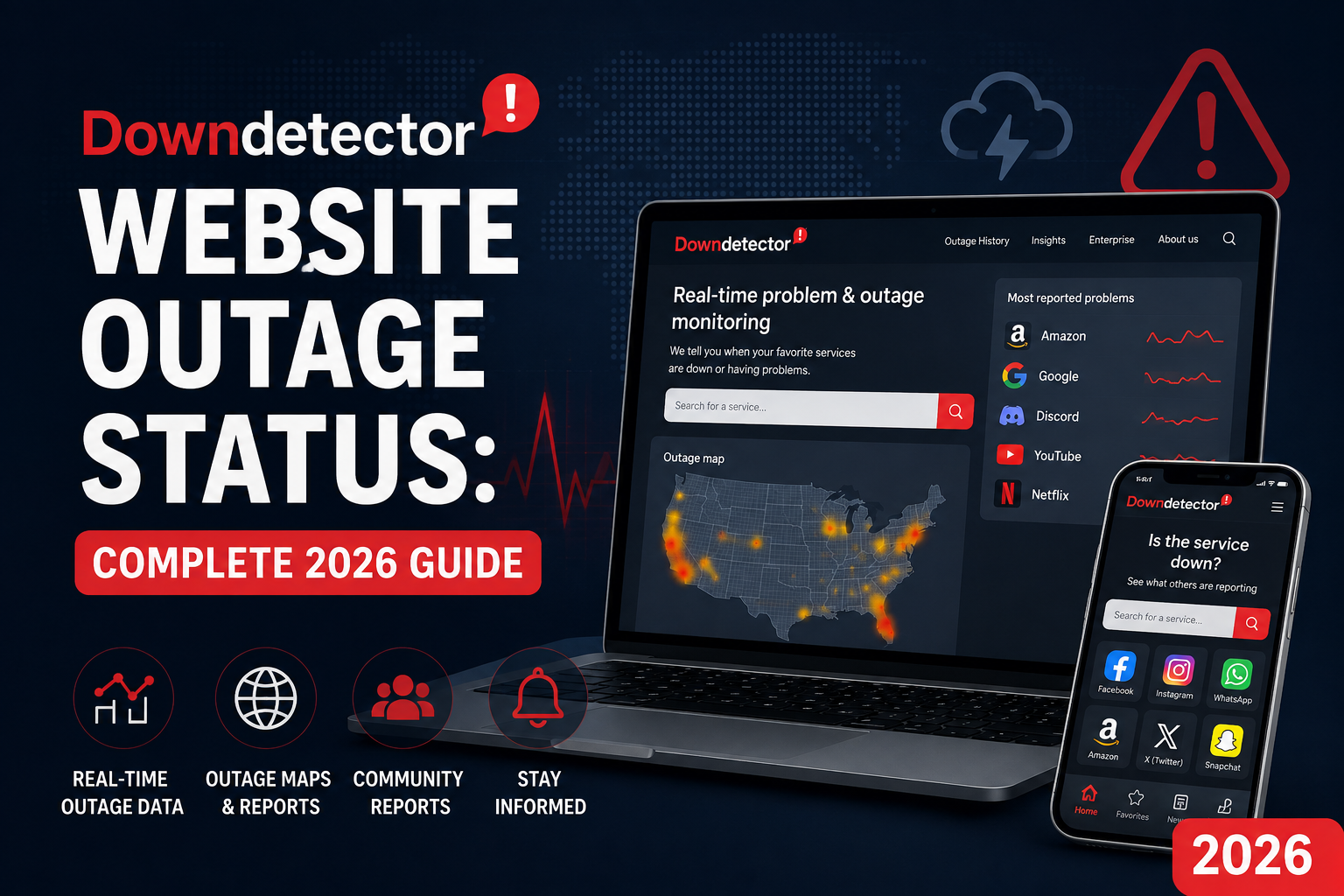
Downdetector website outage status Downdetector is an online service-status platform that collects information about reported problems with websites, apps, internet providers, financial services, gaming platforms, social networks, and other digital services.
Its basic purpose is straightforward:
Help people determine whether a problem is local to their device or part of a larger service disruption.
Downdetector website outage status Downdetector says it collects user reports and monitors other online sources for indications of service problems. Its service pages can display outage trends, reported problem categories, geographic information, and community feedback.
Downdetector website outage status That makes Downdetector particularly useful during situations where the company’s own website or status page has not yet published an update.
For example, imagine that Instagram suddenly stops refreshing.
You might initially assume:
- Your Wi-Fi is broken.
- Your phone has a software problem.
- The Instagram app needs an update.
- Your account has been restricted.
- Your internet provider is experiencing trouble.
But if thousands of other people are reporting similar problems at roughly the same time, the situation looks very different.
It may be a broader service incident.
That is the central value of Downdetector.
Why Do People Search for Downdetector?
The keyword “downdetector” has strong informational and problem-solving intent.
Someone searching for the term may be trying to do several different things.
1. Check whether a service is down
A user may search for Downdetector after seeing an error message.
2. Confirm a suspected outage
A service may appear broken, but the user wants independent evidence before concluding that the company has a problem.
3. Find out whether other people are affected
This is especially important for services such as the following:
- Banks
- Mobile carriers
- Internet providers
- Social media
- Streaming services
- Gaming networks
- Work applications
- Cloud platforms
4. Understand an outage’s scale
Users may want to know whether a problem is the following:
- Local
- Regional
- National
- International
- Intermittent
- Widespread
5. Decide whether troubleshooting is worthwhile
If thousands of people are reporting the same issue, repeatedly reinstalling an application may not accomplish anything.
6. Follow an outage as it develops
Downdetector’s graphs can help users see whether reports are increasing, stabilising, or declining.
This explains why the platform often becomes especially popular during breaking technology incidents.
How Downdetector Works
One of the most important things to understand is that Downdetector is not simply a giant list of companies declaring whether their servers are online.
Its information is heavily connected to user-reported problems and monitoring of online signals.
Downdetector explains that its statuses are based on the number of reports it receives compared with normal reporting levels for a particular service.
That distinction matters.
A service can technically have functioning servers while many users are still experiencing problems.
Likewise, a small technical issue may affect some customers without becoming large enough to produce an obvious Downdetector spike.
Downdetector website outage status The platform therefore works best as an outage signal, not as an absolute technical diagnosis.
The Importance of the Normal Baseline
Suppose a popular website normally receives a small number of complaints every hour.
Then suddenly, reports increase dramatically.
The important factor is not simply the raw number.
It is the difference between the following:
Normal activity → unusual activity
This allows Downdetector to identify unusual patterns.
A service with hundreds of reports every day should not necessarily be considered down simply because hundreds of people have submitted complaints.
The platform instead looks for reporting activity that is significantly above the service’s expected level.
This is why a spike can be more informative than a single complaint.
What Do Downdetector Status Indicators Mean?
Downdetector generally presents service conditions using three broad statuses.
No Problems
This indicates that there is no evidence of a significant incident based on the platform’s reporting levels.
It does not necessarily mean every user can access the service perfectly.
A person can still experience the following:
- Login errors
- Slow loading
- Regional connectivity problems
- Account-specific problems
- Device-specific bugs
Downdetector describes this status as an absence of evidence that the company is experiencing an incident.
Possible Problems
This means there is some evidence that the service may be experiencing an incident.
The signal is stronger than normal background complaints, but it may not yet meet the threshold for a major detected outage.
Problems
This represents a stronger signal that reporting activity is significantly above the expected level.
In practical terms, this is the status users are most likely to notice when a large outage is developing.
What Does a Downdetector Spike Mean?
A sudden spike in reports usually means that an unusual number of people have submitted problem reports within a relatively short period.
That can be an important warning sign.
However, there is a major distinction between the following:
Reports submitted
and
People actually affected
They are not the same number.
If Downdetector shows 10,000 reports, that does not automatically mean exactly 10,000 customers lost access.
In reality, the affected population could be much larger.
Many people experiencing an outage never visit Downdetector.
Others may submit more than one report during a prolonged incident.
This limitation is important when interpreting outage coverage. Reuters has similarly noted that Downdetector aggregates user submissions and that the number of reports may differ from the actual number of affected users.
Downdetector Reports Are Not a Customer Census
This is one of the most important concepts for anyone writing about internet outages.
A Downdetector report should generally be interpreted as a signal of user-reported disruption, not a precise measurement of every affected customer.
Consider a hypothetical example.
A service has:
- 20 million active users
- 50,000 Downdetector reports
It would be incorrect to conclude that only 50,000 people were affected.
Many users may never report the problem.
At the same time, 50,000 reports do not prove that 50,000 unique individuals were affected.
The data is useful, but it needs context.
Why Downdetector Is Useful During Breaking Outages
The biggest advantage of a crowdsourced outage tracker is speed.
When something breaks online, official communication can take time.
A company may first need to do the following:
- Detect the problem.
- Confirm the problem.
- Identify the affected systems.
- Investigate the cause.
- Notify internal teams.
- Prepare a public statement.
Users, meanwhile, notice the problem immediately.
That creates an interesting information gap.
A large group of users may already be saying the following:
Something is wrong.
before the affected company publicly explains:
We are investigating an incident.
Downdetector can help fill that early information gap.
Tumblr and Downdetector: What Happened?
On August 7, 2026, reports emerged that Tumblr users were experiencing problems.
Coverage of the incident described a substantial increase in user reports, with more than 3,000 complaints appearing during the disruption.
For Tumblr users, the practical question was not necessarily the technical root cause.
It was much simpler:
Is Tumblr down right now?
That is exactly the type of question that drives people toward outage-tracking services.
When a familiar platform suddenly stops behaving normally, users typically look for confirmation from three places:
- The company’s own channels.
- Social media discussions.
- Independent outage trackers.
Downdetector is particularly useful because it converts individual complaints into a visible trend.
Instead of seeing one person, say:
“Tumblr isn’t working.”
Users can see whether there is a broader pattern.
Why Tumblr Outages Create So Much Search Interest
A social platform outage can affect several different functions at once.
For Tumblr, users may encounter problems involving:
- Website loading
- Mobile access
- Login
- Posting
- Dashboard functionality
- Content loading
- Notifications
- Server connections
This creates multiple search variations.
People may search for:
- Tumblr down
- Is Tumblr down?
- Tumblr not working
- Tumblr outage
- Tumblr status
- Tumblr Downdetector
- Tumblr website down
- Tumblr app not working
- Tumblr login not working
This illustrates an important SEO lesson.
The primary keyword may be Downdetector, but the surrounding search ecosystem includes many problem-specific phrases.
Amazon Alexa and Downdetector
Downdetector becomes even more interesting when the affected service is not simply a website.
Amazon Alexa is an example of a cloud-connected ecosystem.
A user can have:
- A working Wi-Fi connection
- A powered-on Echo device
- A functioning smartphone
- An operational home network
and still find that Alexa does not respond correctly.
That can be confusing.
If Alexa lights up but fails to answer, the user may initially suspect the device itself.
But if many users report similar behaviour at approximately the same time, a broader service-side problem becomes more plausible.
Recent user discussions have described situations where Alexa devices appeared online but did not respond normally, reinforcing why outage tracking can be useful when troubleshooting connected services.
Why Cloud Services Make Outages Complicated
Modern apps rarely operate as isolated programs.
A service may depend on:
- Cloud computing
- DNS
- Content delivery networks
- Databases
- Authentication providers
- Payment systems
- APIs
- Storage systems
- Third-party services
- Regional data centers
If one important component fails, several seemingly unrelated services can develop problems.
This is why a cloud infrastructure incident can affect applications that have no obvious relationship from a consumer’s perspective.
A major AWS outage in 2025, for example, affected numerous internet services and demonstrated how dependent modern applications can be on shared infrastructure.
The lesson is simple:
An app can fail even when the app itself is not the original source of the problem.
Downdetector vs. Official Status Pages
Downdetector and an official status page serve different purposes.
| Feature | Downdetector | Official Status Page |
|---|---|---|
| Main source | User reports and online signals | Company’s infrastructure monitoring |
| User perspective | Very strong | Variable |
| Independent | Yes | No |
| Technical explanation | Usually limited | Often stronger |
| Geographic reporting | Often available | Depends on company |
| Community comments | Often available | Usually limited |
| Early public signal | Often useful | Depends on company response |
| Root-cause detail | Limited | Potentially detailed |
| Best use | Detecting unusual user impact | Confirming official incidents |
The smartest approach is not to choose one over the other.
Use both.
How to Check if a Website Is Down Using Downdetector
The process is simple.
Step 1: Go to Downdetector
Open the Downdetector website for your region.
Downdetector operates region-specific sites and provides service-status information across numerous categories. Its platform is part of Ookla, the company also known for Speedtest.
Step 2: Search for the service
Enter the name of the website or app.
Examples include:
- YouTube
- X
- Netflix
- Spotify
- Amazon
- Roblox
- Xbox
- Mobile carriers
- Banking services
Step 3: Check the current status
Look at the service’s status indicator.
You may see:
- No problems
- Possible problems
- Problems
Step 4: Examine the outage graph
Do not stop at the headline status.
Look at the reporting chart.
A sudden upward movement can be more informative than a handful of isolated reports.
Step 5: Look at reported problem categories
Depending on the service, reports can be divided into categories such as the following:
- Website
- App
- Login
- Server connection
- Feed
- Posting
- Calling
- Messaging
Downdetector service pages can display these categories to help users understand what kind of problem is being reported.
Step 6: Check the outage map
A map can show where reports are concentrated.
This is particularly useful for determining whether the issue appears:
- Localized
- Regional
- National
- Broadly distributed
Step 7: Read recent comments carefully
User comments can reveal practical details that a chart cannot.
For example:
- Desktop works but mobile does not.
- Login is failing.
- Videos are not loading.
- Notifications are delayed.
- The service works intermittently.
However, comments are anecdotal.
Treat them as clues rather than definitive technical evidence.
How to Read a Downdetector Outage Graph
The graph is one of the most useful parts of the platform.
Imagine normal reporting looks like this:
Reports
  |
  |       .
  |      . .
  | . . .   . .
  |________________
       Time
Then suddenly:
Reports
  |
  |             /\
  |            /  \
  |           /    \
  |__________/      \____
       Time
The second pattern indicates a sudden increase in reports.
That is more significant than a steady stream of complaints.
Why the Shape of the Spike Matters
A sharp spike can indicate that something changed quickly.
A gradual rise can mean something different.
For example:
Sudden spike
Potentially consistent with:
- Server failure
- Deployment problem
- Authentication failure
- Network incident
- Infrastructure disruption
Gradual increase
Could be associated with:
- Growing regional problems
- A rolling incident
- Increased traffic
- Partial service degradation
- A problem spreading across systems
Spike followed by rapid decline
May suggest:
- Short-lived incident
- Quick mitigation
- Temporary infrastructure failure
- Recovery already underway
But remember: a graph cannot independently identify the root cause.
What Does “Most Reported Problems” Mean?
Downdetector may categorise reports to show which functions users are struggling with most.
For example, a service could show the following:
| Problem Category | Approximate Share |
|---|---|
| App | 48% |
| Website | 25% |
| Login | 18% |
| Server Connection | 9% |
This does not necessarily mean the app itself is broken.
It simply describes what reporting users are selecting when they submit complaints.
That distinction is important.
Can Downdetector Tell You Why a Service Is Down?
Usually, not by itself.
Downdetector is primarily an indicator of reported impact, rather than a complete technical postmortem.
It can help answer:
Is something unusual happening?
It generally cannot answer independently:
Exactly which server, database, code deployment, DNS record, or infrastructure component caused it?
For root-cause information, users should look for:
- Official company statements
- Status pages
- Engineering updates
- Incident reports
- Reputable news coverage
Why a Company Might Say Everything Is Fine While Downdetector Shows Reports
This situation can happen.
There are several possible explanations.
1. The incident is regional
The company’s overall infrastructure may be healthy while one region is experiencing problems.
2. Only a specific feature is broken
For example:
- Login works
- Messaging fails
or:
- Website works
- Mobile app fails
3. The company has not detected the incident yet
There can be a delay between user experience and official confirmation.
4. The problem affects a third-party dependency
The service may be technically operational while another provider is causing failures.
5. User reports are concentrated around a smaller problem
A group of users may experience a genuine problem without the entire service being down.
This is why Downdetector should be interpreted as evidence, not absolute proof.
Why Downdetector Sometimes Shows Problems When Your Service Works
This is the opposite situation.
You might visit a Downdetector page and see reports rising, yet your app works normally.
That is completely possible.
Outages are not always universal.
You may be outside the affected region.
You may be using a different device.
Your account may be routed through different infrastructure.
Your ISP may take a different network path.
Or the incident may affect only a particular feature.
For example:
User A: Cannot log in.
User B: Logged in already and can browse normally.
Both can be telling the truth.
How to Tell Whether the Problem Is Your Internet
Before assuming a major outage, perform a few basic tests.
Test 1: Open another website
Try several unrelated websites.
If everything fails, the problem may be your connection.
Test 2: Switch networks
Move from:
- Wi-Fi → cellular
- Cellular → Wi-Fi
If the service works on one connection but not another, your local network may be involved.
Test 3: Try another device
Open the service on:
- Phone
- Laptop
- Tablet
- Desktop
If every device fails, the problem may be broader.
Test 4: Check Downdetector
Look for a reporting spike.
Test 5: Check the company’s status page
Look for an official incident.
Using these five checks together is much more reliable than relying on one signal.
A Simple Outage Troubleshooting Decision Tree
Use this sequence:
Service not working
↓
Try another website.
↓
If everything is broken:
Check your internet connection.
If only one service is broken:
Check Downdetector.
↓
Reports sharply increasing?
A broader outage is possible.
Reports normal?
Continue local troubleshooting.
↓
Check the company’s official status page.
↓
Try another network.
↓
Try another device.
↓
Wait and retry if a confirmed outage exists.
This approach prevents unnecessary troubleshooting.
Common Reasons Websites and Apps Go Down
There is no single cause of internet outages.
Server failures
Servers can crash or become unavailable.
Software bugs
A new update can introduce unexpected behaviour.
Database problems
Applications often depend heavily on databases for:
- Accounts
- Posts
- Messages
- Orders
- Profiles
- Settings
If database services fail, the application may appear completely broken.
DNS failures
DNS translates domain names into network addresses.
If DNS fails, users may be unable to reach a service even if the underlying application is still running.
Cloud infrastructure incidents
Many applications rely on large cloud platforms.
An infrastructure problem can therefore affect multiple services simultaneously.
Authentication failures
A service may be operational, but users cannot log in.
That can make the entire platform appear unavailable.
API failures
Modern apps frequently depend on APIs.
If a critical API stops responding, parts of the application can break.
Traffic overload
A sudden traffic surge can overwhelm infrastructure.
This can happen during the following:
- Major events
- Product launches
- Breaking news
- Viral posts
- Game releases
- Ticket sales
Cybersecurity incidents
Cyberattacks can cause service disruption.
However, users should not automatically assume an outage is the result of hacking.
The cause needs confirmation.
Internet Outages Can Be Partial
One of the biggest misconceptions is that a service is either
Up
or
Down
Real-world systems are more complicated.
A platform can be:
- 90% operational
- 50% operational
- Working in one country
- Broken in another
- Working on mobile
- Broken on desktop
- Working for existing sessions
- Failing for new logins
This is why outage reporting needs nuance.
Regional Outages vs. Global Outages
A regional outage affects users in a particular area.
For example:
- One city
- One state
- One country
- One cloud region
A global outage has a much broader impact.
Downdetector’s map can be useful when trying to understand geographical concentration. Its map pages explain that reports are shown according to where user reports are concentrated over a recent period.
However, map concentration does not automatically prove that the underlying technical problem originates in that location.
It simply shows where reports are being submitted.
Why Location Matters During an Outage
Suppose users in California report a problem while users in New York report normal service.
That could indicate:
- Regional infrastructure issues
- ISP-specific problems
- Data centre routing problems
- Geographic deployment differences
Now imagine reports appearing across the United States.
The likelihood of a localised home-network issue becomes much smaller.
This is one reason geographic outage data can be valuable.
Downdetector for Internet Providers
Downdetector is especially useful for internet and mobile providers.
If your connection suddenly stops working, you might initially assume the problem is inside your home.
But if many customers of the same provider report the following:
- No internet
- Slow speeds
- Connection drops
- Mobile data failure
- Calls not connecting
then a provider-side problem becomes more plausible.
Still, your neighbourhood may have a localised outage even if the provider does not appear to have a nationwide incident.
Downdetector for Banking Services
Banking outages can be particularly frustrating.
Users may notice:
- Login failures
- App errors
- Website problems
- Payment failures
- Account information not loading
In this situation, avoid assuming that an unavailable banking app means money has disappeared.
A temporary service-access problem can prevent the interface from communicating with the bank’s systems.
If a financial transaction is involved, check the transaction status through an official channel rather than repeatedly submitting the same payment.
Downdetector for Streaming Services
Streaming outages often appear as the following:
- Videos not loading
- Playback errors
- Login failures
- Buffering
- Blank screens
- Server connection errors
If Netflix, YouTube, Spotify, or another major platform suddenly behaves strangely, Downdetector can help determine whether other users are seeing the same thing.
Downdetector for Gaming
Gamers are particularly familiar with outage trackers.
Online games depend on multiple systems:
- Authentication
- Matchmaking
- Game servers
- Friends lists
- Cloud saves
- Store services
- Voice chat
- Content delivery
A game can launch successfully while matchmaking is broken.
That is a classic example of a partial outage.
Downdetector and Social Media Outages
Social networks are among the most visible outage categories because users notice problems immediately.
Common complaints include:
- Feed not loading
- Messages failing
- Login problems
- Posts not publishing
- Stories not loading
- Notifications disappearing
- Search failing
When users cannot access a social network, they often turn to another network to ask whether it is down.
That creates a unique pattern:
Platform A fails → users move to Platform B → users discuss the outage → outage awareness spreads
Downdetector adds another layer of visibility.
Is Downdetector accurate?
The best answer is:
It is useful, but it should not be treated as an infallible technical authority.
Its strength is identifying unusual patterns in user-reported problems.
Its weakness is that user reports are not the same thing as direct measurements of every server and every customer.
Think of it as an early-warning system.
If you see a large spike, it is worth investigating.
If you see no spike, that does not prove your individual problem is imaginary.
Strengths of Downdetector
Fast visibility
Users can see unusual reporting activity quickly.
Independent perspective
The information is not solely controlled by the affected company.
Community feedback
Comments can reveal real-world symptoms.
Geographic information
Maps can help identify concentration.
Historical context
Charts can show how reporting changes over time.
Broad service coverage
The platform covers many types of consumer services.
Limitations of Downdetector
Reports are user-driven
Not everyone submits a report.
Report counts are not affected by user counts
A spike does not tell you the exact number of customers affected.
Comments can be unreliable
Individual users may misunderstand the problem.
Small outages can be difficult to identify
A limited incident may not create a large enough signal.
A service can work for some users while being down for others
Status indicators represent broader patterns.
It does not automatically reveal the root cause
Technical confirmation usually requires the affected company.
What You Should Do When Downdetector Shows an Outage
If Downdetector indicates a widespread problem, don’t immediately start changing everything on your device.
Instead:
1. Confirm the problem
Try the service on another device or connection.
2. Check the official status page
Look for confirmation.
3. Avoid unnecessary account changes
Do not reset passwords or reinstall apps unless there is a specific reason.
4. Avoid repeated transactions
This is particularly important for banking, shopping, and payment services.
5. Save important work locally
If an outage affects a productivity platform, protect unsaved work whenever possible.
6. Wait for recovery
If a major service outage is confirmed, the problem may be outside your control.
What Not to Do During a Major Outage
Outages often create confusion.
Avoid these mistakes.
Don’t immediately factory-reset your device
A cloud outage cannot normally be fixed by resetting your phone or smart speaker.
Don’t repeatedly submit payments
You could create duplicate transactions if the first request succeeded but the confirmation failed.
Don’t assume your account was hacked
An outage can look like a login problem.
Investigate before jumping to conclusions.
Don’t trust random social-media claims
Someone saying “the servers were hacked” is not evidence.
Don’t confuse one broken feature with a total outage
A service can remain operational while one component is failing.
How Businesses Can Use Downdetector
Downdetector isn’t only useful to consumers.
Businesses can use outage information as an external view of customer experience.
Suppose an online retailer receives a sudden increase in customer complaints.
Its internal monitoring may show:
The server’s healthy.
But Downdetector or similar external signals may show the following:
Customers experiencing problems.
That difference can be valuable.
Modern service reliability requires understanding not just whether infrastructure is running but also whether users can actually complete tasks.
Downdetector also offers an enterprise-orientated product designed to help organisations monitor reported service issues and respond to customer-impacting problems.
Why External Monitoring Matters
Internal monitoring usually answers questions like the following:
- Is the server responding?
- Is CPU usage normal?
- Is memory available?
- Are error rates increasing?
- Is the database healthy?
External monitoring can answer a different question:
Are customers actually experiencing the service the way we expect?
That distinction is becoming increasingly important as applications become more complex.
Downdetector and the Modern Internet
The modern internet is highly interconnected.
A typical consumer service may rely on dozens of technologies behind the scenes.
A simplified chain might look like:
User device
↓
ISP
↓
DNS
↓
CDN
↓
Cloud infrastructure
↓
Application server
↓
API
↓
Database
↓
Third-party services
A failure anywhere along that path can affect the final user experience.
That is why diagnosing outages can be difficult.
Why “My Internet Works” Does Not Mean “The Website Works”
This is another common misunderstanding.
You may be able to:
- Open Google
- Watch YouTube
- Send a message
- Browse another website
while one specific service refuses to load.
Your internet connection may therefore be perfectly healthy.
The problem could exist farther down the application chain.
Conversely, if every website is failing, the problem is more likely to involve your connection, router, ISP, or DNS configuration.
Why “The Website Works for Me” Does Not Mean “Nobody Is Down”
The reverse is also true.
A website can work normally for one person and fail for another.
Potential explanations include the following:
- Different geographic region
- Different ISP
- Different DNS resolver
- Different application version
- Different authentication state
- Different server cluster
- Different device
- Different account configuration
This is why outage diagnosis requires multiple signals.
Downdetector and Social Media: Which Should You Trust?
Both can be useful, but they serve different purposes.
Social media is excellent for discovering the following:
- New complaints
- Specific symptoms
- User frustration
- Screenshots
- Regional reports
Downdetector is better suited to showing:
- Reporting volume
- Trends
- Categories
- Geographic concentration
- Whether reporting appears unusually high
Official company channels remain important for:
- Confirmed incidents
- Technical explanations
- Recovery announcements
- Maintenance notices
The strongest approach is to compare all three.
A Better Way to Research an Outage
If you are writing about or reporting an outage, use a layered verification process.
Layer 1: User reports
Check Downdetector.
Layer 2: Community discussion
Look at current social posts and user discussions.
Layer 3: Official communication
Check the company’s status page and official social accounts.
Layer 4: Independent reporting
Look for reputable technology or news organisations.
Layer 5: Recovery confirmation
Do not declare an outage resolved simply because reports begin falling.
Wait for stronger confirmation when possible.
Why Outage News Can Be Misleading
A headline saying:
“Thousands report problems.”
does not necessarily mean the following:
“Thousands of users have lost service.”
The first statement refers to reported incidents.
The second implies a verified count of affected customers.
Those are different claims.
Good outage reporting should clearly distinguish between them.
How SEO Writers Should Use Downdetector Data Responsibly
For publishers creating outage-related articles, accuracy matters.
Avoid writing:
“Downdetector confirms that 10,000 people are affected.”
A better formulation is:
“Downdetector showed a sharp increase in user-submitted reports.”
That wording accurately describes what the platform measures.
Similarly, avoid claiming a cause unless it has been independently confirmed.
Instead of:
“The outage was caused by a server failure.”
Write:
“The cause was not immediately confirmed.”
That keeps the article factual.
Search Intent Behind “Downdetector”
Understanding search intent is crucial.
Someone searching simply for Downdetector probably wants immediate access to the service.
They may not want a 5,000-word history lesson.
That means an optimised article should provide the practical answer quickly before going deeper.
A strong structure is the following:
- What Downdetector is
- How to check an outage
- What its statuses mean
- How reports work
- How accurate it is
- How to troubleshoot your own device
- How to confirm an outage
- FAQs
This satisfies both immediate and informational intent.
Downdetector for Everyday Troubleshooting
You do not need to be a technical expert to use an outage tracker.
Consider this simple situation.
You open a streaming app.
Nothing loads.
You restart the app.
Still nothing.
You restart your phone.
Still nothing.
You switch Wi-Fi.
Still nothing.
At this point, instead of repeating the same steps, check an outage tracker.
If reporting activity is suddenly very high, you have a useful clue.
That can save time.
A Practical 60-Second Outage Check
When something stops working, use this routine.
0–10 seconds: Try another website.
10–20 seconds: Try another device.
20–30 seconds: Switch networks.
30–40 seconds: Search Downdetector.
40–50 seconds: Check the official status page.
50–60 seconds: Look for recent user reports.
If all signals point toward a widespread incident, stop troubleshooting your device and wait for official recovery information.
How Downdetector Can Help Developers
Developers can use outage-reporting patterns as an external clue during incidents.
Imagine an engineering team sees:
- Normal server CPU
- Normal database metrics
- Normal application health checks
but customer support suddenly reports that users cannot log in.
A third-party outage tracker showing a corresponding spike can strengthen the evidence that the problem is real and widespread.
The next step would be deeper investigation.
Developers should then inspect:
- Authentication
- CDN behavior
- DNS
- API errors
- Regional traffic
- Deployment changes
- Third-party dependencies
Downdetector does not replace observability tools.
It complements them.
Downdetector Is Not a Substitute for Technical Monitoring
Professional engineering teams should rely on tools such as the following:
- Application monitoring
- Log aggregation
- Error tracking
- Infrastructure monitoring
- Synthetic tests
- Real-user monitoring
- Distributed tracing
Downdetector provides an external customer-impact signal.
The two perspectives can be combined.
What Makes an Outage “Major”?
There is no universal number.
A service used by millions could receive thousands of reports during a meaningful disruption.
A smaller service might experience a major incident with only hundreds.
Therefore, raw numbers should always be interpreted relative to the following:
- Service size
- Normal report volume
- Time period
- Geographic distribution
- Problem categories
- Duration
The baseline matters.
Why Some Outages Feel Bigger Than They Are
Outage visibility can increase rapidly through social media.
One person posts:
“Is Instagram down?”
Others respond:
“Same here.”
Then someone shares a screenshot.
Soon, thousands of people are discussing it.
This can make an incident feel enormous.
Sometimes the underlying disruption is widespread.
Other times, social amplification makes a smaller incident appear larger.
Again, multiple sources are essential.
What Happens After an Outage?
Recovery is not always instantaneous.
A company may fix the original failure but still experience secondary effects.
For example:
- The service goes down.
- Users repeatedly retry.
- The company restores infrastructure.
- Millions of devices reconnect.
- Traffic suddenly spikes.
- Some systems remain overloaded.
- Errors continue intermittently.
- Service gradually stabilises.
This is why an outage graph can remain elevated even after engineers begin resolving the underlying problem.
Why Repeated Refreshing Can Sometimes Make Things Worse
During a major outage, millions of users may repeatedly:
- Refresh pages
- Restart apps
- Attempt logins
- Retry payments
- Reconnect devices
This creates additional demand.
In some systems, recovery is therefore not simple:
Fix server → everything immediately works.
Instead, services may need time to process accumulated requests and restore normal traffic patterns.
What Does an Outage Recovery Look Like on Downdetector?
A typical pattern might look like:
Normal → spike → peak → decline → normal
The decline is encouraging.
But it should not automatically be interpreted as complete recovery.
There may still be:
- Intermittent errors
- Regional problems
- Login failures
- Delayed notifications
- Feature-specific outages
For that reason, users should combine Downdetector’s trend with official service information.
Does Downdetector Work on Mobile?
Yes.
Users can access Downdetector through a mobile browser, and Downdetector’s service information is also available through the Speedtest app ecosystem.
Mobile access is particularly convenient during an internet outage because a user can switch from Wi-Fi to cellular data and investigate whether the problem is local.
Can Downdetector Check Your Personal Connection?
Not directly.
Downdetector is not a replacement for an internet speed test or network diagnostic tool.
It can tell you whether other users are reporting problems with a service.
It does not automatically diagnose:
- Your router
- Your Wi-Fi signal
- Your computer
- Your Ethernet cable
- Your local DNS configuration
For personal connectivity, use appropriate network diagnostic tools.
For service-wide problems, use outage trackers.
Downdetector vs. Speed Test
These tools answer different questions.
| Tool Type | Main Question |
|---|---|
| Downdetector | Are other users reporting problems with this service? |
| Speed test | How is my internet connection performing? |
| Official status page | Has the company confirmed an incident? |
| Social media | Are users discussing the problem? |
| Network diagnostics | What is wrong with my local connection? |
A good troubleshooting process can use all of them.
Frequently Asked Questions About Downdetector
What is Downdetector used for?
Downdetector is used to check whether websites, apps, internet providers, banking platforms, gaming services, and other digital services are experiencing unusual levels of user-reported problems.
Is Downdetector official?
Downdetector is an independent outage-monitoring platform. It is part of Ookla, which also operates Speedtest.
Does Downdetector show real-time outages?
It provides near-real-time visibility based on user reports and other monitored signals. Its service statuses are determined by reported activity compared with normal levels.
Does a Downdetector spike mean a website is definitely down?
Not necessarily.
A large spike is strong evidence that many users are reporting problems, but it does not automatically identify the technical cause or prove that every customer is affected.
Does Downdetector count every affected user?
No.
The number of reports should not be treated as a precise count of affected customers.
Why does Downdetector show problems when my app works?
Outages can be regional, feature-specific, device-specific, or intermittent.
Why does Downdetector show no problems when my service is broken?
Your issue may be isolated, too small to produce a significant reporting spike, or specific to your network, account, or device.
Can Downdetector tell me why a service is down?
Usually not.
It can provide evidence that users are experiencing problems, while the affected company or independent technical reporting may provide the root cause.
Is Downdetector useful for internet outages?
Yes. It can help determine whether other customers of an internet or mobile provider are reporting similar issues.
Can I report a problem?
Yes. Downdetector service pages provide reporting options that allow users to indicate the type of problem they are experiencing.
Should I restart my device when Downdetector shows an outage?
If a widespread outage is clearly developing, repeatedly restarting devices is unlikely to fix a server-side problem. You can perform basic troubleshooting, but it may be better to wait for the service provider’s recovery.
Can Downdetector detect regional outages?
Its reporting maps can show where user reports are concentrated, which can help reveal geographic patterns.
Is a service outage always global?
No.
Many incidents affect only certain regions, networks, features, or user groups.
What should I check besides Downdetector?
Check the affected company’s official status page, official social channels, and reputable news coverage.
How to Use Downdetector the Smart Way
The most effective approach is not to treat Downdetector as a simple “down or up” button.
Instead, use it as one piece of an evidence-based troubleshooting process.
Check the status.
Is reporting activity normal or unusually high?
Check the graph.
Is there a sudden spike?
Check the categories.
Are users reporting login problems, app failures, website problems, or server connections?
Check the map.
Are reports concentrated in one region or spread broadly?
Check comments.
Are users describing symptoms similar to yours?
Check official channels.
Has the company acknowledged the incident?
Test your own connection.
Does the problem continue on another device or network?
This gives you a much clearer picture.
The Bigger Lesson Behind Downdetector
Downdetector is useful because the modern internet is complicated.
When a service fails, the cause may not be obvious.
A user only sees the final symptom:
“It isn’t working.”
Behind that symptom could be:
- A software deployment
- A database issue
- DNS trouble
- Authentication failure
- Cloud infrastructure
- Network routing
- Regional capacity
- Third-party dependency
- Security incident
- Hardware failure
Downdetector does not necessarily tell you which one occurred.
What it does provide is something extremely valuable:
A view of whether other users are experiencing similar problems.
That can be enough to turn a frustrating mystery into a recognisable outage.
Read More: Microsoft Teams Downdetector: Is Teams Down Today? Complete Outage Guide
Final Verdict
Yes — especially when a popular website, app, online service, or connected device suddenly stops working.
Its greatest strength is speed and visibility.
It can help you answer the following:
“Am I the only one?”
But its data should be interpreted correctly.
A Downdetector report is not the same as an official incident confirmation. A report count is not the same as the number of affected customers. And a status indicator cannot explain every technical detail behind an outage.
The best strategy is to combine Downdetector with the affected company’s official status information, your own connection tests, and reliable reporting.
For everyday users, that means less unnecessary troubleshooting.
For businesses and developers, it means another useful perspective on real-world service reliability.
And for anyone trying to understand an internet outage in real time, Downdetector can be one of the quickest places to start.
When Tumblr users reported problems, when Alexa users experienced unexpected behaviour, or when another major platform suddenly stops responding, the underlying question remains the same.