
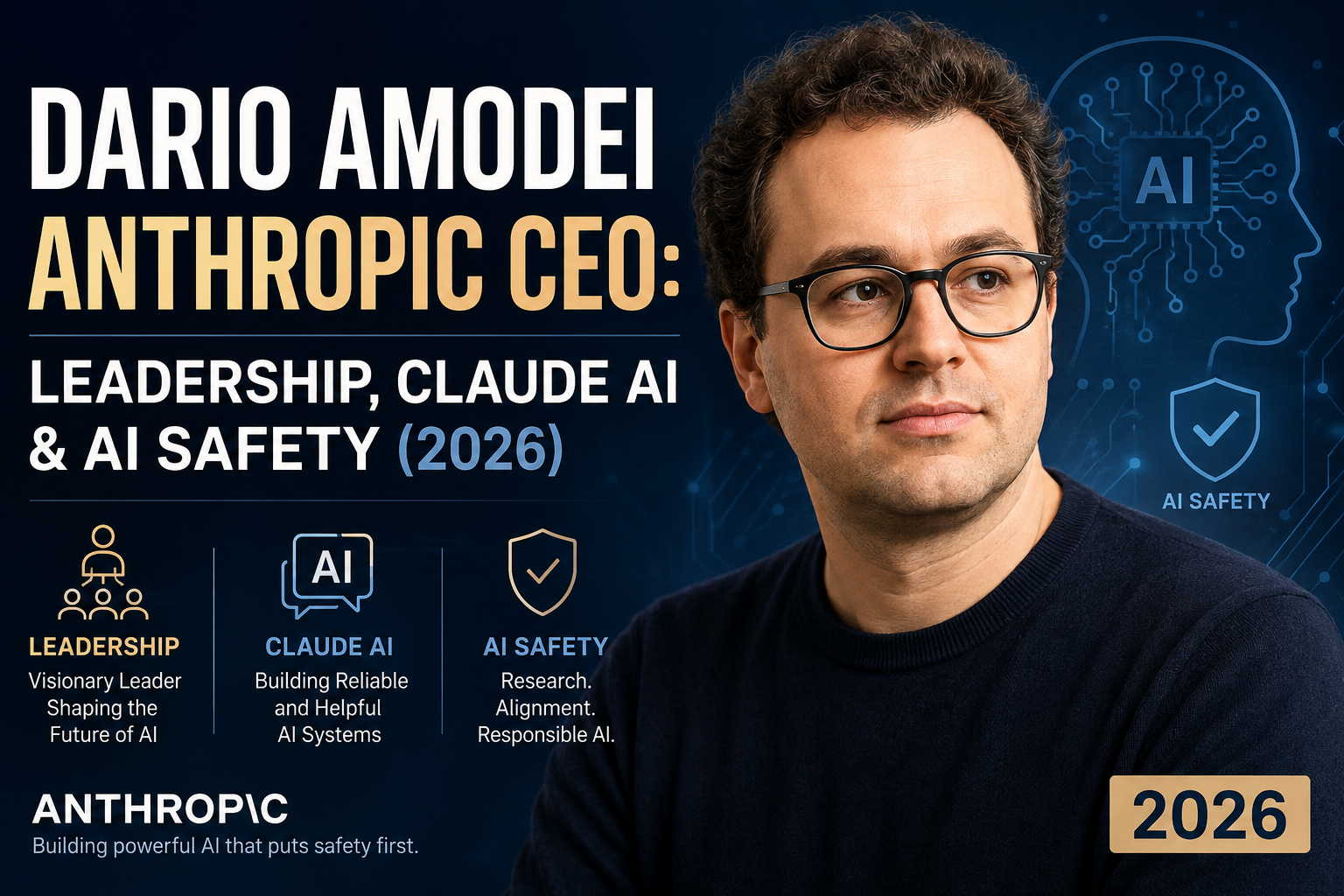

Dario Amodei: The Vision, Leadership Style, and AI Philosophy Shaping Anthropic
Dario Amodei, Anthropic CEO: Artificial intelligence has rapidly evolved from a niche research field into one of the world’s most competitive industries. As AI systems become more capable, the people leading their development have gained significant influence over technology, business, and public policy. Among these leaders, Dario Amodei has emerged as one of the most closely watched figures.
Known for combining deep technical expertise with a strong focus on AI safety, Amodei has helped shape conversations about how advanced AI should be developed and governed. His work spans scientific research, executive leadership, and public advocacy for responsible innovation. Rather than viewing artificial intelligence solely as a race to build the most powerful models, he has consistently emphasised the importance of creating systems that remain useful, transparent, and aligned with human interests.
As co-founder and CEO of Anthropic, Amodei oversees one of the world’s leading AI companies. Anthropic’s Claude family of language models competes directly with products from OpenAI, Google, Meta, and other major technology organisations. Under his leadership, the company has attracted substantial investment, expanded rapidly, and become a central participant in discussions about the future of generative AI.
This article explores Dario Amodei’s background, career journey, leadership philosophy, contributions to AI research, and why his ideas continue to influence the direction of the industry.
Who Is Dario Amodei?
Dario Amodei is an American artificial intelligence researcher, entrepreneur, and executive best known as the co-founder and CEO of Anthropic. Throughout his career, he has focused on developing advanced machine learning systems while addressing the broader challenges associated with increasingly capable AI.
Unlike many technology executives who transition into management from business backgrounds, Amodei built his reputation through scientific research. His experience in computational biology, neuroscience, and deep learning provided the analytical foundation that later influenced his approach to artificial intelligence.
Today, he is recognised for balancing two important priorities:
- Advancing frontier AI capabilities
- Promoting responsible AI development
This combination has made him one of the industry’s most influential voices.
Quick Profile
| Detail | Information |
|---|---|
| Full Name | Dario Amodei |
| Profession | AI Researcher, Entrepreneur |
| Current Role | CEO and Co-founder of Anthropic |
| Industry | Artificial Intelligence |
| Expertise | Machine Learning, AI Safety, Deep Learning |
| Known For | Anthropic, Claude AI, AI Alignment Research |
Why Dario Amodei Matters in Today’s AI Industry
The AI landscape has changed dramatically over the last decade. Organisations are no longer competing solely on computing power or model size. Instead, they are also competing for top researchers, responsible deployment strategies, and public trust.
Amodei represents this newer generation of AI leadership.
His influence extends beyond building products because he regularly contributes to discussions involving:
- AI safety
- Alignment research
- Ethical deployment
- Long-term societal impact
- Government policy conversations
- Responsible scaling of advanced AI
As businesses increasingly integrate AI into everyday operations, these topics have become just as important as technological performance.
Early Life and Academic Background
Long before becoming one of the best-known names in artificial intelligence, Dario Amodei developed a strong interest in scientific problem-solving.
His educational background reflects curiosity across multiple disciplines rather than focusing exclusively on computer science.
Areas that influenced his thinking include:
- Mathematics
- Physics
- Biology
- Neuroscience
- Computational modeling
This interdisciplinary approach later became one of his greatest strengths. Understanding biological systems helped shape how he approached complex learning systems and neural networks.
Instead of viewing intelligence purely through the lens of programming, he explored how learning emerges from interconnected systems.
That perspective continues to influence his work today.
Scientific Research Before Artificial Intelligence
Before becoming deeply involved in modern AI research, Amodei worked in computational biology and neuroscience.
These fields required analysing enormous datasets while developing models capable of identifying meaningful patterns.
Many of the same principles later became essential in machine learning:
- Pattern recognition
- Statistical inference
- Optimization
- Large-scale computation
- Predictive modeling
Although AI eventually became his primary focus, these earlier experiences helped him understand how complex systems behave under uncertainty.
Transition Into Machine Learning
As deep learning began transforming artificial intelligence during the 2010s, Amodei shifted more of his research toward neural networks.
The rapid improvement of machine learning presented opportunities to solve problems that previously seemed impossible.
Researchers started building systems capable of:
- Language understanding
- Image recognition
- Scientific discovery
- Code generation
- Decision support
Amodei became increasingly involved in pushing these capabilities forward while examining the associated risks.
Rather than asking only the following:
“How can AI become smarter?”
he also considered:
“How can increasingly intelligent AI remain reliable, predictable, and beneficial?”
That question continues to define much of his work.
Joining OpenAI
One of the most significant chapters in Dario Amodei’s career began when he joined OpenAI.
At the time, OpenAI was growing into one of the world’s leading AI research organisations.
The company’s mission centred on advancing artificial intelligence while ensuring that its benefits could reach society broadly.
During his time there, Amodei worked alongside leading researchers on frontier machine learning projects.
His responsibilities included:
- Research leadership
- Scaling neural networks
- Model evaluation
- Safety research
- Long-term AI planning
These experiences placed him at the centre of some of the most important breakthroughs in generative AI.
Contributions During His OpenAI Years
Although large AI projects involve hundreds of researchers, Amodei played an important leadership role in several areas.
His work focused on improving:
Large Language Models
He contributed to research involving increasingly capable language models that demonstrated impressive reasoning, writing, and conversational abilities.
Scaling Laws
One important research area examined how AI performance changes as the following:
- model size increases
- computing resources expand
- datasets become larger
Understanding these relationships helped organisations plan future generations of AI systems more efficiently.
AI Safety
Even while working on powerful AI systems, Amodei remained deeply interested in safety research.
Questions included:
- How should models be evaluated?
- How can harmful outputs be reduced?
- How should increasingly capable AI systems be monitored?
- What safeguards should exist before deployment?
These ideas would later become central to Anthropic’s philosophy.
Why AI Safety Became Central to His Thinking
Artificial intelligence is becoming increasingly capable.
Modern models can:
- write software
- summarize research
- analyze documents
- generate images
- solve complex reasoning tasks
- assist businesses
- automate workflows
However, greater capability also introduces new challenges.
Potential concerns include:
- inaccurate information
- unintended behavior
- misuse
- security risks
- bias
- transparency
- accountability
Rather than treating these issues as secondary, Amodei argued that safety research should advance alongside capability research.
This philosophy eventually distinguished his leadership from many competitors.
Leaving OpenAI
Eventually, Dario Amodei chose to leave OpenAI.
The decision attracted significant attention because he had become one of the organisation’s senior research leaders.
Like many major career transitions in the technology industry, multiple factors contributed to this move. Public discussions have often centred on differences in long-term priorities, organisational direction, and approaches to developing increasingly capable AI systems.
Rather than viewing safety as something addressed after powerful models are built, Amodei believed safety research should progress simultaneously with capability improvements.
That philosophy ultimately inspired the creation of a new company.
The Birth of Anthropic
In 2021, Dario Amodei and several colleagues founded Anthropic.
The company’s objective was straightforward in concept but ambitious in execution:
Build highly capable artificial intelligence while making safety, reliability, and alignment fundamental parts of the development process.
From the beginning, Anthropic emphasised research into the following:
- AI alignment
- interpretability
- constitutional training methods
- responsible deployment
- scalable oversight
- trustworthy model behavior
This approach differentiated the company from competitors by making safety not just a research topic but a core organisational principle.
Building a Different Kind of AI Company
Many AI startups focus primarily on releasing products as quickly as possible.
Anthropic adopted a somewhat different philosophy.
Its priorities included balancing the following:
- innovation
- research quality
- long-term planning
- careful evaluation
- commercial success
- responsible deployment
This does not mean slower innovation. Instead, the company has sought to integrate safety considerations throughout the research and development process rather than treating them as a final checklist before launch.
Anthropic’s Long-Term Vision
Under Dario Amodei’s leadership, Anthropic aims to create AI systems that are:
- Helpful
- Honest
- Harmless
- Reliable
- Transparent where possible
- Useful across diverse industries
These goals influence both research priorities and product development.
Rather than viewing advanced AI simply as another software product, Anthropic frames its work around building systems that people and organisations can depend on over time.
Introducing Claude AI
One of Anthropic’s most recognisable achievements is the Claude family of AI assistants.
Claude has become a major competitor in the rapidly expanding generative AI market.
Its capabilities include:
- Writing
- Coding assistance
- Data analysis
- Research support
- Business productivity
- Content generation
- Brainstorming
- Educational assistance
Claude is widely used by individuals, startups, enterprises, educators, developers, and research organisations seeking conversational AI with a strong emphasis on reliability and user experience.
Claude’s Design Philosophy
While many AI assistants share similar core capabilities, Anthropic has focused heavily on improving qualities such as:
- Clear reasoning
- Reduced hallucinations
- Better context handling
- Safer responses
- More natural conversations
- Strong document understanding
These priorities reflect Amodei’s broader belief that trust is an essential component of AI adoption.
Organisations are more likely to integrate AI into critical workflows when they believe the systems behave consistently and predictably.
Dario Amodei’s Leadership Style
Leading an AI company today involves much more than overseeing engineering teams or approving product launches. The rapid pace of innovation means executives must make decisions that influence not only business performance but also how society interacts with increasingly intelligent technology.
Dario Amodei has developed a leadership approach that blends scientific thinking with long-term strategic planning. Rather than focusing exclusively on short-term milestones, he encourages research that can continue delivering value years into the future.
Several characteristics define his leadership style:
- Evidence-based decision-making
- Long-term thinking
- Research-first culture
- Open scientific discussion
- Responsible innovation
- Careful risk assessment
Employees and industry observers often describe Anthropic as an organisation where researchers are encouraged to explore difficult problems rather than simply chase product deadlines.
This culture has helped attract engineers, scientists, and AI specialists interested in tackling some of the field’s most complex challenges.
Balancing Innovation with Responsibility
Many technology companies operate under intense competitive pressure. Releasing new features quickly can provide significant market advantages.
However, AI introduces challenges that extend beyond traditional software development.
For example, advanced models can:
- Generate persuasive text
- Write functional software
- Summarize sensitive documents
- Assist scientific research
- Influence business decisions
Because these systems increasingly affect real-world outcomes, Amodei argues that innovation and responsibility should move together instead of being treated as separate priorities.
This philosophy influences how Anthropic evaluates new models before they reach users.
What Makes Anthropic Different?
Although every major AI company has its own research priorities, Anthropic has consistently emphasised developing systems that are not only capable but also dependable.
Some distinguishing characteristics include:
| Focus Area | Anthropic’s Approach |
|---|---|
| Safety | Built into research process |
| Reliability | High priority during development |
| Transparency | Encouraged wherever practical |
| Long-Term Research | Major investment area |
| Alignment | Core organizational objective |
| Product Development | Guided by research findings |
This emphasis has become part of Anthropic’s public identity and influences both hiring decisions and research direction.
Understanding AI Alignment
One of the topics most closely associated with Dario Amodei is AI alignment.
The phrase may sound technical, but the concept is relatively straightforward.
AI alignment refers to designing artificial intelligence systems that behave in ways consistent with human goals and values.
For example, an aligned AI assistant should:
- Understand user intent accurately.
- Provide helpful information.
- Avoid generating harmful content.
- Recognise uncertainty instead of inventing answers.
- Respect safety boundaries.
- Adapt appropriately to different situations.
Alignment becomes increasingly important as AI systems become more capable and are trusted with more significant responsibilities.
Why Alignment Matters
Imagine an AI system assisting doctors, financial analysts, engineers, or government agencies.
If the system misunderstands instructions or confidently provides inaccurate information, the consequences could be substantial.
Effective alignment helps reduce risks such as the following:
- Incorrect recommendations
- Dangerous instructions
- Misleading responses
- Security vulnerabilities
- Unexpected behavior
- Poor decision support
While perfect alignment remains an ongoing research challenge, Amodei believes continuous improvement is essential as AI capabilities advance.
Constitutional AI Explained
One of Anthropic’s most notable research contributions is a training approach known as Constitutional AI.
Instead of relying entirely on human reviewers to evaluate responses, this approach encourages AI models to follow a structured set of guiding principles during training.
The idea resembles providing a system with a consistent framework for evaluating its own responses before presenting them to users.
Potential advantages include the following:
- More consistent behavior
- Improved reasoning
- Better handling of difficult questions
- Reduced harmful outputs
- Greater scalability
Rather than memorising fixed answers, the model learns to evaluate responses against broader principles.
This research direction reflects Amodei’s interest in creating AI systems capable of improving their reasoning processes while remaining aligned with human expectations.
Research Before Marketing
One noticeable aspect of Anthropic’s culture is its emphasis on scientific research.
Instead of measuring success solely by product releases, the company also invests heavily in:
- Model evaluation
- Safety research
- Interpretability
- Scaling research
- Benchmark testing
- Infrastructure improvements
This approach mirrors Amodei’s background as a scientist.
In research environments, solving foundational problems often creates more value over time than optimising only for immediate commercial gains.
AI Safety as an Engineering Discipline
Many people think of AI safety as a collection of ethical guidelines.
Amodei often frames it differently.
From his perspective, safety also represents a technical engineering challenge.
Researchers investigate questions such as the following:
Can AI explain its reasoning?
Understanding how a model reaches conclusions can improve trust and identify potential weaknesses.
How should models be tested?
Comprehensive evaluation helps identify limitations before systems are deployed widely.
Can harmful behaviour be reduced?
Researchers continually develop methods for minimising problematic outputs while maintaining usefulness.
How should increasingly powerful models be monitored?
As AI capabilities improve, oversight becomes more important throughout development and deployment.
The Growing Competition for AI Talent
The AI industry has entered a period of intense competition for highly skilled researchers and engineers.
Unlike many traditional technology roles, frontier AI research depends on a relatively small pool of experts with experience in:
- Machine learning
- Deep learning
- Distributed systems
- Model optimization
- Reinforcement learning
- AI safety
- Large-scale infrastructure
As demand for these specialists has grown, companies have invested heavily in recruiting and retaining top talent.
The Modern AI Talent War
Today, major AI organisations compete not only through products but also through people.
Leading companies seek researchers capable of advancing:
- Foundation models
- Multimodal AI
- Robotics
- Scientific AI
- Coding assistants
- Agentic systems
Competition involves organisations, including:
- Anthropic
- OpenAI
- Google DeepMind
- Meta
- Microsoft
- Amazon
- xAI
- Numerous AI startups
For experienced researchers, career opportunities have expanded dramatically over the past several years.
Compensation vs Mission
One recurring discussion within the AI industry involves employee motivation.
Some professionals prioritise:
- Compensation
- Equity packages
- Financial incentives
Others are drawn by:
- Scientific freedom
- Company mission
- Research opportunities
- Organizational culture
- Long-term impact
Amodei has frequently emphasised that many researchers are motivated by the opportunity to contribute to meaningful work rather than focusing exclusively on financial rewards.
While competitive compensation remains important, mission-driven cultures can play a significant role in attracting talented individuals.
Why Researchers Choose Anthropic
Although every employee has unique motivations, several factors make Anthropic appealing to AI researchers.
Strong Research Environment
Scientists often appreciate opportunities to investigate foundational AI questions instead of concentrating only on short-term product development.
Focus on Safety
Researchers interested in alignment and responsible AI may find Anthropic’s mission particularly compelling.
Collaborative Culture
The company encourages interdisciplinary collaboration across research, engineering, and product teams.
Long-Term Vision
Many employees value working toward ambitious scientific objectives rather than quarterly performance metrics alone.
Competing Against Industry Giants
Anthropic competes with some of the world’s largest technology companies.
This presents both opportunities and challenges.
Advantages
- Research-focused culture
- Clear mission
- Flexible organizational structure
- Strong investor backing
- Growing enterprise adoption
Challenges
- Competition for talent
- Massive infrastructure costs
- Rapid product cycles
- Intense market expectations
- Increasing regulatory attention
Despite these challenges, Anthropic has established itself as one of the leading organisations in frontier AI research.
Comparing Anthropic with Other AI Companies
| Company | Primary Strength |
|---|---|
| Anthropic | AI safety, alignment, Claude models |
| OpenAI | Broad AI ecosystem and consumer adoption |
| Google DeepMind | Large-scale research and infrastructure |
| Meta | Open-source AI initiatives and ecosystem development |
| Microsoft | Enterprise AI integration |
| xAI | Large-scale model development and infrastructure |
Each organisation contributes differently to the rapidly evolving AI landscape.
Rather than following identical strategies, they often emphasise distinct research priorities and business objectives.
Building Trust in Artificial Intelligence
Technical capability alone does not guarantee widespread adoption.
Businesses considering AI investments often ask questions such as:
- Can this model be trusted?
- Is it reliable?
- How accurate are its responses?
- How should sensitive information be handled?
- Can it integrate into existing workflows?
Amodei has repeatedly highlighted the importance of earning user trust through consistent performance and responsible development.
Without trust, even highly capable AI systems may struggle to achieve broad adoption.
Enterprise AI and Business Adoption
Organisations across industries increasingly use AI to improve productivity.
Common enterprise applications include:
- Customer support
- Software development
- Document analysis
- Legal research
- Marketing
- Education
- Healthcare administration
- Financial reporting
Enterprise customers often prioritise the following:
- Security
- Reliability
- Privacy
- Performance
- Predictable behavior
These priorities align closely with Anthropic’s emphasis on dependable AI systems.
Long-Term Thinking in AI
One recurring theme in Dario Amodei’s public discussions is the importance of planning beyond immediate product cycles.
Artificial intelligence continues advancing rapidly.
Questions that seem theoretical today may become practical within a relatively short period.
Examples include:
- More capable reasoning systems
- Autonomous AI agents
- Scientific discovery acceleration
- Personalized education
- Healthcare diagnostics
- Advanced software engineering assistance
Preparing for these developments requires ongoing research rather than reactive decision-making.
Dario Amodei’s Influence on AI Policy and Regulation
As artificial intelligence becomes more capable and widely deployed, governments around the world are working to determine how these systems should be governed. Unlike earlier waves of software innovation, advanced AI raises questions that extend into national security, education, healthcare, intellectual property, employment, and public trust.
Dario Amodei has become one of the industry’s most recognisable voices in these conversations. While he continues to lead cutting-edge AI research, he has also encouraged collaboration between technology companies, academic institutions, and policymakers.
His perspective generally centres on a simple idea:
Innovation should continue rapidly, but safeguards should evolve just as quickly.
Rather than viewing regulation as an obstacle, Amodei has suggested that well-designed frameworks can help create public confidence while allowing responsible technological progress.
Why AI Governance Matters
Artificial intelligence is now influencing decisions that affect millions of people every day.
Examples include:
- Medical documentation
- Financial analysis
- Software engineering
- Customer service
- Legal research
- Scientific discovery
- Education
- Government operations
As AI becomes integrated into critical infrastructure, organisations need clear standards regarding:
- Transparency
- Accountability
- Privacy
- Security
- Risk management
- Responsible deployment
Leaders like Amodei argue that building trust requires more than technical excellence—it also requires thoughtful governance.
A Practical Approach to AI Development
One reason Dario Amodei has gained attention is his ability to discuss highly technical topics in practical terms.
Instead of framing AI as either completely safe or inherently dangerous, he often describes it as a transformative technology that deserves careful engineering and continuous evaluation.
This balanced perspective has resonated with:
- Business leaders
- Policymakers
- Researchers
- Investors
- Enterprise customers
It also reflects Anthropic’s broader philosophy that capability and responsibility should advance together.
Anthropic’s Business Growth
Although Anthropic began as a research-focused startup, it has quickly evolved into one of the world’s leading AI companies.
Several factors have contributed to its rapid expansion:
Strong Investor Confidence
Building frontier AI requires enormous investments in computing infrastructure, specialised hardware, and world-class talent.
Anthropic has attracted significant backing from major technology and investment partners, allowing the company to expand research while developing commercial products.
Enterprise Adoption
Businesses increasingly seek AI systems that can support real-world operations.
Claude has found applications in areas such as the following:
- Customer support
- Programming assistance
- Internal knowledge management
- Research
- Writing
- Document analysis
- Workflow automation
Many organisations value dependable performance, strong context handling, and enterprise-focused capabilities.
Research Reputation
Anthropic continues publishing research that contributes to broader AI understanding.
Its work in areas such as:
- Alignment
- Constitutional AI
- Model evaluation
- Interpretability
- Safety techniques
has strengthened its reputation within the research community.
Challenges Facing Anthropic
Despite its impressive growth, Anthropic faces significant challenges shared by nearly every frontier AI company.
1. Intense Competition
The AI market evolves at extraordinary speed.
Competitors continuously introduce the following:
- New language models
- Coding assistants
- Enterprise platforms
- Multimodal capabilities
- AI agents
Maintaining leadership requires continuous innovation.
2. Infrastructure Costs
Training advanced AI models requires the following:
- Massive computing clusters
- High-performance GPUs
- Large datasets
- Energy resources
- Specialized engineering teams
Infrastructure investment remains one of the largest barriers to entry in frontier AI research.
3. User Expectations
Modern AI users expect systems to be the following:
- Fast
- Accurate
- Helpful
- Reliable
- Secure
- Easy to use
Meeting all of these expectations simultaneously presents ongoing engineering challenges.
4. Regulatory Changes
Governments continue developing policies covering:
- AI transparency
- Data privacy
- Consumer protection
- Model evaluation
- Security standards
Companies must adapt as legal and regulatory landscapes evolve.
Criticism and Public Debate
Like other prominent AI leaders, Dario Amodei’s ideas have sparked healthy debate within the technology community.
Some critics argue the following:
- AI companies move too quickly.
- Existing safeguards should become even stronger.
- Greater transparency is needed.
- More public oversight should exist.
Others believe excessive regulation could slow innovation and reduce competitiveness.
These differing viewpoints illustrate the complexity of governing a rapidly evolving technology.
While opinions vary, most experts agree that discussions around AI safety, ethics, and regulation will remain central as the field advances.
The Future of Artificial Intelligence
Predicting the future of AI is difficult, but several trends appear likely to shape the next decade.
More Powerful Models
Language models will likely continue improving in:
- Reasoning
- Coding
- Mathematics
- Planning
- Scientific research
Greater Personalization
Future AI systems may better understand individual preferences, work styles, and long-term projects while respecting privacy controls.
Enterprise Transformation
Businesses will increasingly integrate AI into the following:
- Operations
- Customer support
- Internal documentation
- Data analysis
- Automation
- Decision support
Scientific Discovery
Artificial intelligence could accelerate research across the following:
- Medicine
- Chemistry
- Materials science
- Climate modeling
- Biology
- Engineering
AI Collaboration
Instead of replacing humans, many organisations are likely to focus on AI systems that enhance productivity through collaboration.
This aligns closely with Amodei’s vision of AI serving as a capable assistant rather than an independent replacement for human expertise.
Lessons Entrepreneurs Can Learn from Dario Amodei
Although his work centres on artificial intelligence, several broader business lessons emerge from Amodei’s career.
Build Around a Clear Mission
Organisations with a well-defined purpose often attract employees, customers, and partners who share similar values.
Mission alone is not enough, but it can strengthen long-term culture.
Invest in Research
Sustainable innovation often begins years before commercial success becomes visible.
Companies that continue investing in foundational research may create lasting competitive advantages.
Think Long-Term
Many successful technology leaders prioritise decisions that create value over decades rather than focusing exclusively on quarterly performance.
Hire Exceptional People
Advanced industries depend heavily on talented teams.
Recruiting, supporting, and retaining skilled professionals often becomes a company’s greatest competitive advantage.
Balance Speed and Quality
Moving quickly is valuable.
Maintaining quality while scaling can be even more important.
Successful organisations continuously improve rather than simply releasing products as fast as possible.
Dario Amodei’s Lasting Impact
Whether discussing AI safety, research strategy, or leadership, Dario Amodei has influenced how many people think about artificial intelligence.
His contributions extend beyond individual products.
They include:
- Advancing alignment research
- Promoting responsible AI development
- Encouraging long-term scientific thinking
- Building one of the world’s leading AI organizations
- Expanding discussions about AI governance
As AI continues evolving, his ideas are likely to remain part of broader conversations about technology’s future.
Frequently Asked Questions
Who is Dario Amodei?
Dario Amodei is an artificial intelligence researcher and entrepreneur best known as the co-founder and CEO of Anthropic, an AI company focused on developing advanced language models and AI safety research.
What is Dario Amodei known for?
He is widely recognised for his leadership in frontier AI research, contributions to AI alignment, and guiding the development of Anthropic’s Claude AI models.
What company does Dario Amodei lead?
He serves as the CEO of Anthropic.
What is Anthropic?
Anthropic is an artificial intelligence company that develops large language models and conducts research into AI safety, alignment, and responsible deployment.
What is Claude AI?
Claude is Anthropic’s family of conversational AI assistants designed for writing, coding, reasoning, research, and enterprise productivity.
Did Dario Amodei work at OpenAI?
Yes. Before founding Anthropic, he held a senior research leadership role at OpenAI, where he contributed to large-scale AI research and model development.
Why did Dario Amodei found Anthropic?
Anthropic was established to pursue advanced AI research while placing a strong emphasis on safety, reliability, and alignment throughout the development process.
What is AI alignment?
AI alignment refers to designing AI systems that behave consistently with intended human goals, values, and instructions.
What is Constitutional AI?
Constitutional AI is a research approach developed by Anthropic that trains AI systems to evaluate responses using guiding principles rather than relying solely on human feedback.
Why is Dario Amodei important?
He has helped shape discussions around responsible AI development while leading one of the world’s most influential AI research organisations.
How does Anthropic differ from other AI companies?
Anthropic places particular emphasis on AI safety, model reliability, alignment research, and long-term responsible development alongside advancing model capabilities.
What industries use Claude AI?
Claude is used across software development, education, finance, healthcare administration, legal services, customer support, research, and enterprise productivity.
What leadership qualities define Dario Amodei?
His leadership is often associated with scientific rigour, long-term thinking, evidence-based decision-making, collaboration, and a strong focus on responsible innovation.
What challenges does Anthropic face?
Key challenges include intense industry competition, infrastructure costs, regulatory changes, rapidly evolving user expectations, and attracting top AI talent.
What is Dario Amodei’s vision for AI?
His vision emphasises creating highly capable AI systems that remain useful, reliable, and aligned with human interests while advancing scientific research responsibly.
Key Takeaways
| Topic | Summary |
|---|---|
| Profession | AI Researcher and Entrepreneur |
| Company | Anthropic |
| Role | CEO and Co-founder |
| Major Focus | AI Safety and Alignment |
| Known Product | Claude AI |
| Leadership Style | Research-driven and Long-Term Focused |
| Industry Impact | Responsible AI Development |
| Key Philosophy | Build Powerful AI Responsibly |
Read More: GoogleBook Designed for Gemini Intelligence | Future of AI Computing
Final Thoughts
Artificial intelligence is entering a period of extraordinary growth, and the decisions made by today’s leaders will shape how this technology affects businesses, governments, and everyday life. Dario Amodei has distinguished himself by advocating that progress should be measured not only by how capable AI becomes but also by how reliably and responsibly it serves people.
Through Anthropic, he has demonstrated that research excellence, commercial success, and a commitment to safety can coexist. While debates about AI regulation, competition, and ethics will undoubtedly continue, his emphasis on thoughtful innovation has already influenced the broader industry.
For readers interested in the future of AI, Dario Amodei’s career offers an important case study in how scientific curiosity, strategic leadership, and long-term vision can come together to shape one of the most transformative technologies of our time.