
Introduction
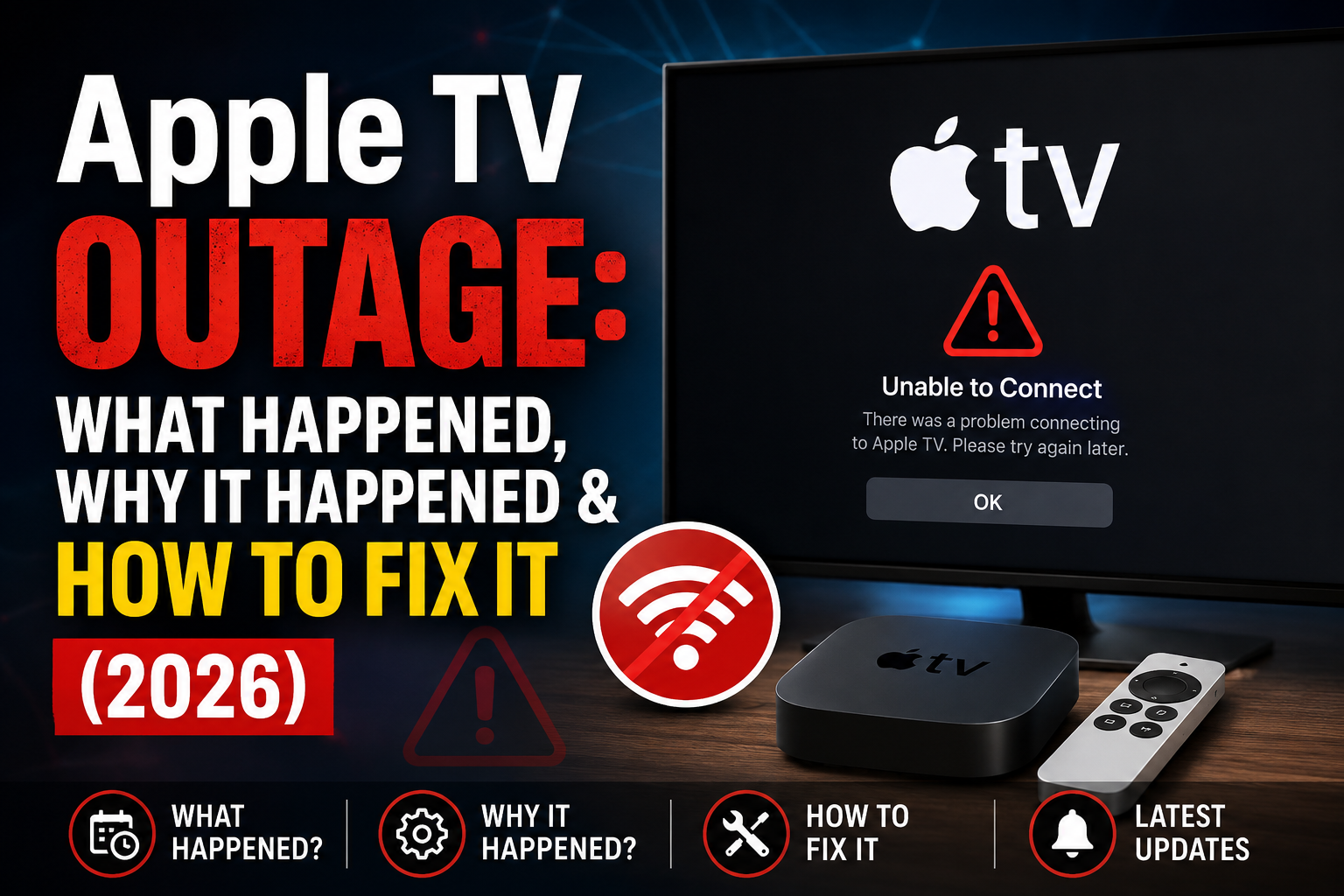
Streaming services have become an essential part of everyday entertainment, allowing millions of people to watch movies, TV shows, live sports, and original content whenever they want. When a major platform suddenly stops working, even for a short period, it quickly becomes one of the most talked-about topics online. That’s exactly what happened during the recent Apple TV outage, when many users found themselves unable to access Apple TV and several other Apple-powered services.
As reports spread across social media and outage tracking platforms, users began asking the same questions:
- Is Apple TV down?
- Why isn’t Apple TV working?
- Is the problem on my device or Apple’s servers?
- When will Apple TV be back online?
The outage affected users differently depending on their location and the Apple services they were using. While some people experienced complete service interruptions, others noticed slower loading times, playback failures, login issues, or errors when trying to stream content.
Although service disruptions are relatively uncommon for Apple, they can still happen. Modern digital services rely on massive cloud infrastructure, authentication systems, content delivery networks (CDNs), payment services, and regional servers. If one critical component experiences technical difficulties, it can temporarily affect millions of users across multiple products.
This guide explains everything you need to know about the recent Apple TV outage, including what happened, which services were affected, how users were impacted, and what the incident reveals about today’s connected streaming ecosystem. Whether you’re an Apple TV subscriber, an Apple device owner, or simply curious about the outage, this article provides a comprehensive overview in clear and easy-to-understand language.
What Is Apple TV?
Before discussing the outage itself, it’s helpful to understand what people mean when they refer to “Apple TV”. The name actually represents several related products and services rather than a single platform.
| Apple Product | Description |
|---|---|
| Apple TV App | A streaming application available on Apple devices and many smart TVs. |
| Apple TV+ | Apple’s subscription streaming service featuring exclusive original shows and movies. |
| Apple TV 4K | Apple’s dedicated streaming hardware device. |
| Apple TV Channels | Third-party premium subscriptions that can be accessed through the Apple TV app. |
Because these services are interconnected, a technical issue affecting Apple’s backend infrastructure can sometimes impact several features simultaneously.
For example, a user might still be able to power on an Apple TV device but be unable to:
- Sign in
- Browse content
- Start a movie
- Resume an existing show
- Purchase or rent media
- Synchronize watch history
This distinction became especially important during the recent outage, as not every Apple TV feature was affected in exactly the same way.
Understanding the Apple TV Outage
The recent Apple TV outage was part of a broader service disruption involving multiple Apple online services. Rather than being limited to a single application, the incident affected cloud-based systems that many Apple products depend upon.
As users attempted to access Apple TV, they encountered a variety of unexpected problems. While the exact experience differed between individuals, common issues included:
- Apps failing to load
- Endless loading screens
- Playback interruptions
- Login failures
- Account verification problems
- Unexpected error messages
- Streaming sessions stopping unexpectedly
At roughly the same time, users also reported issues with several additional Apple services, suggesting that the disruption extended beyond Apple TV itself.
Whenever multiple cloud services experience problems simultaneously, it usually indicates that the issue lies within shared backend infrastructure rather than individual user devices.
How the Situation Unfolded
Like many modern internet service disruptions, the incident unfolded rapidly.
Initially, only a small number of users noticed something unusual. They attempted to stream content but found the service responding much more slowly than expected.
Within minutes:
- Social media posts increased rapidly.
- Users compared experiences.
- Outage reporting websites began showing spikes in complaints.
- Technology communities started investigating.
- Apple users searched for confirmation that the issue wasn’t isolated.
As more reports emerged, it became clear that the disruption extended beyond a single geographic region.
Many people initially assumed:
- Their Wi-Fi had stopped working.
- Their television had frozen.
- Their Apple TV device required restarting.
- Their internet provider was experiencing issues.
However, after basic troubleshooting failed, attention shifted toward Apple’s online infrastructure.
Signs That Apple TV Was Experiencing Problems
Service interruptions can appear differently depending on the affected system. During this outage, users reported a wide variety of symptoms.
Playback Problems
Some viewers could browse content but were unable to actually start streaming.
Common examples included:
- Videos refusing to play
- Infinite buffering
- Playback stopping after a few seconds
- Unexpected loading screens
Login Issues
Another noticeable symptom involved authentication.
Some users experienced:
- Sign-in failures
- Session expiration errors
- Account verification loops
- Authentication timeouts
Because streaming platforms rely on secure account verification, even minor issues with login services can prevent access to otherwise available content.
App Loading Errors
Instead of opening normally, some versions of the Apple TV app appeared to
- Freeze during launch
- Display blank screens
- Fail to retrieve recommendations
- Show missing artwork
- Display generic connection errors
These symptoms often indicate communication problems between the application and Apple’s cloud servers.
Sync Problems
Apple’s ecosystem automatically synchronises information between devices.
When backend services encounter difficulties, users may notice:
- Watch history not updating
- Continue Watching missing
- Purchased content unavailable
- Library synchronization delays
- Recently viewed titles disappearing temporarily
Which Users Were Affected?
One important aspect of the outage was that not every user experienced identical issues.
Cloud-based services frequently operate through distributed infrastructure spread across multiple regions. As a result:
- Some users experienced complete outages.
- Others noticed only slower performance.
- Some could stream normally.
- Others encountered repeated failures.
Factors influencing user experience included:
- Geographic region
- Local server routing
- Device type
- Network path
- Cached authentication tokens
- Individual account session timing
This explains why two people in different locations—or even within the same city—could have completely different experiences during the same outage.
Services That Appeared to Experience Related Issues
Although the focus of public discussion centred on Apple TV, reports indicated that several Apple online services also experienced temporary difficulties.
These included cloud-based features that share common infrastructure, such as authentication, account services, media delivery, and digital content management.
Some users also reported temporary issues involving:
- Music streaming
- Cloud account services
- Media purchases
- Subscription verification
- Content synchronization
The broader nature of these reports suggested that the interruption was not limited to a single entertainment platform.
Why Modern Streaming Platforms Sometimes Experience Outages
Many people assume that global technology companies operate with perfect reliability. In reality, every online platform depends on highly complex systems working together in real time.
A streaming request might involve:
- User authentication
- Subscription verification
- Account permissions
- Regional licensing checks
- CDN routing
- Video encoding services
- Encryption verification
- Playback authorization
- Analytics systems
- Device synchronization
If one critical service experiences unexpected problems, the effects can cascade throughout the platform.
That doesn’t necessarily mean the video servers themselves are offline. Sometimes the content exists and is ready to stream—but users simply can’t reach it because another supporting service is unavailable.
Common User Reactions During the Outage
When a major streaming service experiences downtime, users often follow a familiar pattern.
Step 1: Assume It’s a Personal Issue
Most people begin by checking the following:
- Their Wi-Fi connection
- Their modem
- Their television
- Their streaming device
Step 2: Restart Everything
Many users attempt to solve the issue by:
- Restarting Apple TV
- Closing the app
- Rebooting the television
- Resetting the router
Step 3: Check Other Apps
If Netflix, YouTube, Disney+, or other streaming services continue working normally, users often suspect the issue is specific to Apple TV.
Step 4: Search Online
Searches quickly increase for phrases such as the following:
- Apple TV down
- Apple TV outage
- Apple TV not working
- Apple TV servers
- Apple TV problems today
Step 5: Wait for Official Updates
Once it becomes clear that the issue affects many users, attention shifts toward official status updates while technical teams investigate and restore service.
Why Outages Spread So Quickly Across Social Media
Today’s internet users notice service interruptions almost immediately.
Platforms like X, Reddit, Threads, and community forums allow thousands of people to compare experiences in real time.
Within minutes of an outage, users typically begin sharing:
- Screenshots of error messages
- Videos of loading issues
- Questions about service availability
- Device-specific problems
- Regional experiences
This rapid exchange of information often helps identify widespread technical issues long before formal announcements are made.
It also reduces unnecessary troubleshooting by confirming that the problem isn’t isolated to a single household or device.
Early Lessons From the Apple TV Outage
Although temporary service interruptions are frustrating, they also highlight several important realities about modern digital entertainment.
Streaming Relies on Cloud Infrastructure
Even locally installed apps depend on remote servers for authentication, content delivery, subscriptions, and synchronisation.
Hardware Isn’t Always the Problem
A functioning Apple TV device cannot access online features if supporting cloud services experience difficulties.
Multiple Services Can Share the Same Infrastructure
A single backend issue may temporarily affect several Apple services at once, even if users only notice problems with Apple TV first.
Patience Often Saves Time
Repeatedly reinstalling apps or resetting devices is unlikely to resolve an issue caused by a server-side outage. Confirming whether the problem is widespread before making major changes can help avoid unnecessary troubleshooting.
Why Apple TV Outages Happen: The Technology Behind Service Disruptions
Understanding why an Apple TV outage occurs can help users respond more effectively when streaming problems arise. Although Apple is known for its reliable ecosystem, no online service is completely immune to technical issues. Even companies with sophisticated infrastructure occasionally face unexpected disruptions.
Unlike older television systems that relied solely on cable or satellite signals, modern streaming platforms depend on multiple cloud-based technologies working together in real time. If one critical component encounters problems, users may experience playback failures, login issues, or complete service interruptions.
Let’s explore the most common reasons why an Apple TV outage can occur.
How Apple TV Delivers Streaming Content
When you press the Play button on a movie or TV show, a surprising number of systems work together within seconds.
A simplified streaming process looks like this:
| Step | What Happens |
|---|---|
| 1 | Your device checks your internet connection. |
| 2 | Apple verifies your Apple ID and subscription. |
| 3 | The request is routed to the nearest server. |
| 4 | Content Delivery Networks (CDNs) locate the video. |
| 5 | The video begins streaming in the appropriate quality. |
| 6 | Your viewing progress syncs across devices. |
If any one of these steps encounters a problem, streaming may fail—even if everything else is functioning correctly.
Common Causes of an Apple TV Outage
1. Server Infrastructure Problems
The most common cause of widespread outages is an issue with Apple’s cloud infrastructure.
Modern cloud platforms operate thousands of interconnected servers across different regions. These servers handle:
- User authentication
- Streaming requests
- Purchase verification
- Subscription management
- Watch history
- Recommendations
- Content libraries
If one of these backend systems experiences difficulties, millions of users may notice service interruptions almost simultaneously.
2. Authentication Service Failures
Every Apple service depends on secure account verification.
Before allowing access, Apple typically confirms:
- Apple ID credentials
- Active subscriptions
- Device authorisation
- Regional permissions
- Purchase history
If authentication services experience problems, users might see:
- Login failures
- “Unable to Connect” messages
- Endless loading screens
- Requests to sign in repeatedly
Interestingly, the streaming servers themselves may still be working perfectly—the issue lies in verifying user access.
3. Content Delivery Network (CDN) Issues
Streaming platforms don’t send every movie from one central location.
Instead, they rely on content delivery networks (CDNs), which store copies of content on servers around the world.
Benefits include:
- Faster loading
- Reduced buffering
- Better video quality
- Lower latency
However, if part of the CDN experiences technical problems, users in certain regions may experience slower streaming or temporary outages while others remain unaffected.
4. Software Deployment Problems
Technology companies frequently update their services.
Updates may include:
- Security improvements
- Performance enhancements
- Bug fixes
- New features
- Infrastructure upgrades
Despite extensive testing, an unexpected issue can occasionally appear after deployment, affecting users until engineers identify and resolve the problem.
5. Database Synchronisation Issues
Apple’s ecosystem continuously synchronises information across devices.
Examples include:
- Watch history
- Continue Watching
- Purchased content
- User preferences
- Family Sharing access
If databases temporarily lose synchronisation, users might notice missing content or delayed updates.
6. Third-Party Infrastructure Issues
Even large technology companies sometimes rely on external partners for parts of their infrastructure.
Potential dependencies include:
- Network routing
- Internet exchange points
- DNS services
- Cloud networking
- Security filtering
A problem affecting one of these components can indirectly impact streaming services.
Apple TV App vs Apple TV+ vs Apple TV Device
One of the biggest sources of confusion during an Apple TV outage is the terminology.
Many users use the term “Apple TV” to describe three different products.
| Product | Purpose |
|---|---|
| Apple TV Device | Physical streaming hardware connected to a television. |
| Apple TV App | Application used to access streaming content. |
| Apple TV+ | Subscription streaming service featuring Apple Originals. |
Understanding the difference helps identify where a problem might exist.
Example 1
Your Apple TV hardware powers on normally.
But:
- Apple TV+ won’t load.
- Movies won’t play.
- Login fails.
This usually indicates an online service issue rather than a hardware problem.
Example 2
Your Apple TV device won’t start at all.
This may indicate:
- Hardware failure
- Power issues
- Software corruption
- Local device problems
In this case, the issue is unrelated to an Apple service outage.
How to Tell Whether Apple TV Is Down
Before spending time troubleshooting your device, it’s worth determining whether the issue is widespread.
Here are several practical ways to check.
Check Other Apple Services
Ask yourself:
- Is Apple Music working?
- Can you access the App Store?
- Does iCloud sync normally?
- Are Apple Podcasts loading?
If several Apple services experience problems simultaneously, the issue may extend beyond Apple TV.
Test Other Streaming Platforms
Try opening another streaming service.
Examples include:
- Netflix
- Disney+
- Hulu
- Prime Video
- YouTube
If these services work normally while Apple TV does not, the issue is more likely specific to Apple’s ecosystem.
Use Apple’s system status page.
Apple maintains an official System Status page that provides updates on many of its online services.
It can indicate whether services are operating normally or if Apple has identified an ongoing issue.
Check outage tracking websites.
Independent outage monitoring platforms collect user reports from around the world.
A sudden increase in reports often indicates a widespread service disruption rather than an isolated problem.
Search Social Media
Users frequently report problems within minutes.
Searching for terms like:
- Apple TV outage
- Apple TV down
- Apple TV not working
can quickly reveal whether others are experiencing similar issues.
Step-by-Step Troubleshooting Guide
If you’re unsure whether the issue is caused by your device or an Apple outage, work through the following checklist.
Step 1: Check Your Internet Connection
Confirm that:
- Wi-Fi is connected.
- Other devices can browse websites.
- Speed appears normal.
Step 2: Restart the Apple TV device.
A simple restart often resolves temporary software glitches.
Restart:
- Apple TV
- Smart TV
- Streaming box
- Internet router (if necessary)
Step 3: Force-Close the Apple TV App
Sometimes the application itself becomes temporarily unresponsive.
Closing and reopening the app may restore normal functionality.
Step 4: Update Software
Ensure both:
- Apple TV software
- Streaming applications
are running the latest available versions.
Software updates frequently contain stability improvements.
Step 5: Verify Your Apple ID
Check whether:
- You’re signed in correctly.
- Your subscription remains active.
- Your account credentials are accepted.
Step 6: Wait Before Resetting
Avoid immediately performing:
- Factory resets
- Device erasure
- Account deletion
- Subscription cancellation
If the problem is caused by an Apple server outage, these actions are unlikely to help.
Problems Users Report Most Often During Outages
Although every outage differs, similar symptoms appear repeatedly.
Streaming Issues
Users commonly report:
- Endless buffering
- Playback errors
- Black screens
- Frozen loading indicators
Library Problems
Some people notice:
- Purchased movies missing
- TV shows unavailable
- Recently watched content disappearing
These issues often resolve automatically once services recover.
Account Errors
Common authentication messages include:
- Unable to verify account
- Login failed
- Session expired
- Unable to connect
Synchronisation Delays
Apple devices constantly exchange information.
Temporary outages may interrupt:
- Viewing history
- Recommendations
- Continue Watching
- Device syncing
How Apple Typically Responds to Service Disruptions
Large technology companies generally follow a structured incident response process.
Although the exact details vary, the workflow usually includes:
Phase 1: Detection
Monitoring systems identify unusual activity.
Examples include:
- Increased error rates
- Server failures
- Traffic anomalies
- Authentication problems
Phase 2: Investigation
Engineers analyse:
- System logs
- Network traffic
- Infrastructure performance
- Recent software changes
to determine the root cause.
Phase 3: Mitigation
Temporary measures may include:
- Redirecting traffic
- Restarting affected services
- Rolling back recent updates
- Activating backup systems
Phase 4: Recovery
As systems stabilise:
- Users gradually regain access.
- Performance improves.
- Error rates decrease.
- Normal operations resume.
Phase 5: Post-Incident Review
After recovery, engineering teams often conduct internal reviews to understand:
- What caused the outage
- How it spread
- Which safeguards can reduce the risk of similar incidents in the future
How Outages Affect Different Types of Users
Not everyone experiences an outage in the same way.
Casual Viewers
May simply postpone watching a film until service returns.
Families
Shared accounts can affect multiple users across different devices at once.
Travellers
Those relying on hotel Wi-Fi or mobile connections may find it harder to determine whether the issue is local or service-wide.
Smart Home Users
Some Apple TV devices act as Home Hub controllers. Depending on the nature of the disruption, certain connected-home features may also behave unexpectedly until services recover.
Practical Tips for Future Apple TV Outages
If another outage occurs, these best practices can save time and frustration:
- Stay calm and avoid repeated sign-in attempts.
- Confirm whether the issue is widespread before changing device settings.
- Check Apple’s official System Status page.
- Verify your internet connection with another service.
- Wait for official updates if the issue is confirmed to be server-side.
- Avoid unnecessary factory resets unless a local hardware problem has been identified.
- Keep your Apple TV software updated to benefit from the latest fixes and improvements.
What Happened After the Apple TV Outage?
As with many large-scale cloud incidents, service recovery did not happen for every user at exactly the same moment. Once Apple’s engineering teams addressed the underlying issue, systems gradually returned to normal rather than switching back instantly worldwide.
This phased recovery is common because global services rely on distributed infrastructure spread across multiple regions. As servers reconnect, cached data refreshes, and traffic balances across networks, users may regain access at slightly different times.
During the recovery period, some users experienced:
- Successful logins but slower app performance
- Videos loading after multiple attempts
- Delayed synchronization of watch history
- Missing recommendations that later reappeared
- Temporary playback interruptions before normal streaming resumed
Fortunately, most of these issues resolved automatically without requiring users to change any settings.
What Users Should Do After an Outage Ends
Once services are restored, it’s a good idea to confirm that everything is working correctly.
Check Your Account
Verify that:
- Your Apple ID is signed in.
- Your subscription is active.
- Purchased content appears correctly.
- Family Sharing (if used) functions normally.
Test Streaming
Open several types of content, such as:
- Movies
- TV series
- Recently watched titles
- Apple Originals
This helps confirm that both playback and account services have fully recovered.
Restart Only If Necessary
If problems continue after Apple’s systems are restored, try:
- Closing the Apple TV app.
- Restarting the device.
- Checking for software updates.
Avoid resetting your device unless the issue clearly appears to be local rather than service-wide.
Lessons Learned from the Apple TV Outage
Every service disruption provides valuable insights for both users and technology providers.
1. Cloud Services Are Highly Connected
Streaming platforms rely on much more than video servers. Authentication, subscriptions, recommendations, licensing, and synchronisation all work together behind the scenes.
A problem affecting one component can influence many others.
2. Not Every Error Means Your Device Is Broken
Many users immediately assume:
- Their Apple TV has failed.
- Their internet provider is at fault.
- Their television needs updating.
In reality, the issue may be entirely outside their home network.
3. Official Status Pages Save Time
Checking official service status before troubleshooting can prevent unnecessary
- Factory resets
- Password changes
- App reinstallations
- Router resets
4. Distributed Systems Recover Gradually
Even after engineers resolve the root cause, services often stabilise over time rather than instantly.
Patience during this phase is usually more effective than repeatedly restarting devices.
Comparing Apple TV Outages with Other Streaming Service Interruptions
Apple is not alone in experiencing occasional service disruptions. Nearly every major streaming platform has faced temporary outages at some point.
Platform Common Causes of Outages Apple TV Authentication, cloud infrastructure, backend services Netflix Regional server issues, CDN disruptions, software deployments Disney+ High-traffic events, infrastructure maintenance Prime Video Network congestion, service updates Hulu Authentication, streaming platform maintenance Although the technical details differ, the overall user experience is often similar:
- Apps fail to load.
- Playback stops unexpectedly.
- Users receive connection errors.
- Services gradually recover.
The important takeaway is that occasional outages are an industry-wide challenge rather than something unique to Apple.
Why Streaming Services Prioritize Reliability
Millions of people rely on streaming platforms every day for:
- Entertainment
- Live sports
- Educational content
- Family programming
- News coverage
To maintain reliability, providers invest heavily in:
- Redundant servers
- Global Content Delivery Networks
- Automated monitoring
- Cybersecurity protections
- Disaster recovery systems
- Performance testing
These safeguards greatly reduce downtime, but no internet-based platform can guarantee uninterrupted availability at all times.
Security During an Outage
Service disruptions can create opportunities for scams. When users search for solutions, they may encounter misleading websites or fake support offers.
To stay safe:
- Sign in only through official Apple apps or websites.
- Avoid downloading unofficial “fix” tools.
- Ignore messages asking for your Apple ID password.
- Never share verification codes with anyone.
- Be cautious of social media posts claiming to offer instant fixes.
If you’re ever unsure, visit Apple’s official support resources rather than relying on unknown sources.
How to Prepare for Future Streaming Outages
While you can’t prevent a service-wide outage, you can reduce its impact.
Keep Devices Updated
Software updates often improve stability, compatibility, and security.
Download Content in Advance
If supported by your subscription and the specific content, downloading movies or shows before travelling can help you continue watching even if internet access becomes unreliable.
Maintain a Stable Home Network
A strong Wi-Fi connection won’t prevent a server outage, but it eliminates one common source of streaming problems.
Know Where to Check Service Status
Bookmark Apple’s official System Status page so you can quickly confirm whether an issue is affecting multiple users.
Avoid Unnecessary Troubleshooting
If widespread reports confirm an outage, excessive troubleshooting is unlikely to resolve the problem until services are restored.
Expert Tips for Troubleshooting Apple TV Problems
If Apple TV isn’t working, use this simple checklist before assuming there’s a major outage.
Network Checklist
✔ Internet connection working
✔ Wi-Fi signal strong
✔ Other streaming apps functioning
✔ Router restarted (if needed)
Device Checklist
✔ Apple TV software updated
✔ Apple TV app updated
✔ Signed into Apple ID
✔ Correct date and time settings
✔ Device restarted
Service Checklist
✔ Apple System Status checked
✔ Outage reports confirmed
✔ Social media updates reviewed
✔ Waited for official recovery if services are down
Apple TV Outage: Frequently Asked Questions (FAQs)
1. What is an Apple TV outage?
An Apple TV outage is a temporary interruption that affects users’ ability to access Apple TV services. Depending on the cause, it may impact streaming, sign-ins, purchases, or other online features.
2. Why is Apple TV not working today?
Possible reasons include the following:
- A temporary Apple service disruption
- Internet connectivity issues
- Software bugs
- Device configuration problems
- Scheduled maintenance
Checking Apple’s official System Status page is the quickest way to determine whether a broader issue exists.
3. Does an Apple TV outage affect Apple TV hardware?
Not necessarily. In many cases, the physical device continues working normally, but online services such as streaming or account verification become temporarily unavailable.
4. Can I fix an Apple server outage myself?
No. If the problem originates on Apple’s servers, users generally need to wait until Apple restores service. Basic troubleshooting can help rule out local issues but cannot resolve a server-side outage.
5. Should I reset my Apple TV during an outage?
Usually not. Factory resets are rarely necessary for service-wide incidents and may create additional setup work without solving the underlying problem.
6. How can I check if Apple TV is down?
You can:
- Visit Apple’s official System Status page.
- Check reputable outage-monitoring websites.
- Search social media for widespread reports.
- Test other Apple services.
7. Why do some users experience problems while others do not?
Cloud services use multiple regional servers and network routes. Depending on your location, device, and server connection, your experience may differ from someone else’s.
8. Are Apple TV outages common?
No. While occasional service disruptions can occur, Apple generally maintains a high level of service availability across its ecosystem.
9. Will my purchased movies disappear after an outage?
Temporary synchronisation issues may make purchased content appear unavailable during an outage, but access is typically restored once services return to normal.
10. How long do streaming outages usually last?
There is no fixed duration. Some incidents are resolved within minutes, while more complex infrastructure issues may take longer to fully stabilise.
11. Can internet problems look like an Apple TV outage?
Yes. Weak Wi-Fi, ISP outages, or router issues can produce symptoms similar to a service interruption. Testing other online services can help identify the source.
12. Where can I get reliable updates during an outage?
Use trusted sources such as Apple’s official System Status page and verified Apple support channels. These provide the most accurate information about ongoing service availability.
Key Takeaways
- The recent Apple TV outage highlighted how modern streaming services depend on interconnected cloud infrastructure.
- Service disruptions may affect authentication, streaming, purchases, and synchronisation—not just video playback.
- Before troubleshooting extensively, confirm whether the issue is widespread by checking official status pages and trusted outage trackers.
- Avoid unnecessary factory resets or account changes during confirmed server-side incidents.
- Keeping devices updated, maintaining a stable internet connection, and following official updates can make future outages easier to manage.
Conclusion
The recent Apple TV outage served as a reminder that even mature, globally distributed digital platforms can experience temporary disruptions. While these incidents may interrupt entertainment plans, they also demonstrate the complexity of modern streaming ecosystems, where authentication, cloud services, content delivery, and account synchronisation all work together to deliver a seamless viewing experience.
For most users, the best response during a confirmed outage is simple: verify that the issue is widespread, avoid unnecessary troubleshooting, and wait for official confirmation that services have been restored. Once recovery is complete, streaming typically returns to normal without requiring major changes to your device or account.
As streaming technology continues to evolve, providers like Apple will keep investing in more resilient infrastructure, stronger monitoring systems, and faster recovery processes. Although occasional interruptions cannot be eliminated entirely, they are generally short-lived, and understanding how they happen can help users respond with confidence the next time a service disruption occurs.