
Verizon Outage Los Angeles: What Happened, Causes, Status & What to Do
If you searched for “Verizon outage Los Angeles” after your phone suddenly showed SOS, no service, or failed to make calls, you were not alone. A significant Verizon service disruption affected parts of Los Angeles and Southern California, leaving some customers without normal mobile or internet connectivity.
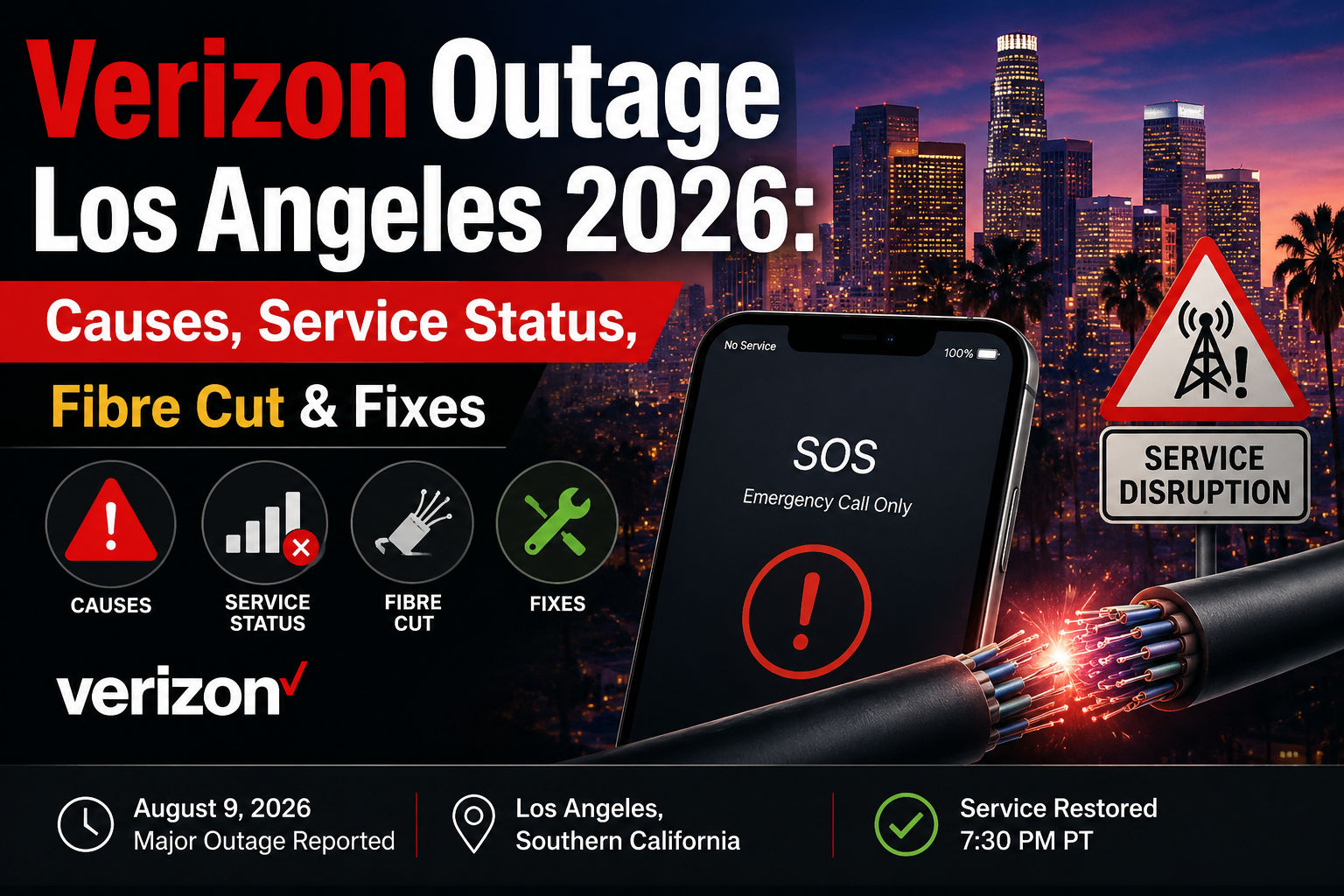
The incident quickly attracted attention because customers reported problems across different parts of the region. At the same time, Verizon confirmed that multiple fibre cables had been cut. The company attributed the damage to vandalism and sent crews to restore the affected network.
Verizon Outage Los Angeles Fortunately, Verizon later reported that service had been restored in the affected Southern California areas at around 7:30 p.m. Pacific Time on August 9, 2026. However, that does not necessarily mean every customer experienced an immediate return to normal service.
Verizon Outage Los Angeles Some phones can remain stuck on SOS or No Service for a while after a major network disruption. Therefore, customers who still have problems should check Verizon’s current network status and perform a few basic troubleshooting steps.
This guide explains what happened, why fibre damage can affect mobile phones, whether Verizon is still down, how to check the outage status, and what you should do if your Verizon phone still does not work.
Verizon Outage Los Angeles: Quick Facts
Here is the situation at a glance:
| Question | Details |
|---|---|
| Was Verizon down in Los Angeles? | Yes, parts of Los Angeles and Southern California experienced a major disruption. |
| When did it happen? | Sunday, August 9, 2026. |
| What caused it? | Verizon said multiple fibre cables were cut and attributed the incident to vandalism. |
| What services were affected? | Some mobile and internet services experienced interruptions. |
| Was the entire U.S. affected? | No. The Los Angeles incident had a regional impact. |
| Was service restored? | Verizon reported restoration at approximately 7:30 p.m. PT on August 9. |
| Why might my phone still show SOS? | Your device may need to reconnect, or your local area may have a separate issue. |
| Where can I check status? | Verizon’s official network-status tools provide the most reliable information. |
Verizon explains that network outages can affect voice, data, messaging, or several services simultaneously. The company also recommends checking outage information and restarting your device after service returns.
What Happened During the Verizon Outage in Los Angeles?
The latest Los Angeles-area outage involved physical telecommunications infrastructure.
According to Verizon, multiple fibre cables were cut in Southern California. The company said the damage resulted from vandalism, and repair crews worked to restore connectivity.
ABC7 reported that Verizon had not publicly disclosed the exact locations of the damaged cables or a definitive number of customers affected.
Meanwhile, FOX 11 reported a sharp increase in customer outage reports. At one point, more than 12,000 Verizon users had reported problems through Downdetector.
However, that number does not mean exactly 12,000 Verizon customers lost service.
Downdetector reflects customer reports and other indicators of service problems. Therefore, the actual number of affected subscribers could differ significantly.
The important point is that this was not simply one person’s faulty phone.
A broader network problem affected customers across parts of Southern California.
Why Did a Fibre Cut Affect Verizon Cell Phones?
At first, a fibre cut might sound unrelated to a mobile phone.
After all, your smartphone connects to a cell tower wirelessly.
However, the tower still needs a connection to Verizon’s larger network.
A simplified version looks like this:
Your phone → Cell tower → Fiber/backhaul → Verizon network → Internet and other services
Your phone communicates with the tower through radio signals. However, the tower needs backhaul infrastructure to transport that traffic to the wider network.
Fibre frequently performs this role because it can carry enormous amounts of data at very high speeds.
Therefore, if an important fibre connection gets damaged, a cell site can lose its connection to the rest of the network.
In some cases, Verizon can reroute traffic through another path.
However, backup routes may have limited capacity. Moreover, multiple damaged cables can make rerouting much harder.
That explains why a physical fibre problem can cause thousands of wireless customers to lose service.
What Does a Verizon Fibre Cut Actually Mean?
Fibre optic cables carry information using light.
These cables form a major part of the infrastructure behind modern communications.
They can carry:
- Mobile network traffic
- Internet data
- Voice communications
- Business connections
- Cloud traffic
- Video services
- Data centre connections
Consequently, damage to a major fibre route can affect many different services at once.
Imagine a city with several major highways.
If one highway closes, traffic can move onto other roads. However, if several major routes close at the same time, congestion increases quickly.
Telecommunications networks work in a similar way.
A carrier can build redundancy into its network, but redundancy has limits.
That is why network engineers continuously work on alternative routes, backup capacity and faster restoration procedures.
Which Services Were Affected?
Customers experienced different symptoms during the Los Angeles disruption.
Some users reported cellular connectivity problems, while others experienced internet-related issues.
Depending on the customer’s location and network connection, symptoms could include:
- No cellular signal
- SOS mode
- Failed calls
- Delayed text messages
- Slow mobile data
- No mobile data
- Intermittent connectivity
- Internet service interruptions
Not everyone experienced the same problem.
For example, one Verizon customer might have lost mobile data while another could not make a phone call.
This happens because different services can depend on different parts of the network.
Therefore, a customer should test voice, messaging and data separately rather than assuming that everything has either completely failed or completely recovered.
Why Does My Verizon Phone Say SOS?
Seeing SOS on an iPhone can be alarming.
However, it does not automatically mean your phone has a hardware problem.
When the device cannot establish its normal connection to your carrier, it can display SOS or a similar warning.
During a major Verizon outage, this can happen because your phone cannot properly register with the Verizon network.
You may also see:
- SOS
- No Service
- Searching
- Emergency Calls Only
- Very weak signal
The exact message depends on the device.
If several Verizon customers near you experience the same issue simultaneously, a network outage becomes much more likely.
For example, if everyone in your office suddenly sees SOS, replacing your phone probably will not solve the problem.
Was the Verizon outage nationwide?
No.
This distinction is important because Verizon also experienced another service disruption shortly before the Los Angeles incident.
On August 8, customers in different parts of the United States reported problems, particularly with voice services. That incident received nationwide attention.
The following day, however, the Southern California incident involved a different publicly reported cause.
August 8 outage
The earlier incident affected customers across multiple parts of the United States and primarily involved voice-service problems.
August 9 outage
The Southern California incident involved multiple fibre cuts. Verizon attributed those cuts to vandalism.
Therefore, customers should not automatically assume that both events came from one continuous nationwide failure.
The timing made the situation confusing, but the available reporting points toward separate incidents.
How Many People Were Affected by the Los Angeles Outage?
There is no definitive public customer count for the Southern California fibre incident.
ABC7 reported that Verizon had not provided a specific number of affected customers or exact cable locations.
However, outage-reporting platforms showed a significant increase in complaints.
FOX 11 reported that more than 12,000 Verizon users had submitted reports to Downdetector during the incident.
Still, readers should interpret that number carefully.
A report on an outage-tracking website does not represent a verified customer count.
Instead, it provides an indication that an unusually large number of people are experiencing problems.
Therefore, saying “12,000 customers were affected” would be misleading.
A more accurate statement is the following:
More than 12,000 Verizon outage reports appeared on Downdetector during the incident, indicating a significant spike in customer complaints.
Is Verizon Working Again in Los Angeles?
Verizon reported that service had been restored in the affected Southern California areas at approximately 7:30 p.m. PT on August 9, 2026.
That means the main network incident was considered resolved.
Nevertheless, some customers may continue experiencing problems.
Why?
Because restoring the main network does not always mean every device reconnects instantly.
Your phone may need to establish a fresh connection.
Additionally, a particular neighbourhood could experience a separate local problem.
Therefore, if your Verizon phone still shows SOS, you should not immediately assume that the entire Los Angeles network remains down.
Instead, perform a few checks.
How to Check Verizon Outage Status
If your phone stops working, start with official information.
Verizon provides a network-status tool that can help customers determine whether the company knows about an outage affecting their area.
You can check the official Verizon network status here:
You can also check Verizon’s support resources:
These official sources should generally come before social media rumours.
However, independent outage-reporting services can also provide useful information.
For example, if thousands of customers suddenly begin reporting problems in Los Angeles, that can reinforce the possibility of a wider outage.
Still, third-party outage reports should serve as an indicator rather than official confirmation.
How to Know Whether Verizon Is Actually Down
Before changing phone settings, determine whether the problem affects other customers.
Check Other Verizon Phones
Ask someone nearby who also uses Verizon.
If their phone also has no service, the carrier network may be experiencing an issue.
Turn Off Wi-Fi
Your phone may appear to be working because it has Wi-Fi access.
Turn Wi-Fi off temporarily.
Then try:
- Making a phone call
- Sending a text
- Opening a website
This gives you a better idea of whether cellular service has returned.
Check Verizon’s Network Status
Look for an active outage notification.
If Verizon already acknowledges a network problem, there is usually no reason to perform complicated troubleshooting.
Check an independent outage tracker.
A sudden spike in reports can provide another clue.
However, remember that outage-reporting websites do not measure every Verizon customer.
What to Do If Verizon Has No Service
If your phone still does not work, follow these steps in order.
1. Restart Your Phone
This should be your first basic troubleshooting step after Verizon restores service.
Turn your phone off.
Wait a few seconds.
Then turn it back on.
A restart can help the device establish a fresh network connection.
Verizon also recommends restarting a device when service problems continue after an outage has ended.
2. Turn Airplane Mode On and Off
Aeroplane Mode can force your phone to stop and restart its wireless connections.
Turn it on.
Wait around 10 to 15 seconds.
Then turn it off.
Give the phone a moment to search for the Verizon network.
3. Turn Wi-Fi Off
If you want to test your cellular service, disable Wi-Fi.
Otherwise, your phone may continue using your home or office internet connection.
Once Wi-Fi is off, test mobile data.
4. Try Making a Call
Make a normal cellular call.
If it fails, check whether your phone shows the following:
- SOS
- No Service
- Searching
- Emergency Calls Only
That information can help identify the problem.
5. Send a Text Message
Next, send a standard SMS message.
Do not rely only on WhatsApp or iMessage because those services can use Wi-Fi.
You want to test the actual cellular network.
6. Move to Another Location
If possible, move outside or travel a short distance.
A local cell site may have a problem even though another nearby site works normally.
If your phone suddenly reconnects, the problem may have been limited to your previous location.
Why Your Phone May Still Show SOS After Verizon Restores Service
This is a common source of confusion.
Suppose Verizon announces that the outage has ended.
You restart your phone.
Yet it still says SOS.
Several explanations remain possible.
Your phone has not re-registered
The device may need another connection attempt.
Your local cell site still has an issue
The broader network may work while a specific location continues to experience problems.
Your device has a separate problem
The outage may have happened at the same time as a SIM, eSIM or software issue.
Network congestion remains
Large numbers of devices may reconnect at once.
Another local outage exists
Not every connectivity problem necessarily comes from the same incident.
Therefore, compare your experience with another Verizon customer nearby.
That simple test can provide valuable information.
Verizon Outage vs. Weak Verizon Coverage
A network outage and weak coverage are two different problems.
Network outage
You normally have excellent Verizon service.
Suddenly, several Verizon customers around you lose service.
That suggests a network issue.
Weak coverage
You consistently receive one or two bars in a particular building.
Other Verizon users nearby still have service.
That may indicate a coverage limitation.
Device problem
Everyone around you has normal service.
Only your phone remains offline.
That makes a device or account issue more likely.
Understanding the difference can prevent unnecessary troubleshooting.
Could the Verizon outage be a cyberattack?
There is no evidence in the cited reporting that the Los Angeles incident resulted from a cyberattack.
Instead, Verizon identified physical fibre cuts and attributed them to vandalism.
Therefore, customers should avoid automatically assuming that a large outage means Verizon was hacked.
Large networks can fail for many reasons.
These include:
- Fiber damage
- Equipment failure
- Power problems
- Software errors
- Configuration mistakes
- Construction accidents
- Severe weather
- Physical vandalism
- Cybersecurity incidents
In this particular Southern California incident, the publicly reported explanation involved physical infrastructure damage.
Why Fiber Infrastructure Matters So Much
Fibre may be hidden underground or inside infrastructure corridors, so most customers rarely think about it.
Yet modern communication depends heavily on it.
Fibre carries huge volumes of information between:
- Cell towers
- Data centers
- Internet exchanges
- Businesses
- Network facilities
- Cloud platforms
As a result, one damaged route can have a much wider impact than the physical location of the cable suggests.
That is also why telecommunications companies invest heavily in network redundancy.
However, redundancy cannot eliminate every risk.
If multiple routes fail or backup capacity cannot handle normal traffic, customers can still lose service.
What Businesses Should Do During a Verizon Outage
Businesses face a bigger problem than ordinary consumers because communication failures can directly affect revenue.
A Verizon outage can disrupt:
- Customer calls
- Sales teams
- Appointment reminders
- Delivery coordination
- Remote employees
- Customer support
- Payment systems
- Security equipment
For that reason, businesses should avoid relying on one communication channel.
A good backup strategy can include:
- Business email
- Website contact forms
- Microsoft Teams
- Slack
- Secondary phone service
- Backup internet connection
Businesses with critical connectivity requirements can also consider dual-WAN systems or a secondary internet provider.
Although redundancy adds cost, it can reduce the financial impact of a major outage.
Can Wi-Fi Calling Help During a Verizon Outage?
Yes, potentially.
If your cellular service is unavailable but your Wi-Fi connection still works, Wi-Fi Calling can provide another way to make or receive calls on supported devices and plans.
Verizon’s outage guidance recommends connecting to Wi-Fi and using Wi-Fi Calling when cellular service is unavailable, where supported.
This makes Wi-Fi particularly valuable during a cellular outage.
However, remember one important limitation:
Wi-Fi Calling still requires a working internet connection.
If both your cellular network and home internet are unavailable, Wi-Fi Calling will not solve the problem.
Should You Reset Your Network Settings?
Not immediately.
If Verizon is experiencing a known outage, changing your network settings will not repair damaged fibre.
A network reset can also remove saved Wi-Fi information and other network configurations.
Therefore, use it only when:
- Verizon confirms the network works normally.
- Other Verizon customers have service.
- Your phone remains offline.
- Basic troubleshooting has failed.
Start with simpler steps.
Check outage status → restart → aeroplane mode → test cellular service → investigate further.
That approach saves time and avoids unnecessary changes.
Should You Buy a New Phone?
No—not simply because Verizon is down.
If thousands of Verizon customers in Los Angeles have lost service, your phone is unlikely to be the cause.
Buying a new device will not repair a damaged fibre route.
Before spending money, compare your phone with another Verizon device.
If another phone has the same problem, investigate the network.
If everyone else has service but your phone remains offline, then a device or account issue becomes more plausible.
Could a Second Carrier Help?
For some users, absolutely.
People who rely heavily on mobile connectivity can benefit from having a second carrier available.
This can be especially useful for:
- Business owners
- Remote workers
- Frequent travelers
- Emergency-dependent users
- Field workers
- Families who need reliable communication
A compatible second SIM or eSIM can provide another network option.
However, network diversity matters.
If both services depend on the same damaged local infrastructure, the backup may not work as expected.
Therefore, a secondary carrier works best when it genuinely provides a different network path.
How to Prepare for the Next Verizon Outage
You cannot prevent a carrier outage.
However, you can make its impact much smaller.
Keep a power bank
A phone becomes much more useful during an outage when its battery remains charged.
Save Important Contacts
Keep critical numbers available outside your phone’s cellular connection.
Enable Wi-Fi Calling
If your internet works during a cellular outage, Wi-Fi Calling can provide an alternative communication method.
Keep Important Information Offline
Save:
- Addresses
- Tickets
- Travel details
- Emergency contacts
- Work instructions
Some information should not depend entirely on the cloud.
Consider Backup Connectivity
Businesses and heavy internet users may benefit from a secondary ISP or mobile carrier.
What the Los Angeles Verizon Outage Tells Us About Modern Networks
The incident provides a useful reminder about how complex cellular networks have become.
A smartphone looks simple.
You see:
Signal bars → network → internet
Behind that small icon, however, a massive infrastructure operates continuously.
It includes:
- Cell towers
- Fiber routes
- Network switches
- Routing systems
- Data centers
- Power systems
- Authentication systems
- Backhaul connections
- Field technicians
When everything works, customers rarely notice any of it.
However, when one important physical connection fails, the hidden complexity becomes obvious.
A damaged cable can therefore create problems for thousands of people.
What We Know About the Verizon Outage
It helps to separate confirmed information from speculation.
What Verizon and local reporting confirmed
- Parts of Southern California experienced a Verizon service disruption.
- Some wireless and internet customers were affected.
- Multiple fibre cables were cut.
- Verizon attributed the incident to vandalism.
- Customers reported a significant increase in service problems.
- Repair crews worked to restore connectivity.
- Verizon reported restoration around 7:30 p.m. PT on August 9.
What remains unclear
- The exact location of every damaged cable.
- The precise number of affected customers.
- The complete technical path used by every affected service.
- Whether every customer who experienced problems afterward was still dealing with the original incident.
That distinction matters because breaking news can change quickly.
Therefore, customers should rely on Verizon’s latest official status information when making decisions.
Frequently Asked Questions
Is Verizon down in Los Angeles right now?
A major Southern California outage occurred on August 9, 2026, and Verizon reported that service had been restored later that evening. However, individual customers may still experience local or device-specific problems. Check Verizon’s current network status for the latest information.
What caused the Verizon outage in Los Angeles?
Verizon said multiple fibre cables had been cut and attributed the damage to vandalism.
Was the Verizon outage nationwide?
No. The Los Angeles-area incident affected parts of Southern California. Verizon had also experienced a separate service disruption across parts of the United States on August 8.
Why does my Verizon phone say SOS?
Your phone usually displays SOS when it cannot connect normally to your carrier. During an outage, this can happen because the Verizon network is unavailable in your area.
Will restarting my phone fix Verizon service?
Restarting will not repair a network outage. However, after Verizon restores service, restarting can help your phone establish a fresh connection.
Can I use Wi-Fi during a Verizon outage?
Yes. If your Wi-Fi connection works, you can continue using internet-based services. Wi-Fi Calling may also work on supported devices and plans.
How can I check whether Verizon is down?
Use Verizon’s official network-status page first. You can also compare your experience with other Verizon customers and check independent outage-reporting platforms.
Was Verizon hacked?
There is no evidence in the cited reporting that the Los Angeles incident was caused by hacking. Verizon publicly attributed the Southern California disruption to physical fibre cuts and vandalism.
How many Verizon customers were affected?
Verizon had not publicly provided a definitive customer count. However, more than 12,000 outage reports appeared on Downdetector during the incident.
Why does my Verizon phone work in one area but not another?
Cellular networks rely on local towers and backhaul infrastructure. A problem affecting one site or route can therefore impact one area while another location continues working normally.
Should I reset my phone?
Start with a restart rather than a full network reset. If Verizon confirms that service has returned and only your phone remains offline, then deeper troubleshooting may make sense.
Will Verizon automatically give me a refund?
Not necessarily. Verizon’s current outage policy says certain customers may qualify for a credit after more than 24 consecutive hours of service loss when Verizon is responsible, subject to applicable requirements.
Can a fibre cable really shut down cellular service?
Yes. Cell towers need backhaul connections to communicate with the wider network. If a critical fibre route fails and traffic cannot move through alternative routes, mobile services can become unavailable.
Read More: T-Mobile Outage 2026: Latest Updates, SOS Mode Explained & Fixes
Final Verdict
The recent Verizon outage in Los Angeles showed just how dependent modern mobile communications are on physical network infrastructure.
Verizon said multiple fibre cables were cut in Southern California and attributed the incident to vandalism. The damage disrupted service for some wireless and internet customers, while outage reports climbed sharply.
Fortunately, Verizon later reported that service had been restored around 7:30 p.m. PT on August 9.
Still, customers who continue seeing SOS, No Service, failed calls, or missing mobile data should not immediately assume that their phone has failed.
Instead, check Verizon’s network status first. Then restart your device, toggle Aeroplane Mode, turn off Wi-Fi temporarily, and test calls, texts and cellular data separately.
Furthermore, remember that the August 9 Southern California incident differed from the Verizon voice-service problems reported across parts of the country on August 8.
The biggest lesson is simple: a wireless network still depends on a huge physical infrastructure underneath it.
When fibre routes, cell sites and network systems work together, your phone feels almost effortless.
When an important connection fails, however, thousands of customers can suddenly see the same SOS symbol.
For Los Angeles Verizon customers, checking official outage information, keeping an alternative communication method available, and understanding the difference between a network outage and a device problem can make the next disruption much easier to handle.