
Smartphone Market 2026: Why Premium Phones Are Winning as Global Shipments Decline
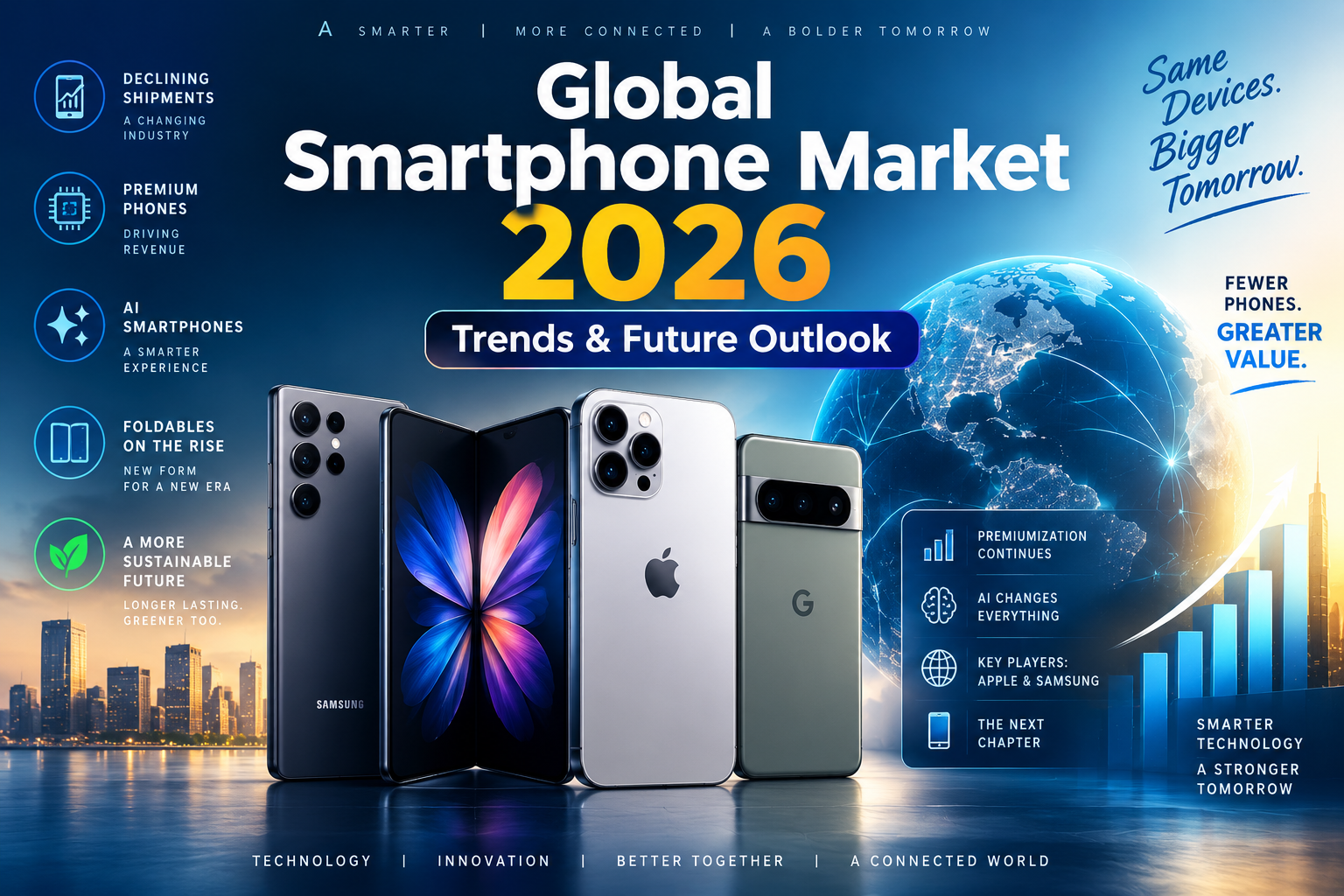
global smartphone market 2026 The smartphone market is entering a major transition in 2026.
On one side, global smartphone shipments are falling. Rising component costs, memory shortages, economic uncertainty, and longer replacement cycles are making it harder for manufacturers to sell devices at the same pace as previous years.
On the other side, premium smartphones are performing surprisingly well.
Consumers are still willing to spend more on high-end devices, particularly when manufacturers offer better cameras, longer software support, advanced AI features, powerful processors, and attractive trade-in deals. As a result, the industry is selling fewer phones in some regions while generating more value from each device.
This creates one of the most interesting situations the smartphone industry has faced in years.
The question is no longer simply, “How many smartphones are being sold?”
Instead, the bigger question is
“How much is the average customer willing to spend on a smartphone?”
That shift is changing the competitive landscape for Apple, Samsung, Google, and other major manufacturers. It is also changing the way consumers should evaluate their next phone.
Smartphone Market 2026: The Big Picture
The global smartphone market is facing significant pressure in 2026.
According to IDC, worldwide smartphone shipments are expected to decline by 13.9% in 2026 to around 1.09 billion units. The company also expects the global average selling price to reach a record level of approximately $550.
At first, those numbers may seem contradictory.
If fewer phones are being sold, why is the average price increasing?
The answer lies in premiumisation.
Instead of competing primarily through low prices, smartphone manufacturers are increasingly focusing on higher-value devices. Furthermore, consumers are keeping phones for longer periods, so when they finally upgrade, many are choosing devices that they expect to keep for several years.
That behaviour benefits premium smartphones.
Key trends shaping the smartphone market
| Trend | What it means |
|---|---|
| Global shipments | Declining |
| Average selling price | Increasing |
| Premium smartphones | Gaining share |
| Budget phones | Facing stronger pressure |
| Mid-range phones | Facing a difficult price equation |
| AI smartphones | Becoming more important |
| Foldables | Continuing to grow |
| Trade-ins | Increasingly influential |
| Replacement cycles | Getting longer |
| Apple | Extremely strong in premium revenue |
| Samsung | Strong global shipment position |
Therefore, the smartphone market is not simply shrinking.
Instead, the market is changing from a volume-driven business toward a value-driven business.
Why Premium Smartphones Are Gaining Ground
Premium smartphones have been gaining market share for several years. However, 2026 has made this trend even more noticeable.
Counterpoint Research reported that smartphones priced at $600 or more at the wholesale level accounted for a record 29% of global smartphone sales during the first half of 2026, compared with 25% during the same period a year earlier.
That is significant because the overall market is under pressure.
Usually, when consumers become cautious, expensive products should suffer first. However, smartphones do not always follow that pattern.
A smartphone is now an essential device for many people.
Consumers use it for:
- Banking
- Work
- Communication
- Entertainment
- Photography
- Navigation
- Shopping
- Social media
- Video calls
- Gaming
- AI tools
Because of that, some buyers prefer to spend more on one device and keep it for several years.
For example, someone may hesitate to purchase a $400 phone every two years but feel comfortable spending $800 on a phone that remains useful for four or five years.
As a result, premiumisation is becoming a powerful force.
The Mid-Range Smartphone Problem
For years, mid-range smartphones represented the sweet spot for consumers.
They provided good performance without the high price of a flagship.
However, that advantage is becoming less obvious.
Component costs have increased, particularly in memory. At the same time, manufacturers continue adding better displays, larger storage capacities, AI capabilities, improved cameras, and more powerful processors.
Consequently, the price of a good mid-range smartphone can move closer to the price of a discounted flagship.
That creates a difficult decision.
Imagine a buyer has two choices:
Option A: New Mid-Range Phone
- $599
- Good processor
- Good camera
- Modern design
- Standard materials
- Strong battery
Option B: Previous-Generation Flagship
- $649 after a promotion
- Faster processor
- Better camera system
- Premium materials
- Better display
- More advanced features
- Higher resale value
In this situation, the older flagship may provide better overall value.
That does not mean mid-range smartphones have become bad purchases.
Instead, buyers need to compare them more carefully.
Why Flagship Phones Can Be Better Deals
A flagship smartphone normally carries a higher launch price. However, that price can fall considerably after several months.
Manufacturers and retailers often introduce the following:
- Trade-in promotions
- Seasonal discounts
- Carrier credits
- Launch offers
- Clearance pricing
- Financing deals
Therefore, consumers should not compare a new mid-range phone with the original launch price of a flagship.
Instead, compare it with the current street price.
This is especially important in the United States, where carrier promotions can dramatically reduce the effective cost of premium smartphones.
A phone listed at $999 might effectively cost much less after a qualifying trade-in.
So, before purchasing, buyers should ask:
What will I actually pay after discounts and trade-in credits?
That number matters far more than the MSRP.
Apple Shows the Power of the Premium Strategy
Apple provides one of the clearest examples of how premiumisation is transforming the smartphone market.
In Q2 2026, Samsung led global smartphone shipments with a 24% share, while Apple followed with 20%, according to Counterpoint Research.
However, shipment share does not tell the complete story.
Apple’s revenue position is much stronger.
Data reported by PhoneArena from Counterpoint showed Apple capturing approximately 49% of global smartphone revenue in Q2 2026. Apple’s smartphone revenue also grew strongly year over year.
This difference illustrates an important point:
Selling more phones does not necessarily mean generating more revenue.
Apple focuses heavily on premium products. Consequently, every device can generate considerably more revenue than a lower-priced smartphone.
That gives Apple several advantages.
Stronger margins
Premium devices generally provide more room to absorb higher component costs.
Strong ecosystem
The iPhone connects with services and products such as Apple Watch, AirPods, Macs, iCloud, and other Apple services.
High resale value
iPhones often retain significant value, which makes trade-in programmes more attractive.
Carrier support
US carriers frequently use iPhone promotions to attract customers.
Therefore, Apple’s premium strategy fits the current direction of the smartphone market extremely well.
Samsung Takes a Different Route
Samsung’s strength comes from its enormous product range.
The company competes across several price categories, including:
- Budget smartphones
- Mid-range Galaxy A devices
- Premium Galaxy S models
- Foldable Galaxy Z devices
That strategy gives Samsung something Apple does not have to the same extent: massive coverage across different consumer segments.
Samsung’s shipment leadership in Q2 2026 demonstrates the value of this approach.
However, Samsung also continues pushing its premium Galaxy S and Galaxy Z lines.
This combination gives the company two major opportunities.
First, it can sell large volumes globally.
Second, it can encourage existing customers to move toward more expensive devices.
That balance could become increasingly important as the global market becomes more polarised.
Memory Costs Are Changing Smartphone Economics
One of the biggest challenges facing smartphone manufacturers in 2026 is memory.
Modern phones require significant amounts of RAM and storage.
Furthermore, AI workloads are increasing demand for memory across the technology industry.
That creates competition for semiconductor resources.
When memory becomes more expensive, manufacturers have several options.
They can:
- Increase smartphone prices.
- Reduce hardware specifications.
- Reduce storage options.
- Absorb the additional cost.
- Focus on higher-margin products.
The fifth option becomes particularly attractive when the low-end market offers very little room for profit.
As a result, rising memory costs can indirectly encourage manufacturers to focus on premium smartphones.
AI Is Becoming a Smartphone Upgrade Driver
AI is another major factor reshaping the smartphone market.
In previous generations, smartphone upgrades often focused on obvious hardware improvements.
A new phone might offer the following:
- A faster processor
- Better cameras
- A brighter screen
- More battery capacity
Now manufacturers are adding AI to the upgrade story.
Modern smartphones increasingly offer features such as the following:
- AI photo editing
- Real-time translation
- Writing assistance
- Voice transcription
- Call summaries
- Image generation
- Intelligent search
- Personalized recommendations
- On-device AI processing
However, there is still an important challenge.
Consumers will not necessarily upgrade simply because a phone has an AI label.
The features need to solve real problems.
If AI can save users time, improve photos, translate conversations, summarise meetings, or automate everyday tasks, it becomes more valuable.
Otherwise, it may remain a marketing feature rather than a genuine upgrade reason.
Longer Upgrade Cycles Are Hurting Shipments
Smartphones have become extremely capable.
A two- or three-year-old premium phone can still perform everyday tasks comfortably.
It can handle:
- Social media
- Streaming
- Messaging
- Web browsing
- Navigation
- Photography
- Video calls
- Productivity
- Gaming
Because of this, consumers have less reason to upgrade every year.
Longer software support makes the situation even more complicated for manufacturers.
If a phone continues receiving security updates and performs well, the owner may simply keep using it.
Therefore, smartphone companies need to create stronger upgrade incentives.
The next generation must provide something meaningful.
Software Support Is Now Part of Smartphone Value
Hardware specifications still matter, but software support has become equally important.
A phone that receives updates for several additional years can offer better long-term value than a cheaper device with limited support.
Before buying a smartphone, consumers should, therefore, check the following:
- Operating system update policy
- Security update duration
- AI feature support
- Battery replacement options
- Repair availability
For someone planning to keep a phone for four or five years, software support can be more important than a small difference in benchmark performance.
Foldable Phones Offer Something Different
Foldables remain a relatively small part of the overall smartphone market. Nevertheless, they are attracting attention because they provide something traditional phones cannot easily replicate.
A foldable can offer the following:
- A compact form factor
- A larger internal display
- Better multitasking
- New productivity experiences
- A different design
IDC expects foldable smartphone shipments to grow in 2026 despite weakness across the wider smartphone market.
That is encouraging for manufacturers.
A traditional smartphone can become faster or thinner, but its basic shape remains familiar.
Foldables create a more noticeable difference.
However, high prices, durability concerns, battery limitations, and repair costs continue to restrict mass adoption.
Still, the category could become increasingly important in the premium segment.
What Is Happening to Budget Smartphones?
The budget segment faces a tougher environment.
Low-cost phones operate with smaller margins. Therefore, even a moderate increase in component prices can create significant pressure.
IDC’s India research provides a useful example. During Q1 2026, India’s smartphone shipments declined 4.1%, while the average selling price reached a record $302. The entry-level segment experienced particularly strong pressure.
The US market has a different structure because consumers frequently use financing and carrier promotions.
Nevertheless, the underlying economics remain relevant.
If it becomes more expensive to manufacture a $150 smartphone, the manufacturer has limited room to absorb the additional cost.
As a result, the cheapest phones may either become more expensive or disappear from certain markets.
What Does This Mean for US Smartphone Buyers?
For American consumers, the changing smartphone market creates both challenges and opportunities.
The biggest opportunity is the growing number of deals around premium devices.
Carrier promotions can make expensive smartphones considerably more affordable.
However, consumers should carefully examine the conditions.
A promotion may require:
- A specific unlimited plan
- A qualifying trade-in
- Monthly bill credits
- A particular financing period
- Staying with the carrier for a specific period
Therefore, buyers should calculate the total cost, rather than focusing only on the advertised monthly payment.
Should You Buy a Flagship or Mid-Range Phone?
There is no universal answer.
It depends on how you use your phone.
Choose a flagship if you:
- Take lots of photos and videos
- Play demanding games
- Need maximum performance
- Want premium materials
- Keep phones for many years
- Want the best display
- Need advanced AI features
Choose a mid-range phone if you:
- Mainly use social media
- Stream videos
- Browse the internet
- Make calls
- Use messaging apps
- Want strong battery life
- Prefer spending less
However, always compare the current prices.
A discounted flagship can sometimes be the better deal.
Why Previous-Generation Flagships Deserve More Attention
One of the smartest smartphone buying strategies in 2026 is looking at older flagship models.
A phone that launched one year ago may still provide the following:
- Excellent cameras
- Powerful performance
- Premium construction
- Advanced displays
- Strong connectivity
- Long software support
Meanwhile, its price may have fallen significantly.
This creates an interesting situation where an older premium phone can compete directly with a newer mid-range device.
Therefore, buyers should not automatically assume that newer means better value.
Sometimes, last year’s flagship is this year’s bargain.
Smartphone Market Share Does Not Tell the Whole Story
When people discuss smartphone market share, they often focus on shipment numbers.
However, several different measurements exist.
A company can lead in the following:
- Unit shipments
- Revenue
- Premium sales
- Operating-system share
- Regional sales
- Profit
These measurements can produce very different rankings.
For example, Samsung led global shipments in Q2 2026, while Apple captured a much larger share of smartphone revenue.
Therefore, consumers and investors should always ask:
“Which market metric are we talking about?”
This distinction becomes particularly important in a premiumising industry.
The smartphone market is becoming more polarised.
The middle of the smartphone market is becoming increasingly competitive.
At one end, budget buyers want affordability.
At the other end, premium customers want the best available experience.
Meanwhile, mid-range phones must compete against both groups.
That creates a difficult position.
For example, a consumer may compare a $450 phone with a $250 model and decide to save money.
Alternatively, they may compare that same $450 phone with a discounted $650 flagship and decide to spend more.
Therefore, manufacturers need to give mid-range devices a clear reason to exist.
Simply offering slightly better specifications may no longer be enough.
What Smartphone Brands Need to Do Next
Manufacturers cannot depend forever on annual specification upgrades.
Instead, they need meaningful innovation.
The strongest opportunities include:
Better AI
AI needs to become genuinely useful.
Longer battery life
Battery improvements remain highly valuable to everyday users.
Better cameras
Photography continues to influence premium purchases.
Longer software support
Long-term updates can encourage customers to pay more.
Foldable designs
New form factors can create stronger upgrade incentives.
Better durability
Consumers want phones that can survive several years of daily use.
Stronger ecosystems
Services, accessories and connected devices can increase customer loyalty.
Ultimately, manufacturers need to answer one simple question:
Why should a customer replace their current phone?
2026 Smartphone Buying Guide
Before purchasing your next smartphone, consider these ten factors.
1. Check the final price
Do not stop at the MSRP.
2. Compare trade-in offers
Your existing phone may significantly reduce the upgrade cost.
3. Check software support
Long-term updates can increase the device’s useful life.
4. Compare previous-generation flagships
They can provide excellent value.
5. Think about battery life
A powerful phone is not useful if the battery cannot last through your day.
6. Look beyond megapixels
Camera quality depends on sensors, lenses and software processing.
7. Consider storage
More storage can make a phone useful for longer.
8. Check network compatibility
This matters especially when switching carriers.
9. Calculate ownership cost
A more expensive phone can sometimes cost less per year.
10. Buy according to your usage
Do not pay for features you will never use.
Smartphone Market Outlook for the Rest of 2026
The rest of 2026 could remain challenging for the global smartphone industry.
Memory costs will remain an important factor. Meanwhile, consumers may continue delaying upgrades because their current devices still perform well.
However, premium smartphones could continue outperforming the broader market.
Several trends deserve attention:
- AI-focused flagship launches
- New foldable devices
- Carrier promotions
- Premium Android competition
- Apple’s next-generation iPhone strategy
- Memory supply
- Component pricing
- Consumer spending
If component costs eventually stabilise, manufacturers could regain more flexibility.
Until then, however, the industry will likely continue emphasising higher-value products.
Will the Smartphone Market Recover?
A recovery remains possible.
However, the timing is uncertain.
IDC expects memory-related constraints to continue affecting the industry and projects a stronger recovery later in the forecast period as supply conditions improve.
Still, a recovery in shipments may not immediately return the industry to its old business model.
Consumers have learned that smartphones can last longer.
At the same time, manufacturers have learned that premium products can generate much more revenue per device.
Therefore, the future smartphone market may continue to prioritise quality and value over pure shipment volume.
Frequently Asked Questions
Is the smartphone market declining in 2026?
Yes. Global smartphone shipments are expected to decline significantly in 2026. IDC forecasts a 13.9% annual decline, although average selling prices are expected to rise.
Why are premium smartphones becoming more popular?
Consumers increasingly want better cameras, performance, AI capabilities, software support and premium designs. Additionally, trade-ins and carrier financing can make expensive phones more accessible.
Is Apple leading the smartphone market?
It depends on the metric. Samsung led global shipments in Q2 2026, while Apple held a much larger share of global smartphone revenue.
Are mid-range smartphones still worth buying?
Yes. They remain excellent choices for many consumers. However, buyers should compare their prices with discounted flagship phones before making a decision.
Why are smartphone prices increasing?
Higher memory and component costs are major factors. Manufacturers are also adding more sophisticated hardware and AI capabilities.
Are foldable smartphones growing?
Yes. Foldables remain a niche category, but shipments are expected to grow in 2026 even while the broader smartphone market contracts.
Should I buy a flagship smartphone in 2026?
A flagship can be a strong choice if you want high-end cameras, performance, display quality and long-term support. However, an older flagship may offer better value than the newest model.
How long should a smartphone last?
For many users, four or five years is realistic when the device receives long-term software updates and the battery remains healthy.
Read More: Smartphone Leasing Guide 2026: Should You Lease or Buy Your Next Smartphone?
Final Verdict
The smartphone market in 2026 is not simply shrinking. It is transforming.
Global shipments are falling, but premium smartphones are gaining importance. At the same time, rising component costs are putting pressure on budget devices, while mid-range phones are being squeezed between affordable alternatives and discounted flagships.
Apple demonstrates how powerful a premium strategy can become. Samsung, meanwhile, continues to benefit from its broad global portfolio and strong shipment position. Furthermore, companies across the Android ecosystem are investing heavily in AI, cameras, foldables and premium hardware.
For consumers, this changing market creates a new buying environment.
The best deal may not be the cheapest phone.
In fact, a discounted flagship with long software support can sometimes offer better value than a new mid-range device. Conversely, a well-priced mid-range phone can still be the smarter choice for someone who does not need premium features.
Therefore, buyers should look beyond specifications and marketing claims.
Consider the real price, trade-in value, software support, battery life, camera quality, performance, resale value and expected lifespan.
Ultimately, the smartphone market is moving toward a simple but important idea:
Consumers may buy fewer phones, but they increasingly expect each phone to do more and last longer.
That shift will shape the industry throughout 2026 and beyond.