
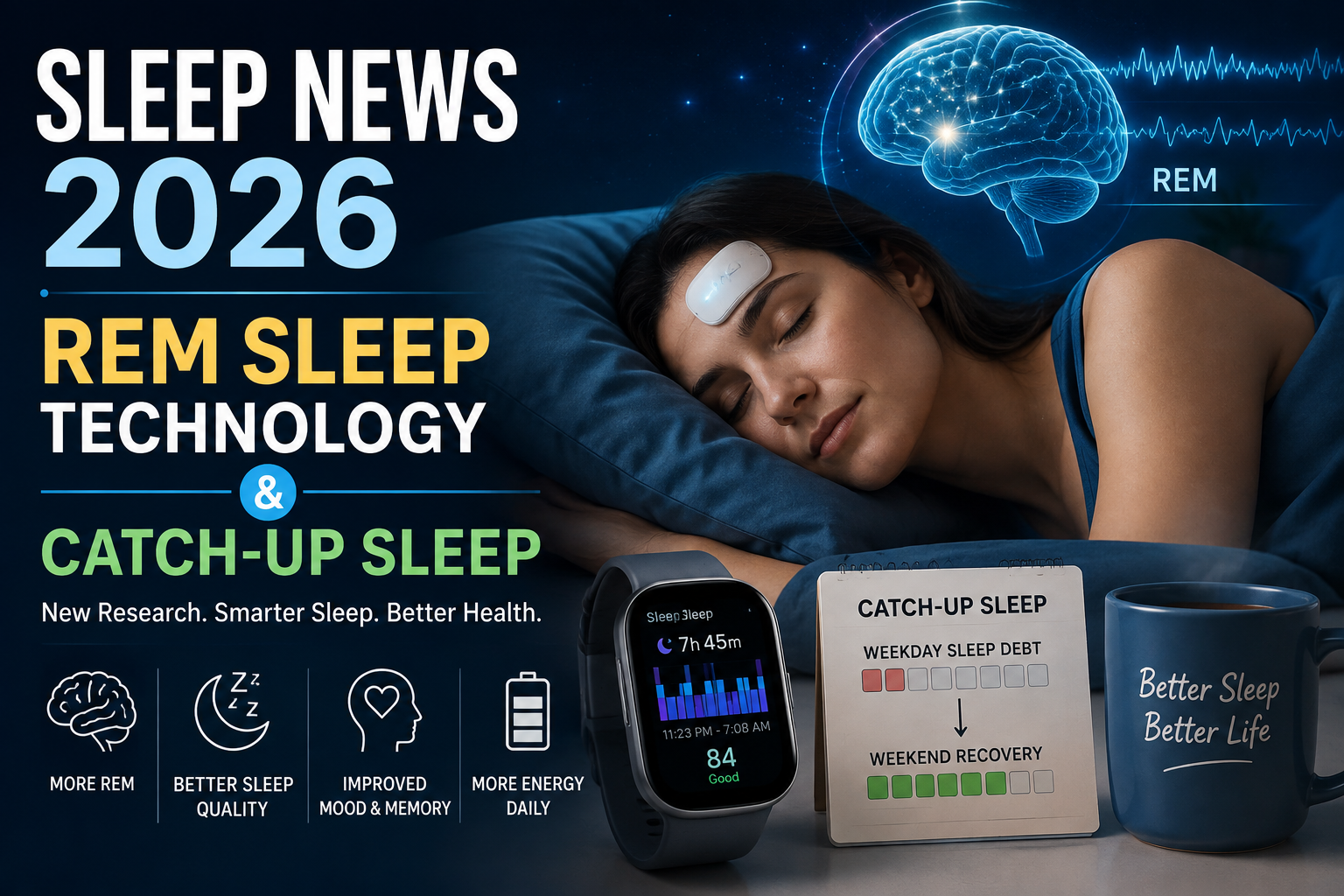

Sleep News 2026: New REM Sleep Technology, Catch-Up Sleep and What It Means for You
latest sleep news, 2026 Sleep has become one of the most closely studied areas of modern health research. And now, the latest sleep news is pushing the conversation beyond the familiar advice of getting seven or eight hours every night.
Researchers are looking more closely at how we sleep, not just how long we sleep. In particular, scientists want to understand what happens during different sleep stages, how the brain regulates those stages, and whether technology can safely influence them.
One of the most interesting developments involves an experimental wearable patch designed to influence REM sleep. The technology combines ultrasound stimulation with electrical monitoring, creating a very different approach from conventional sleep trackers.
At the same time, researchers and doctors continue to examine another issue that affects millions of Americans: catch-up sleep.
Many people sleep too little during the workweek and then try to recover on Saturday and Sunday. Although additional sleep can help, it does not necessarily erase every consequence of repeated sleep deprivation.
So, what should you actually take away from the latest research?
Let’s break down the biggest developments and separate promising science from exaggerated headlines.
The Biggest Sleep News of 2026
The current sleep conversation has several important themes. However, one development stands out because it could eventually change how scientists approach certain sleep problems.
Researchers at the University of Texas at Austin have been developing an experimental wearable system known as NEUSLeeP.
Unlike an ordinary smartwatch, the device does more than estimate when someone is asleep.
Instead, researchers designed it to monitor brain activity and deliver targeted ultrasound stimulation. The goal is to influence brain activity associated with REM sleep.
Early research involved 28 participants. According to reports on the study, participants using the system reached REM sleep sooner and spent more time in that sleep stage.
That sounds impressive. However, the size of the study matters.
A study involving 28 people can provide an important early signal, but it cannot establish that a technology will work equally well for millions of people. Therefore, researchers need larger studies before the patch can become a widely accepted treatment.
Why the NEUSLeeP Research Is Interesting
Traditional sleep technology usually works as a monitoring tool.
For example, a smartwatch may estimate the following:
- Total sleep duration
- Heart rate
- Movement
- Sleep timing
- Estimated sleep stages
- Breathing patterns
That information can help users recognise patterns. However, the device generally observes what happens rather than actively changing the sleep process.
NEUSLeeP takes a different approach.
The researchers are exploring a closed-loop system that can monitor physiological signals and provide stimulation based on the person’s sleep state.
In simple terms, the concept is
Monitor → detect → stimulate → measure the response
That approach could eventually lead to more personalised sleep interventions.
Still, it remains experimental.
What Exactly Is REM Sleep?
REM means rapid eye movement sleep.
During this stage, the brain becomes highly active. People also experience rapid eye movements, and vivid dreaming frequently occurs. At the same time, most skeletal muscles become temporarily relaxed.
However, REM sleep is only one part of a normal night’s sleep.
The brain moves repeatedly through non-REM and REM stages. In addition, REM periods generally become longer later in the night.
That timing explains why consistently cutting sleep short can potentially affect the amount of REM sleep a person experiences.
For instance, someone who regularly sleeps only five or six hours may wake up before completing the later portions of their normal sleep cycles.
Therefore, sleeping longer is not simply about adding more hours to a number on a fitness tracker.
It also gives the brain more opportunity to move through its natural sleep architecture.
Why Scientists Care About REM Sleep
Researchers continue to investigate exactly how REM sleep contributes to health. However, evidence connects sleep and REM-related processes with important functions involving the brain.
Scientists have studied relationships between REM sleep and:
- Memory processing
- Emotional regulation
- Brain activity
- Dreaming
- Learning
- Stress-related processes
Consequently, researchers have become interested in whether changing REM sleep could eventually help people with specific health conditions.
That does not mean that everyone needs more REM sleep.
Instead, scientists want to determine whether carefully modifying sleep stages can produce useful clinical results.
This distinction is important because more is not automatically better.
A healthy night’s sleep involves several stages. Therefore, increasing one stage without understanding the overall effect could create unexpected problems.
Can You Buy the New REM Sleep Patch?
Not as a mainstream consumer treatment.
The NEUSLeeP technology remains under development. The University of Texas’s information surrounding the technology focuses on research and commercialisation opportunities rather than ordinary retail availability.
Therefore, consumers should be cautious about websites or advertisements suggesting that an experimental research device has already become a proven home treatment.
The more accurate description is much simpler:
Researchers have developed a promising experimental wearable system that may influence REM sleep, but larger studies are still necessary.
That distinction protects readers from confusing an early scientific result with an established medical product.
What Did the Early Research Find?
The early study included 28 participants.
Researchers reported that the experimental system helped participants reach REM sleep earlier. They also observed additional REM sleep during the experimental sessions.
Furthermore, the researchers reported changes involving heart-rate variability.
These findings are certainly worth watching.
However, several questions remain unanswered.
Researchers still need to determine:
- Whether the results remain consistent in larger studies.
- Whether the technology works across different age groups.
- Whether people with sleep disorders respond differently.
- Whether increasing REM sleep improves daytime functioning.
- Whether the effects remain after repeated use.
- Whether long-term use remains safe.
- Which patients might benefit most.
- Whether the technology performs better than existing treatments.
Because of these unanswered questions, consumers should view the technology as an exciting research development rather than a finished solution.
Could This Technology Eventually Treat Sleep Problems?
Possibly.
Researchers are already interested in whether targeted sleep modulation could have applications beyond healthy volunteers.
Future studies may investigate potential uses involving conditions such as insomnia, depression and PTSD.
However, these applications remain areas for research.
A technology can successfully change a biological signal without necessarily improving a person’s health.
For example, if a device increases a particular sleep stage but does not improve memory, mood, daytime alertness or quality of life, its practical value could remain limited.
Therefore, future clinical trials will need to measure meaningful outcomes rather than simply showing that the brain responds to stimulation.
Why Larger Studies Matter
Imagine that a new sleep device produces impressive results in 28 people.
That is encouraging.
Now imagine researchers test it on several hundred participants.
The results could change.
Perhaps the average benefit becomes smaller. Alternatively, researchers might discover that the technology works especially well for a particular group.
They could also uncover side effects that did not appear in the first small study.
That is exactly why medical research progresses through multiple stages.
Early research asks:
Can this approach work?
Later research asks:
Does it work consistently?
Clinical research then asks the following:
Is it safe, useful and better than the alternatives?
Those questions require time.
As a result, exciting sleep research should generate curiosity rather than unrealistic expectations.
The Bigger Shift in Sleep Technology
The most interesting part of this development may not be the patch itself.
Instead, it could represent a broader change in sleep technology.
Today’s devices mainly tell people what happened overnight.
Tomorrow’s systems could potentially respond to what the brain is doing in real time.
For example, future technology might combine:
- Brain activity monitoring
- Artificial intelligence
- Ultrasound stimulation
- Heart-rate measurements
- Breathing analysis
- Movement tracking
- Personalized sleep patterns
Consequently, sleep technology could move from simple tracking toward personalised intervention.
That would represent a major change.
Nevertheless, it would also create new questions about safety, privacy, medical regulation and the accuracy of algorithms.
What This Means for Everyday Sleepers
You do not need experimental technology to take advantage of the lessons coming from current sleep research.
In fact, the most important message remains surprisingly simple.
First, give yourself enough time to sleep.
Second, maintain a reasonably consistent schedule.
Third, pay attention to how you feel during the day rather than focusing entirely on a wearable’s score.
Finally, if you consistently struggle with sleep despite giving yourself enough time, consider discussing the problem with a healthcare professional.
The latest sleep news is exciting because researchers are learning more about the brain every year. Yet, the research also reinforces an older lesson: sleep is not simply time spent unconscious.
Instead, it is a complex biological process involving multiple stages, brain activity and physiological changes.
And while future technology may eventually help us influence that process, the foundation still begins with something much simpler — giving your body enough opportunity to sleep.
What Is Catch-Up Sleep?
Catch-up sleep refers to sleeping longer after a period of insufficient sleep.
For example, imagine someone who gets six hours of sleep from Monday through Friday even though their body functions better with more. On Saturday, they might naturally sleep for eight or nine hours.
That additional sleep can be useful.
After all, the body does not suddenly stop needing sleep because the workweek ended.
However, catch-up sleep has limitations.
Sleep is not exactly like money in a bank account. You cannot always lose several hours during the week and then deposit the same number of hours on Sunday to make everything perfectly balanced.
The timing and quality of sleep also matter.
What Is Sleep Debt?
The phrase “sleep debt” describes the accumulated difference between the amount of sleep someone needs and the amount they actually get.
Suppose an adult regularly needs around eight hours but sleeps only six hours on several nights.
The person may gradually experience increasing tiredness, reduced concentration and other effects associated with inadequate sleep.
However, the human body does not operate according to a simple mathematical formula.
For that reason, researchers often examine several outcomes when studying sleep deprivation and recovery rather than treating sleep loss as an exact hourly deficit.
The important point is this:
Repeated short sleep deserves attention even if you plan to sleep longer later.
Can Weekend Sleep Fix a Bad Sleep Schedule?
Not completely.
If you lose sleep during the week, additional sleep on the weekend can certainly help you recover from some of that fatigue.
Nevertheless, it should not become the main solution to a chronic sleep problem.
Imagine two schedules.
Schedule A
- Weekdays: 5–6 hours
- Saturday: 9–10 hours
- Sunday: 9 hours
Schedule B
- Most nights: 7–8 hours
- Similar bedtime each night
- Similar wake time throughout the week
Schedule A may look attractive because the weekend includes much more sleep.
However, Schedule B generally provides a more stable pattern.
The reason is simple: the body responds not only to total sleep but also to timing and regularity.
Therefore, if you regularly need extremely long weekend sleep sessions, that pattern may be a signal that your weekday schedule needs attention.
Why Consistency Matters
Your body follows a biological timing system called the circadian rhythm.
This internal system helps regulate sleep and wakefulness across roughly 24-hour cycles.
Light exposure plays an especially important role.
For example, exposure to light during the day helps reinforce the difference between daytime and nighttime. Meanwhile, a consistent sleep schedule can provide additional timing cues.
That is why a dramatically different weekend schedule can sometimes make Monday morning feel especially difficult.
You may have slept longer.
Yet, your biological clock may still be adjusting to the change.
Consequently, consistency can be just as important as trying to maximise sleep on individual nights.
Is Sleeping Late on Saturday Bad?
Not automatically.
If you occasionally sleep longer because you stayed up late or had an unusually demanding week, there is no reason to panic.
The bigger concern is a repeating pattern.
If you consistently sleep five or six hours from Monday through Friday and depend on Saturday to recover, your weekend sleep may be treating the symptom rather than the cause.
Instead, look at the schedule that created the sleep shortage.
Ask yourself:
- Why am I going to bed so late?
- What time do I actually need to wake up?
- Could I reduce late-night screen use?
- Am I working too close to bedtime?
- Is caffeine affecting my evening?
- Do I have trouble sleeping even when I have enough time?
These questions can reveal more useful information than a single weekend sleep score.
The U.S. Has a Major Sleep Problem
The importance of this issue becomes clearer when looking at national data.
According to the National Center for Health Statistics, 30.5% of U.S. adults reported getting less than seven hours of sleep per 24-hour period on average in 2024.
That means roughly three out of every ten adults fell below the commonly recommended minimum.
The problem is not limited to people who simply choose to stay up late.
Adults can struggle with sleep for many reasons, including work schedules, caregiving responsibilities, stress, health conditions, medications and sleep disorders.
As a result, sleep deprivation should not always be viewed as a matter of discipline.
Sometimes, a person genuinely wants to sleep but cannot.
How Much Sleep Do Adults Need?
There is no universal number that works perfectly for every person.
However, major U.S. sleep organisations recommend that healthy adults regularly get at least seven hours of sleep.
Some adults need more.
For example, individual sleep requirements can vary depending on age, lifestyle, health and other factors.
Therefore, someone who sleeps seven hours and feels consistently refreshed may have different needs from someone who requires eight or nine hours to function well.
The goal should not be to chase a magic number.
Instead, aim for enough sleep to support healthy daytime functioning while maintaining a stable schedule.
What Happens When You Regularly Sleep Too Little?
The consequences can go far beyond feeling tired.
Sleep affects several systems throughout the body.
Concentration
When you are sleep-deprived, staying focused can become harder.
That matters at work, at school and especially while driving.
Reaction Time
Insufficient sleep can reduce alertness and slow responses.
For someone operating a vehicle or machinery, that can create serious safety concerns.
Mood
Poor sleep can affect emotional regulation.
You may become more irritable, less patient or more vulnerable to stress.
Memory
Sleep supports processes involved in learning and memory.
Therefore, studying or working longer while sacrificing sleep may not always produce the productivity gain people expect.
Physical Health
Long-term insufficient sleep has been associated with a range of health concerns, including cardiovascular and metabolic problems.
This does not mean one bad night will cause serious illness.
Rather, the concern grows when inadequate sleep becomes a repeated pattern.
Why “I’ll Sleep Later” Can Become a Trap
Modern work culture often encourages people to sacrifice sleep for productivity.
You may tell yourself:
“I’ll catch up this weekend.”
Then another late night arrives.
You finish work.
You watch a show.
You scroll through social media.
You answer messages.
Suddenly, midnight becomes 1 a.m.
The following morning arrives anyway.
After several days, the weekend becomes the only opportunity to sleep properly.
This cycle can feel normal because millions of people experience it.
However, common does not necessarily mean healthy.
Sleep should not be treated as leftover time after everything else has been completed.
Instead, it should become part of the schedule that allows everything else to work properly.
Sleep Quality Matters Too
Another important lesson from modern sleep research is that time in bed does not tell the entire story.
Imagine two people who both spend eight hours in bed.
Person A sleeps relatively continuously.
Person B wakes repeatedly throughout the night.
Technically, both may have spent eight hours in bed.
However, their experiences can be completely different.
This is why sleep health includes more than duration.
Researchers and clinicians also consider:
- Sleep continuity
- Sleep timing
- Sleep stages
- Regularity
- Daytime alertness
- Breathing
- Movement
- Other physiological factors
Therefore, someone who spends enough time in bed but remains exhausted should not automatically assume they simply need to “try harder” to sleep.
What Can You Do to Improve Your Sleep?
Fortunately, many effective sleep strategies are simple.
They do not require expensive equipment.
1. Protect Your Sleep Schedule
Start by deciding how much time you realistically need for sleep.
Then work backward from your required wake-up time.
For example, if you need to wake at 7 a.m., do not wait until you feel exhausted before deciding when to go to bed.
Create a regular bedtime window instead.
Consistency makes the routine easier to maintain.
2. Keep Weekends Reasonably Close to Weekdays
You do not need to wake up at exactly the same minute every day.
However, try to avoid extreme differences whenever possible.
If you wake at 6:30 a.m. during the week and sleep until noon every Saturday, your body may experience a significant schedule shift.
A smaller difference can make the transition easier.
3. Get Daylight During the Day
Natural light helps reinforce your body’s internal timing.
Morning light can be particularly useful because it helps signal that the active part of the day has begun.
A morning walk can therefore provide two benefits at once:
- Light exposure
- Physical activity
You do not need an elaborate routine.
Even a short outdoor walk can be a practical starting point.
4. Watch Your Caffeine Timing
Caffeine can remain active in the body for several hours.
Therefore, drinking coffee or energy drinks late in the day may affect your ability to fall asleep.
If you have trouble sleeping, consider examining both the amount and timing of your caffeine intake.
Your afternoon coffee may not seem connected to your midnight bedtime.
However, the connection can be real for some people.
5. Create a Wind-Down Period
Your brain does not always switch instantly from work mode to sleep mode.
A short transition period can help.
For example, you might:
- Dim the lights
- Stop demanding work
- Take a warm shower
- Read something relaxing
- Listen to quiet music
- Put your phone away
The goal is not perfection.
The goal is to create a predictable signal that the day is ending.
6. Make Your Bedroom Sleep-Friendly
A comfortable environment can remove unnecessary obstacles.
Try to keep the bedroom
- Cool
- Dark
- Quiet
- Comfortable
- Free from unnecessary distractions
If outside noise is a problem, earplugs or white noise may help some people.
If light is the issue, blackout curtains can be useful.
Small environmental changes can sometimes produce surprisingly noticeable results.
What About Sleep Trackers?
Sleep trackers have become extremely popular.
Smartwatches and rings can provide useful information about sleep timing and other physiological measurements.
However, there is an important limitation.
Most consumer devices estimate sleep stages rather than measuring them with the same methods used in a clinical sleep laboratory.
Therefore, do not treat every REM or deep-sleep number as an exact measurement.
Instead, use the data to identify trends.
For example:
Useful: “I usually sleep less when I drink caffeine late.”
Less useful: “My tracker says I got 17 minutes less REM than yesterday, so something must be wrong.”
The first approach looks for a meaningful pattern.
The second can create unnecessary anxiety.
When Sleep Tracking Becomes Stressful
Technology can sometimes create a strange problem.
A person buys a sleep tracker to sleep better.
Then they begin worrying about their sleep score.
Eventually, bedtime becomes a performance test.
They lie in bed thinking:
“I have to get a perfect score tonight.”
That pressure can make relaxation more difficult.
Researchers and clinicians have discussed this type of excessive focus on sleep data under the term orthosomnia.
Therefore, the best sleep tracker is not necessarily the one with the most numbers.
It is the one that provides useful information without making you more anxious about sleep.
When Should You Talk to a Doctor?
Occasional poor sleep is normal.
Persistent problems deserve more attention.
Consider speaking with a healthcare professional if you regularly experience:
- Severe daytime sleepiness
- Loud or disruptive snoring
- Gasping during sleep
- Repeated breathing pauses
- Persistent insomnia
- Frequent nighttime awakenings
- Difficulty functioning during the day
- Ongoing sleep problems despite enough time in bed
These symptoms can sometimes indicate an underlying sleep disorder.
For example, sleep apnoea can interrupt breathing during sleep and prevent restorative rest.
In such situations, simply buying another sleep gadget may not solve the underlying problem.
Professional evaluation can be much more useful.
The Key Lesson From Catch-Up Sleep Research
The biggest lesson is not that weekend sleep is useless.
It is that recovery sleep should not become a substitute for adequate regular sleep.
If you had one terrible night, sleeping longer afterwards can make sense.
If you repeatedly sleep too little every weekday, however, the better solution is to examine the schedule creating the problem.
That shift in thinking can make a major difference.
Instead of asking:
“How can I recover from this week’s sleep loss?”
try asking:
“What can I change so I do not accumulate the same sleep loss next week?”
That is a much more sustainable approach.
Where Sleep Research Goes Next
The combination of new brain technology and better understanding of sleep behaviour could make the next few years particularly interesting.
Researchers may eventually combine wearable monitoring with personalised stimulation.
Artificial intelligence could also help analyse patterns across enormous amounts of sleep data.
For example, future systems could potentially combine the following:
- Brain activity
- Heart rate
- Breathing
- Movement
- Temperature
- Sleep timing
- Environmental conditions
Then, instead of simply reporting that you slept poorly, a system might identify why your sleep changed.
However, that future still requires careful research.
Technology should improve understanding rather than create another source of confusion.
Sleep Quality vs. Sleep Quantity
Getting enough sleep is important. However, the number of hours does not tell the complete story.
Imagine two people who both spend eight hours in bed.
The first person falls asleep easily and stays asleep for most of the night. The second person wakes repeatedly, struggles to return to sleep and feels exhausted the next morning.
Both people may have similar numbers on a sleep app.
Yet, their nights were completely different.
That is why sleep researchers and healthcare professionals consider several factors when evaluating sleep.
These include:
- How long you sleep
- When you sleep
- How regularly you sleep
- How often you wake
- Whether breathing becomes disrupted
- How you feel during the day
- Whether your sleep contains normal sleep stages
Consequently, someone who consistently feels exhausted despite spending enough time in bed should not automatically assume that they need to sleep longer.
The quality and continuity of sleep may deserve attention.
Why Your Sleep Schedule Matters
Your body follows an internal biological clock.
This circadian system helps coordinate sleep, wakefulness and other daily processes. Light exposure plays an important role because the brain uses environmental light to help determine the timing of day and night.
Therefore, your sleep schedule can influence how easily you fall asleep and wake up.
A completely different weekend schedule can sometimes make the transition back to Monday more difficult.
For example, someone might sleep from 11 p.m. to 7 a.m. during the week but stay awake until 3 a.m. and sleep until noon on Saturday.
That person technically gets plenty of sleep.
However, the large timing change can disrupt the regular pattern their body has become accustomed to.
A more stable schedule may therefore be easier to maintain over time.
How to Build a Better Sleep Routine
Improving sleep does not require a complicated system.
Instead, focus on several habits that you can realistically maintain.
Start With Your Wake-Up Time
Many people focus only on bedtime.
However, your wake-up time also plays an important role.
Choose a reasonably consistent time to get up. Then, work backward to create enough time for sleep.
This approach can be easier than waiting until you feel sleepy every night.
Create a Pre-Sleep Routine
Give your brain a transition period.
About 30 to 60 minutes before bed, reduce activities that keep you highly alert.
For example, you could:
- Lower the lights
- Stop work-related tasks
- Take a shower
- Read a physical book
- Listen to relaxing music
- Prepare for the next morning
The routine does not need to be complicated.
What matters most is consistency.
Keep Your Bedroom Comfortable
Your sleeping environment can make a meaningful difference.
A useful bedroom checklist includes:
| Factor | Helpful approach |
|---|---|
| Temperature | Keep the room comfortably cool |
| Light | Make the room as dark as practical |
| Noise | Reduce disruptive sounds |
| Bedding | Use comfortable pillows and bedding |
| Electronics | Limit unnecessary distractions |
You do not need an expensive bedroom makeover.
Often, small changes can remove simple barriers to sleep.
What About Screens Before Bed?
Phones, tablets, computers and televisions have become part of everyday life.
Therefore, telling people to eliminate every screen is often unrealistic.
Instead, consider reducing highly stimulating activities close to bedtime.
For example, scrolling through stressful news or responding to work messages may keep your brain active when you want to wind down.
You can also reduce bright light exposure in the evening.
The goal is not technological perfection.
It is creating a smoother transition from daytime activity to sleep.
Do Sleep Apps and Smartwatches Really Help?
They can.
Sleep technology can help people recognise patterns that would otherwise remain invisible.
For example, you might notice that your sleep becomes shorter when you:
- Drink caffeine late
- Work late
- Travel
- Exercise at different times
- Change your bedtime
- Spend more time on your phone
That information can be useful.
However, consumer devices have limitations.
A smartwatch is not the same as a clinical sleep study. Its estimates can provide clues, but they should not automatically become medical conclusions.
Therefore, use sleep technology as a trend-tracking tool, not as the final authority on your health.
When Sleep Data Becomes Too Much
More data can sometimes create more anxiety.
Imagine checking your sleep score immediately after waking.
The app says:
72/100
You slept for seven hours, but the device estimates less deep sleep than usual.
You may suddenly think:
“I had a terrible night.”
That belief can affect your mood even if you actually feel fine.
The next night, you might become worried about getting a better score.
Then, you start checking the app repeatedly.
This can turn sleep into a performance challenge.
That is one reason experts have discussed orthosomnia, a pattern involving excessive concern about achieving ideal sleep measurements.
The lesson is simple:
Use technology to understand your sleep, not to become anxious about it.
What Should You Do If You Wake Up Tired?
First, look at the pattern.
One tired morning does not necessarily indicate a sleep problem.
Maybe you went to bed late.
Maybe you woke earlier than normal.
Maybe your schedule changed.
However, if you wake tired almost every day despite giving yourself enough time to sleep, investigate further.
Consider whether:
- You wake frequently
- You snore heavily
- Someone notices breathing pauses
- You wake gasping
- You experience persistent insomnia
- You feel unusually sleepy during the day
If these problems continue, talk with a healthcare professional.
A sleep disorder can sometimes remain unnoticed for years because people assume their fatigue is simply part of modern life.
Sleep and Daily Safety
Sleep also affects safety.
This becomes particularly important when driving.
If you are struggling to stay awake behind the wheel, do not assume that coffee or loud music will reliably solve the problem.
Severe sleepiness can reduce attention and reaction ability.
Therefore, if you are too tired to drive safely, stop and find a safer alternative.
Sleep is not merely a wellness topic.
It can directly affect decisions, reaction time and everyday safety.
What the Future of Sleep Technology Could Look Like
The experimental REM-sleep technology discussed earlier may represent the beginning of a much broader trend.
Future sleep systems could potentially combine several types of information.
Brain signals
EEG and other technologies could provide information about sleep stages and brain activity.
Physiological measurements
Heart rate, breathing, temperature and movement could add additional context.
Artificial intelligence
AI systems could identify patterns across large amounts of personal data.
Targeted stimulation
Researchers could investigate whether certain forms of stimulation can safely influence specific sleep processes.
Together, these technologies could create more personalised sleep systems.
Instead of receiving a generic message saying the following:
“You slept poorly.”
A future system might identify changes in your sleep pattern and provide a more detailed explanation.
However, that future comes with important responsibilities.
Researchers will need to establish safety, accuracy and clinical usefulness. Furthermore, companies will need to protect sensitive health data.
Why Privacy Could Become a Major Sleep Issue
Sleep technology can collect surprisingly detailed information.
Depending on the device, data may include the following:
- Sleep times
- Heart rate
- Movement
- Breathing
- Temperature
- Daily activity
- Health-related patterns
Therefore, consumers should understand what a device collects and how the company uses that information.
Before purchasing a sophisticated sleep device, check its privacy policy and data-sharing practices.
A device that helps you understand your sleep should not create unnecessary concerns about where your personal information goes.
What the Latest Sleep Research Really Tells Us
After looking at both the experimental REM technology and catch-up sleep research, a broader picture emerges.
Sleep science is moving in two directions at once.
On one side, researchers are developing increasingly sophisticated technologies that may eventually influence specific aspects of sleep.
On the other side, basic sleep problems remain extremely common.
That contrast is important.
We may eventually have advanced tools capable of influencing brain activity during sleep.
Yet, millions of people still struggle to give themselves enough time to sleep.
Therefore, technology should not distract us from the fundamentals.
The Four Sleep Priorities
For most adults, a sensible starting point is the following:
1. Get enough sleep
Regularly aim for at least the recommended amount rather than relying on weekend recovery.
2. Keep your schedule reasonably consistent
Avoid extreme differences between weekdays and weekends whenever possible.
3. Improve your sleep environment
Make the bedroom dark, quiet and comfortable.
4. Take persistent problems seriously
If you consistently feel exhausted or experience symptoms such as loud snoring or nighttime breathing problems, seek professional advice.
These fundamentals remain valuable even as sleep technology becomes more advanced.
Sleep News 2026: What Readers Should Watch Next
The next stage of research will be especially interesting.
Keep an eye on larger clinical studies involving experimental REM-sleep technologies.
Researchers will need to determine whether early findings can be reproduced with more participants.
In addition, future research should tell us whether increasing REM sleep produces meaningful improvements in:
- Memory
- Mood
- Daytime alertness
- Emotional regulation
- Sleep quality
- Specific medical conditions
Those outcomes matter much more than simply increasing a number on a sleep report.
At the same time, research into catch-up sleep will continue to help scientists understand how the body responds to repeated sleep restriction and recovery.
Therefore, the most useful future developments will probably combine laboratory research with practical real-world outcomes.
Frequently Asked Questions
What is the latest sleep news in 2026?
One of the most notable developments involves NEUSLeeP, an experimental wearable system developed by researchers at the University of Texas at Austin. The technology combines brain monitoring with ultrasound stimulation and has been investigated as a way to influence REM sleep.
Does the new sleep patch increase REM sleep?
Early research reported that participants using the experimental system reached REM sleep sooner and spent additional time in REM sleep. However, the initial study was small, so larger research is necessary before drawing broad conclusions.
Is the REM sleep patch available to everyone?
No. The technology remains experimental and is not an established consumer treatment.
Can weekend sleep replace lost sleep during the week?
Weekend recovery sleep can help after insufficient sleep. However, it should not be viewed as a complete replacement for getting adequate sleep consistently throughout the week.
Is seven hours enough sleep?
Seven hours is the commonly recommended minimum for healthy adults. However, individual needs vary, and some people need more sleep to feel and function well.
Is more REM sleep always better?
No. Healthy sleep involves multiple stages. Increasing one stage does not automatically mean that overall sleep has improved.
Should I trust my smartwatch’s REM score?
Use it as an estimate and look for long-term patterns. Consumer devices do not provide the same measurements as clinical sleep testing.
Why am I still tired after eight hours?
Possible explanations include fragmented sleep, inconsistent timing, stress, medications, sleep disorders or other health factors. Persistent fatigue deserves professional attention.
Is sleeping late on weekends unhealthy?
Occasionally sleeping longer is not necessarily a problem. However, consistently sleeping much longer on weekends can indicate that you are not getting enough sleep during the week.
What is the best way to improve sleep naturally?
Start with the basics: maintain a regular schedule, allow enough time for sleep, get daytime light, stay physically active, manage caffeine timing and create a comfortable bedroom environment.
Read More: PS Plus Extra July 2026: Expected Games, Release Date, Rumors & Predictions
Final Verdict
The latest sleep news provides an exciting look at how quickly sleep science is evolving.
Researchers are no longer interested only in measuring how long people sleep. They are studying the brain’s activity, individual sleep stages, circadian timing and the possibility of influencing sleep through advanced technology.
The experimental NEUSLeeP system is a particularly interesting example.
Early research suggests that targeted ultrasound stimulation may influence REM sleep. However, the study involved a small number of participants, so the findings need to be tested in larger and more rigorous trials before the technology can be considered an established treatment.
Meanwhile, catch-up sleep provides a much more familiar lesson.
Sleeping longer after a poor night can help. Nevertheless, weekend sleep cannot necessarily erase every consequence of repeatedly sleeping too little during the week.
That is why consistency remains so important.
For most people, the best sleep strategy is still surprisingly straightforward.