
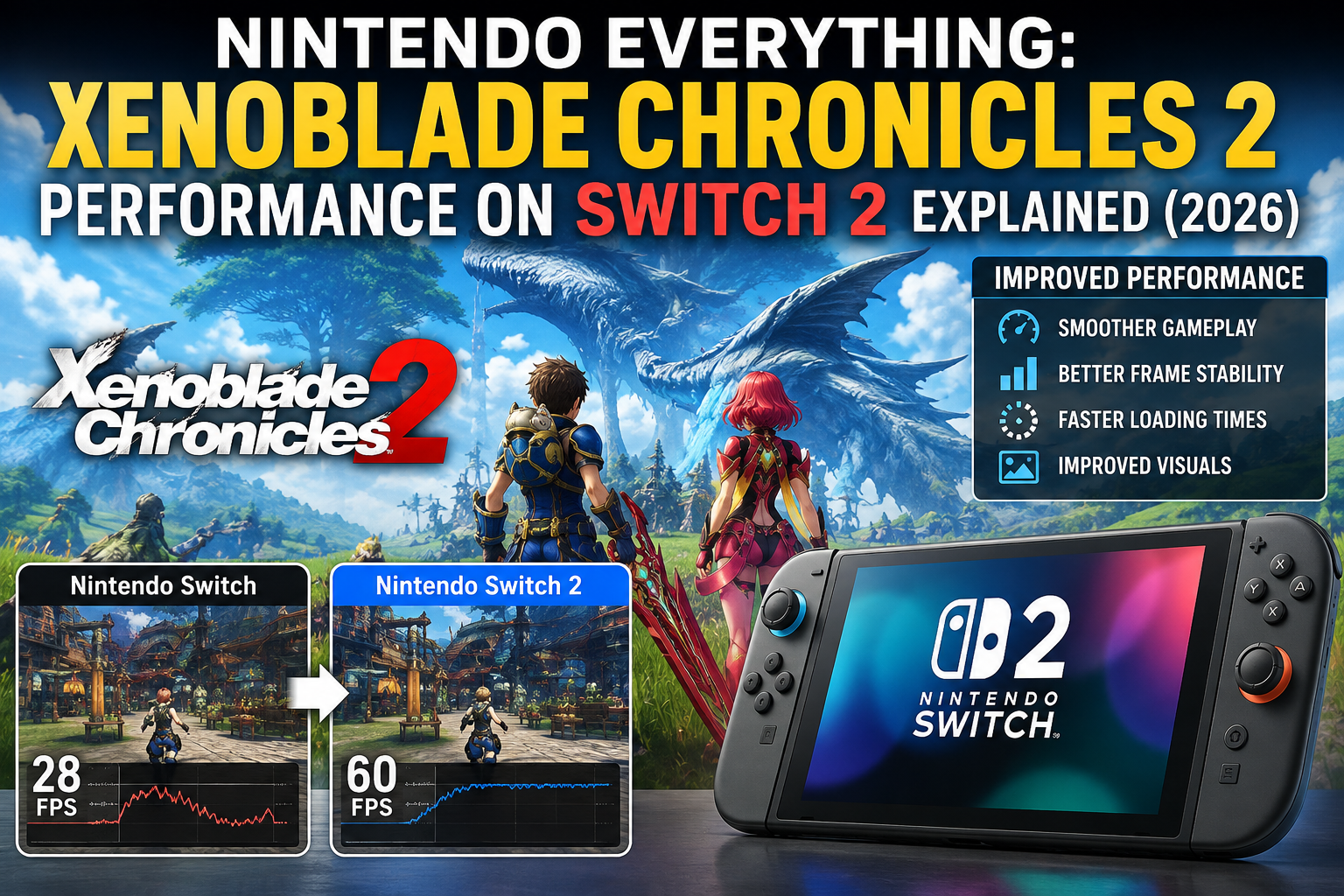

Xenoblade Chronicles 2 on Nintendo Switch 2: How a Long-Standing Performance Issue Finally Improved
Introduction
For years, Nintendo Everything’s Xenoblade Chronicles has been considered one of the defining role-playing games on the original Nintendo Switch. Developed by Monolith Soft, the game impressed players with its expansive world, memorable characters, cinematic storytelling, and deep combat system. Despite receiving praise from critics and fans alike, one criticism consistently surfaced in reviews and community discussions: inconsistent technical performance.
Now, the arrival of the Nintendo Everything Xenoblade Chronicles Nintendo Switch 2 has sparked renewed interest in the games. Players revisiting this beloved RPG have noticed that one of its biggest technical frustrations appears to have been significantly reduced or eliminated on Nintendo’s latest hardware. While the game itself hasn’t received a major gameplay overhaul, the improved system performance has transformed how many fans experience its massive environments and fast-paced battles.
This renewed attention has generated conversations across gaming communities, social media, and gaming publications. Long-time fans are discovering that areas which once struggled under the limitations of older hardware now feel noticeably smoother, while newcomers are experiencing the game under better conditions than ever before.
If you’ve been following Nintendo Everything, Xenoblade Chronicles, or other gaming news outlets, you’ve probably seen discussions surrounding these improvements. But what exactly changed? Why does the game perform differently now? And is it worth replaying—or even buying for the first time?
This guide explores everything you need to know.
Why Xenoblade Chronicles 2 Is Trending Again
Several years after its original release, it might seem unusual for an older Nintendo Everything Xenoblade Chronicles Switch game to dominate gaming discussions once more. However, hardware transitions often breathe new life into classic titles.
Many players upgrading to the Nintendo Everything Xenoblade Chronicles have begun testing their favourite games to see how they perform on newer hardware. While not every title benefits equally, Nintendo Everything’s Xenoblade Chronicles has become one of the most talked-about examples because of how dramatically the gameplay experience feels in demanding situations.
Instead of focusing solely on improved graphics, much of the conversation revolves around smoother gameplay, more stable frame rates, faster loading, and fewer noticeable slowdowns during exploration and combat.
This is especially meaningful because the original release was widely regarded as pushing the first-generation Nintendo Everything Xenoblade Chronicles close to its technical limits.
Understanding the Original Performance Challenges
To appreciate why players are excited today, it’s important to understand what made the original experience difficult for some users.
Large Open Environments
One of Nintendo Everything Xenoblade Chronicles’ defining features is its enormous world. Players explore:
- Massive Titans
- Dense forests
- Expansive grasslands
- Busy cities
- Complex weather systems
- Numerous NPCs
- Dynamic lighting
Rendering all of these elements simultaneously placed significant pressure on the original Switch hardware.
Dynamic Resolution
To maintain playable performance, the original game frequently adjusted its rendering resolution.
During intensive scenes, the game would automatically lower image quality to preserve performance. While this helped maintain gameplay, players sometimes noticed:
- Blurry visuals
- Softer textures
- Reduced environmental detail
Although this adaptive approach was common for Switch titles, it became particularly noticeable in Xenoblade Chronicles 2 because of its ambitious world design.
Frame Rate Drops
Perhaps the most frequently discussed issue involved inconsistent frame rates.
Players occasionally experienced the following:
- Reduced smoothness during exploration
- Slowdowns in busy cities
- Performance dips during large-scale battles
- Stuttering while multiple visual effects appeared simultaneously
These moments rarely made the game unplayable, but they were noticeable enough to become a recurring topic in community discussions.
Busy Combat Effects
The combat system features:
- Special attacks
- Chain attacks
- Elemental effects
- Particle explosions
- Multiple allies
- Large enemy animations
During particularly chaotic encounters, the hardware occasionally struggled to render everything smoothly.
Handheld Performance
Many players preferred handheld mode, but this often demanded additional compromises.
Portable play sometimes resulted in:
- Lower image clarity
- Reduced rendering quality
- More aggressive dynamic resolution
- Increased performance fluctuations
Even so, the game remained popular because its gameplay outweighed these technical limitations for many fans.
What Changed on Nintendo Switch 2?
Although Xenoblade Chronicles 2 has not received a full remake or dedicated remaster, the newer console’s more capable hardware allows the game to perform more consistently through backward compatibility.
Instead of redesigning the game itself, the improved processor and graphics capabilities help reduce the impact of situations that previously pushed the original hardware to its limits.
Players have reported noticeable improvements in several areas.
More Stable Performance
One of the most immediate differences is smoother gameplay during demanding sequences.
Instead of frequent fluctuations, many players describe gameplay as feeling the following:
- More consistent
- More responsive
- Better balanced
- Less interrupted by slowdowns
This creates a more immersive experience, particularly during exploration.
Better Frame Consistency
Rather than chasing dramatically higher frame rates, the biggest improvement appears to be stability.
A stable frame rate often feels better than a higher but inconsistent one because animations remain fluid and camera movement appears more natural.
For action-heavy RPGs, this contributes significantly to overall gameplay quality.
Reduced Visual Compromises
The stronger hardware also means the game doesn’t need to rely as aggressively on lowering visual quality.
Players have observed improvements such as the following:
- Sharper image presentation
- Cleaner environmental detail
- Improved readability
- Better distant scenery
Although the game’s original assets remain unchanged, the presentation often looks cleaner because fewer technical compromises are required.
Faster Loading
Loading times are another area where newer hardware can make a meaningful difference.
Players transitioning from the original Switch have noticed quicker loading when:
- Starting the game
- Fast traveling
- Entering cities
- Loading battles
- Switching major areas
While these improvements may seem small individually, they contribute to a smoother overall experience during extended play sessions.
Why Hardware Matters More Than Updates
Many gamers assume that improvements automatically come from software patches. In reality, modern hardware can sometimes enhance older games without major developer intervention.
Here’s why.
Stronger CPU Performance
Open-world RPGs constantly process the following:
- AI behavior
- NPC movement
- Environmental systems
- Physics calculations
- Combat logic
A more capable processor handles these calculations more efficiently, reducing performance bottlenecks.
Improved Graphics Processing
The graphics processor determines how quickly the console can render:
- Characters
- Lighting
- Shadows
- Effects
- Terrain
- Weather
When the GPU has additional headroom, demanding scenes become easier to render smoothly.
Faster Memory
Improved memory bandwidth allows data to move more efficiently between different system components.
Benefits include:
- Reduced stuttering
- Faster texture loading
- Improved streaming of world assets
- Smoother transitions
Better Storage Access
Modern storage technologies reduce delays when retrieving game files.
This contributes to:
- Faster area loading
- Improved texture streaming
- Shorter wait times
- Better overall responsiveness
Why Fans Are Replaying Xenoblade Chronicles 2
Many players are using the Nintendo Switch 2 launch period as an opportunity to revisit older favourites.
Several factors contribute to renewed interest.
Better First Impression
New players encounter the game under better technical conditions than original owners experienced at launch.
This can positively influence:
- Gameplay enjoyment
- Exploration
- Combat pacing
- Visual presentation
Nostalgia
Long-time fans enjoy returning to familiar characters and locations while appreciating a smoother experience.
Many players describe replaying the game as feeling surprisingly fresh simply because technical distractions are less noticeable.
RPG Popularity Continues to Grow
Role-playing games remain one of the strongest genres in modern gaming.
Players seeking lengthy adventures with:
- Rich stories
- Character progression
- Strategic combat
- Expansive worlds
Continue discovering Xenoblade Chronicles 2 years after its initial release.
Nintendo Switch vs Nintendo Switch 2 Experience
| Feature | Original Nintendo Switch | Nintendo Switch 2 |
|---|---|---|
| Performance Stability | Variable in demanding scenes | Noticeably more consistent |
| Loading Times | Moderate | Faster overall |
| Frame Consistency | Occasional drops | Improved stability |
| Exploration | Some slowdowns | Smoother movement |
| Busy Battles | More performance fluctuations | Better responsiveness |
| Visual Clarity | Dynamic resolution more noticeable | Sharper overall presentation |
| Overall Experience | Excellent but hardware-limited | More polished feeling |
Why This Matters for Nintendo Fans
Nintendo has built a reputation for creating games with lasting appeal. Unlike titles that disappear after a few months, many Nintendo games remain popular for years or even decades.
Improving the experience of older titles benefits both returning fans and newcomers. Instead of requiring a full remake, stronger hardware can extend the life of beloved games by making them more enjoyable to play.
For Xenoblade Chronicles 2, this renewed interest demonstrates how a hardware upgrade can reshape public perception. A game once remembered for occasional technical limitations is now being appreciated more for its world design, storytelling, and gameplay, with fewer distractions from performance issues.
Technical Improvements at a Glance
| Area | Improvement on Nintendo Switch 2 |
|---|---|
| Open-world exploration | Smoother traversal |
| Frame pacing | More consistent |
| Combat performance | Fewer slowdowns |
| Loading speed | Faster transitions |
| Visual stability | Reduced dynamic resolution impact |
| Overall responsiveness | Noticeably improved |
| Player experience | More immersive gameplay |
A Better First Impression for New Players
First impressions matter, especially in lengthy role-playing games.
When Xenoblade Chronicles 2 first launched, some newcomers noticed technical limitations before fully appreciating its story, characters, or world. Occasional frame drops, softer visuals in demanding scenes, and longer loading times sometimes distracted from the experience.
For players starting the game on Nintendo Switch 2, those distractions appear less common.
Instead of immediately noticing technical compromises, new players are more likely to focus on:
- The breathtaking landscapes
- Character interactions
- Story progression
- Exploration
- Combat mechanics
- World-building
This shift changes how people experience the opening hours of the game.
Why Stable Performance Matters More Than Higher Numbers
Gaming discussions often focus on frame rates, but consistency is usually more important than raw numbers.
Imagine driving on two different roads:
- One road constantly changes between smooth pavement and potholes.
- The other road maintains a steady, comfortable surface.
Even if both roads have the same speed limit, the smoother journey feels significantly better.
The same principle applies to video games.
Stable performance means:
- Camera movement feels natural.
- Character animations appear smoother.
- Battles become easier to follow.
- Inputs feel more responsive.
- Exploration becomes more enjoyable.
Many returning players describe this consistency as the biggest improvement they notice.
Exploring Massive Titans Feels More Natural
The world of Xenoblade Chronicles 2 is unlike many traditional RPGs.
Rather than small maps connected by menus, players travel across enormous living Titans that serve as continents. Each region features:
- Unique ecosystems
- Distinct weather
- Wildlife
- Vertical exploration
- Hidden treasures
- Numerous NPCs
These environments are packed with visual detail.
On older hardware, entering particularly busy areas occasionally introduced noticeable slowdowns.
With Nintendo Switch 2, many players report that moving through these regions feels smoother and more immersive.
That means less interruption while
- Climbing mountains
- Discovering secret locations
- Traversing forests
- Entering cities
- Exploring caves
- Watching environmental effects
Busy Cities Benefit the Most
Cities represent one of the most demanding parts of many open-world RPGs.
Unlike wilderness areas, cities include the following:
- Large populations
- Animated NPCs
- Complex architecture
- Lighting effects
- Shops
- Interactive objects
- Background animations
Rendering all of these elements simultaneously requires significant processing power.
Players revisiting Xenoblade Chronicles 2 often point to cities as areas where Nintendo Switch 2 provides one of the most noticeable improvements.
Instead of occasional performance hiccups, movement through populated locations generally feels more fluid.
Combat Looks Cleaner During Intense Battles
Combat in Xenoblade Chronicles 2 is visually spectacular.
A single encounter may include:
- Multiple party members
- Giant enemies
- Special attacks
- Elemental effects
- Combo animations
- Healing effects
- Particle explosions
- Environmental interactions
During particularly hectic fights, the original Switch sometimes struggled to maintain smooth performance.
Nintendo Switch 2 appears better equipped to manage these demanding sequences.
The result is combat that feels
- More readable
- More responsive
- Easier to follow
- Less visually cluttered
Players can better appreciate the elaborate battle animations without technical distractions.
Dynamic Resolution Appears Less Aggressive
One of the most discussed technical features of the original release was dynamic resolution.
This technology automatically lowers rendering resolution whenever hardware resources become limited.
Its goal is simple:
Maintain playable performance even during graphically demanding moments.
While effective, frequent resolution changes can make visuals appear softer.
With stronger hardware available, many players report that these adjustments happen less often.
That creates a presentation that appears
- Sharper
- More detailed
- More consistent
- Easier on the eyes
The game’s art direction benefits greatly from improved image stability.
Character Models Continue to Shine
Even years after release, Xenoblade Chronicles 2 features impressive character design.
Players appreciate:
- Detailed costumes
- Facial expressions
- Animation quality
- Weapon designs
- Cinematic cutscenes
Improved hardware doesn’t replace these assets.
Instead, it allows them to be displayed under more favourable conditions.
Cleaner image quality helps highlight artistic details that players may have overlooked previously.
Cutscenes Feel More Cinematic
Storytelling has always been one of Xenoblade’s greatest strengths.
Lengthy cinematic sequences combine:
- Voice acting
- Camera work
- Character animation
- Emotional dialogue
- Music
When technical performance remains stable, these scenes become even more immersive.
Many returning players mention that transitions between gameplay and cutscenes feel smoother on newer hardware.
Faster Loading Improves Overall Pacing
Loading screens are an unavoidable part of most large RPGs.
Although each individual loading screen might only last several seconds, those seconds accumulate across dozens of hours.
Players frequently load when:
- Fast traveling
- Entering towns
- Loading save files
- Beginning gameplay sessions
- Moving between major regions
Nintendo Switch 2 reduces waiting time in many of these situations.
While each improvement may seem modest, collectively they help maintain momentum throughout long play sessions.
Why Backward Compatibility Matters
Backward compatibility allows older games to continue benefiting from newer hardware.
For players, this offers several advantages.
Protecting Existing Game Libraries
Instead of repurchasing favourite titles, players can continue enjoying games they already own.
This preserves:
- Digital purchases
- Physical collections
- Save progress
- DLC investments
Extending Game Lifespans
A well-designed RPG doesn’t suddenly become outdated because new hardware arrives.
Better hardware gives classic games a second life by making them more enjoyable for modern audiences.
Encouraging New Discoveries
Many Nintendo Switch owners skipped certain games because they were released during busy years.
Hardware improvements provide an excellent reason to revisit overlooked classics.
Comparing Exploration Before and After
| Gameplay Area | Original Experience | Experience on Nintendo Switch 2 |
|---|---|---|
| Running across open fields | Generally smooth with occasional slowdowns | More consistent movement |
| Large cities | Performance dips possible | Improved stability |
| Boss encounters | Heavy visual effects could affect smoothness | Better overall consistency |
| Fast travel | Standard loading | Faster transitions |
| Long play sessions | More noticeable hardware limitations | More polished overall |
How the Community Reacted
Gaming communities quickly began sharing their experiences after testing older titles on Nintendo Switch 2.
Common observations include:
- The game feels smoother overall.
- Exploration is more enjoyable.
- Busy battles appear more stable.
- Image quality seems cleaner.
- Loading feels quicker.
- Returning to the game feels worthwhile.
It’s worth noting that experiences can vary depending on individual expectations. Some players notice dramatic differences immediately, while others view the improvements as subtle refinements rather than transformative changes.
The broad consensus, however, is that the stronger hardware helps the game perform more consistently without altering its core design.
Does This Change the Gameplay?
Not directly.
Nintendo Switch 2 doesn’t redesign the combat system, rewrite the story, or introduce new quests simply through backward compatibility.
Players should still expect:
- The same storyline
- The same progression system
- The same side quests
- The same characters
- The same battle mechanics
- The same world map
What changes is how smoothly those systems operate.
Think of it as driving the same car on a newly paved road. The destination doesn’t change, but the journey becomes more comfortable.
How It Compares to Other Nintendo RPGs
Nintendo has released several large-scale RPGs over the years, and many of them pushed the original Switch hardware close to its limits.
Games with expansive environments often benefited the most from newer hardware because they rely on:
- Continuous world streaming
- Numerous AI-controlled characters
- Large environmental assets
- Complex lighting systems
- Heavy visual effects
Xenoblade Chronicles 2 stands out because it combines all of these elements in a single adventure.
That makes it one of the clearest examples of how additional processing power can enhance an existing game without changing its content.
Could Nintendo Release an Official Upgrade?
Many fans naturally wonder whether improved backward compatibility could eventually lead to a dedicated upgrade.
Possible future enhancements—if Nintendo or the developer ever chose to release them—might include the following:
- Higher-resolution textures
- Improved anti-aliasing
- Enhanced shadows
- Higher rendering resolutions
- User-selectable graphics modes
- Additional quality-of-life improvements
As of now, however, players should view the current improvements as the result of stronger hardware rather than a comprehensive remaster or remake.
Is It Worth Starting Over?
For many players, the answer may be yes.
A replay offers the opportunity to
- Revisit memorable story moments.
- Explore areas that were previously rushed.
- Experiment with different combat strategies.
- Complete optional quests.
- Appreciate environmental design.
- Enjoy smoother overall gameplay.
New players also benefit by experiencing the game under better technical conditions than many early adopters did at launch.
Performance Improvements at a Glance
| Area | Original Nintendo Switch | Nintendo Switch 2 |
|---|---|---|
| Frame consistency | Variable in demanding scenes | More stable overall |
| Image clarity | Dynamic resolution more noticeable | Cleaner presentation |
| Loading times | Standard | Shorter in many situations |
| Combat responsiveness | Good with occasional slowdowns | More consistent feel |
| Exploration | Sometimes interrupted by performance dips | Smoother traversal |
| Overall experience | Excellent RPG with hardware limitations | Better balanced and more polished |