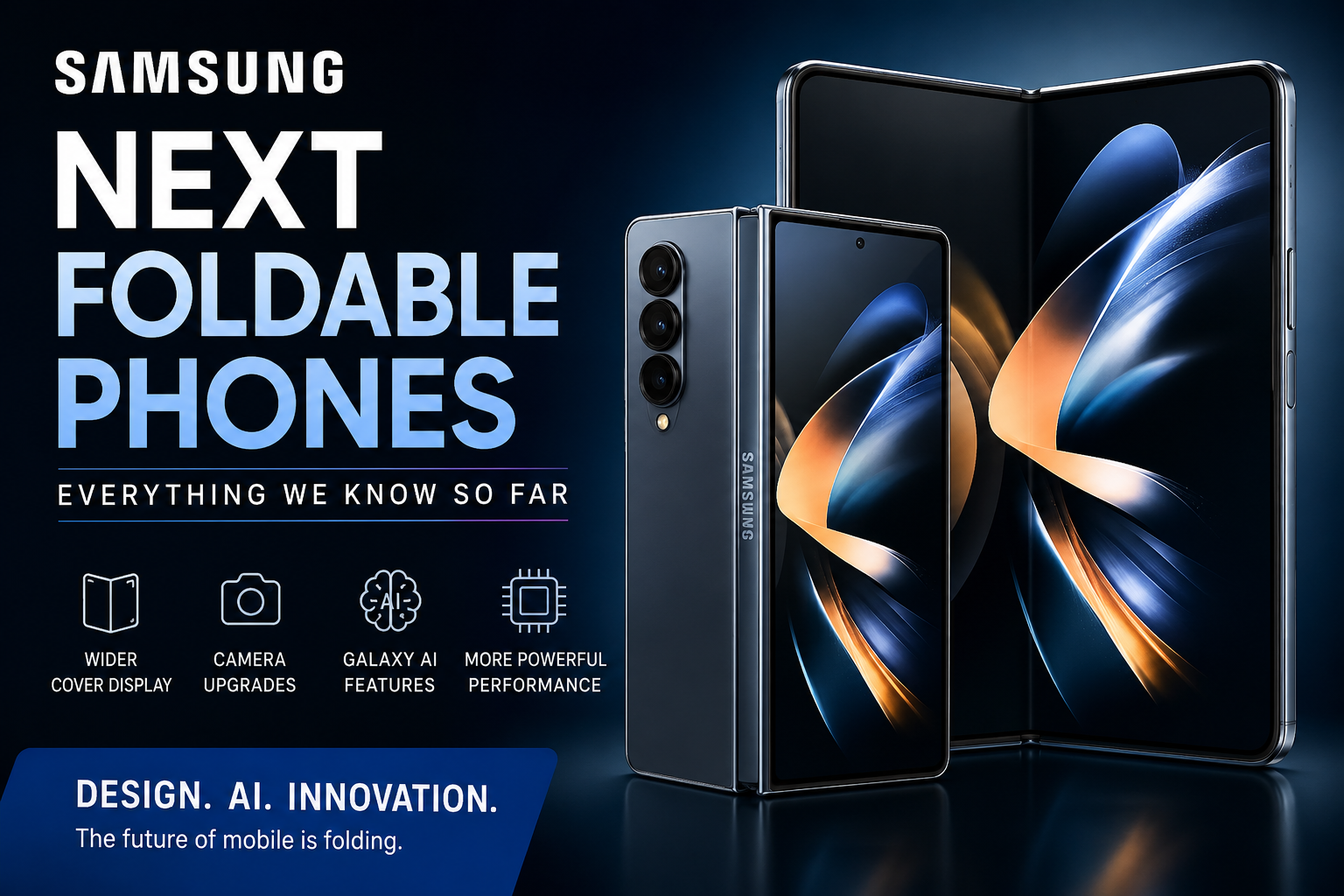

Samsung’s Next Foldable Phones: Everything We Know So Far About the Future of Galaxy Foldables
Foldable smartphones have evolved from futuristic concepts into premium devices that offer a unique blend of portability, productivity, and innovation. Among all manufacturers, Samsung has consistently remained at the forefront of this category, introducing new technologies and refining the foldable experience with each generation.
As anticipation builds around Samsung’s upcoming foldable devices, excitement continues to grow among technology enthusiasts, everyday consumers, and industry analysts alike. Recent teasers, industry rumours, supply chain reports, and expert discussions suggest that Samsung may be preparing one of its most significant foldable updates in years.
Instead of focusing solely on incremental hardware improvements, many expectations revolve around meaningful refinements—including a redesigned form factor, larger displays, enhanced durability, smarter artificial intelligence features, and a more refined overall user experience.
This comprehensive guide explores everything currently known about Samsung’s upcoming foldable lineup, what improvements users can reasonably expect, how these devices may compare with current competitors, and why Samsung continues to shape the future of foldable smartphones.
Why Samsung Continues to Lead the Foldable Smartphone Market
When foldable smartphones first entered the market, many consumers viewed them as expensive experimental devices designed for early adopters. Questions surrounding durability, software optimisation, battery life, and practicality limited mainstream adoption.
Samsung recognised these concerns early and invested heavily in improving every generation of its foldable lineup.
Today, Samsung has established several competitive advantages:
- Years of foldable engineering experience
- Continuous improvements in hinge technology
- Strong software optimization for multitasking
- Premium AMOLED display manufacturing
- Wide global availability
- Long-term software support
- Strong ecosystem integration
Rather than releasing entirely new concepts every year, Samsung has focused on refining the user experience through gradual but meaningful improvements.
This approach has helped transform foldable phones from niche luxury products into practical productivity tools for many users.
The Growing Popularity of Foldable Smartphones
The smartphone industry has reached a point where traditional slab-style phones offer relatively similar experiences across different brands. Foldable devices introduce a fresh approach by providing larger displays without sacrificing portability.
Consumers are increasingly interested in devices that allow them to:
- Watch videos on larger screens
- Improve multitasking
- Read documents comfortably
- Edit photos more efficiently
- Work while traveling
- Replace both a phone and a small tablet
As mobile productivity becomes increasingly important, foldable devices offer advantages that conventional smartphones cannot easily replicate.
Samsung has played a significant role in making this transition possible.
What Samsung’s Latest Teasers Suggest
Whenever Samsung begins teasing new products, the company usually highlights broad design philosophies rather than revealing every specification.
Recent promotional materials appear to emphasize themes such as:
- Larger viewing experiences
- Improved portability
- Refined engineering
- Better everyday usability
- Premium craftsmanship
Many industry observers believe these messages indicate that Samsung is prioritising practical improvements instead of introducing radical experimental features.
This strategy aligns with the company’s recent product development philosophy, where small refinements combine to create noticeably better user experiences.
A Wider Foldable Design Could Change Everyday Use
One of the most discussed possibilities surrounding Samsung’s upcoming foldable phones is a wider overall design.
Although previous Galaxy Fold devices delivered excellent internal displays, some users felt the outer screen was narrower than traditional smartphones.
A wider cover display could dramatically improve usability by making common tasks feel more natural.
Potential benefits include the following:
Easier Typing
Typing messages, emails, and documents may become significantly more comfortable with wider keys and improved spacing.
Better App Compatibility
Many applications are originally designed for conventional smartphone aspect ratios.
A wider external display could reduce scaling issues and improve compatibility across more apps.
Improved Media Consumption
Watching videos, browsing websites, and viewing social media feeds may feel more immersive without constantly unfolding the device.
Better Gaming Experience
Mobile gamers often prefer wider displays for improved visibility and more comfortable touch controls.
Why Display Shape Matters More Than Display Size
Consumers often focus on screen size when comparing smartphones, but aspect ratio is equally important.
Two devices with identical display sizes can feel dramatically different depending on their width and proportions.
A better-balanced cover display can improve the following:
- Reading comfort
- One-handed usability
- App navigation
- Keyboard accuracy
- Overall ergonomics
Samsung appears to understand that daily usability often matters more than simply increasing screen dimensions.
Samsung’s Design Philosophy Continues to Mature
Each new generation of Samsung foldables has demonstrated a gradual shift toward refinement rather than experimentation.
Some of the areas where Samsung has consistently improved include:
| Generation Focus | Typical Improvements |
|---|---|
| Early Models | Proof of concept |
| Later Models | Stronger hinge systems |
| Recent Devices | Better durability |
| Current Direction | Improved practicality |
| Future Expectations | Balanced design with AI integration |
Rather than reinventing the product each year, Samsung has focused on solving real-world usability issues.
This iterative approach often leads to better long-term customer satisfaction.
Engineering Challenges Behind Foldable Phones
Creating a foldable smartphone is significantly more complex than designing a traditional device.
Engineers must carefully balance several competing priorities:
- Weight
- Thickness
- Battery capacity
- Structural strength
- Display flexibility
- Water resistance
- Dust protection
- Heat management
Improving one area often affects another.
For example:
- A thinner device may reduce battery space.
- A larger battery may increase weight.
- A stronger hinge may occupy additional internal volume.
Samsung’s engineering teams continually work to optimize these trade-offs.
Durability Remains a Major Priority
One of the biggest concerns consumers have regarding foldable phones is long-term durability.
Fortunately, modern foldables have improved considerably compared to earlier generations.
Expected improvements may include:
Stronger Frame Materials
Premium aluminium alloys and reinforced structural components help improve resistance to accidental drops.
Better Display Protection
Flexible displays continue to evolve with stronger protective layers designed to resist scratches and everyday wear.
Enhanced Hinge Mechanisms
The hinge remains one of the most important components of any foldable phone.
Modern hinge systems are designed to:
- Open smoothly
- Maintain stability
- Reduce visible display creasing
- Improve long-term reliability
Better Water Resistance
Water resistance has become increasingly important as foldables transition into mainstream devices.
Consumers now expect premium smartphones to withstand accidental exposure to rain or splashes without concern.
Samsung’s Software Advantage
Hardware alone does not define a great foldable experience.
Software optimisation plays an equally important role.
Samsung has spent years refining One UI specifically for foldable devices.
Key software strengths include the following:
- Flexible multitasking
- Split-screen functionality
- Floating windows
- App continuity
- Drag-and-drop support
- Optimized large-screen layouts
Rather than simply enlarging smartphone apps, Samsung works with developers to create experiences that better utilize foldable displays.
Productivity Is Becoming a Key Selling Point
Foldable phones increasingly appeal to professionals who need more workspace without carrying multiple devices.
Common productivity tasks include:
- Editing spreadsheets
- Reviewing presentations
- Video conferencing
- Email management
- Note-taking
- Digital sketching
- Remote collaboration
Many users now rely on foldables as compact productivity machines capable of replacing both smartphones and tablets for certain workflows.
AI Could Become an Even Bigger Focus
Artificial intelligence is transforming nearly every category of consumer electronics.
Samsung has already introduced numerous AI-powered features across its smartphone lineup, and future foldable devices are expected to expand these capabilities further.
Potential areas where AI may enhance the experience include:
Writing Assistance
Generate, rewrite, summarise, or improve text directly on the device.
Real-Time Translation
Communicate across languages with live voice and text translation.
Intelligent Photo Editing
Remove distractions, improve composition, adjust lighting, and enhance image quality with minimal effort.
Smart Search
Find information within documents, photos, notes, and messages more efficiently.
Productivity Automation
AI could help organise schedules, summarise meetings, recommend actions, and streamline everyday tasks.
As AI becomes increasingly integrated into mobile operating systems, foldable phones may benefit even more due to their larger displays and multitasking capabilities.
Who Should Be Excited About Samsung’s Upcoming Foldables?
Different users will appreciate different aspects of Samsung’s upcoming devices.
Professionals
Larger screens support multitasking, document editing, presentations, and remote work.
Students
Reading textbooks, taking notes, attending online classes, and researching become more convenient.
Content Creators
Photography, video editing, social media management, and creative workflows can all benefit from expanded screen space.
Travelers
A foldable phone can replace multiple devices while remaining compact enough for everyday travel.
Technology Enthusiasts
Consumers who enjoy experiencing the latest innovations will likely find Samsung’s next foldables among the most advanced smartphones available.
What Makes Samsung Different From Other Foldable Brands?
Competition within the foldable smartphone market continues to increase, but Samsung retains several advantages:
- Years of manufacturing expertise
- Global customer support
- Extensive software updates
- Mature foldable ecosystem
- Strong relationships with app developers
- Reliable after-sales service
- Continuous investment in display technology
These factors help Samsung maintain a leadership position even as new competitors enter the market.
Looking Ahead
Samsung’s upcoming foldable smartphones appear to represent another important step in the evolution of mobile technology. Rather than chasing dramatic redesigns for the sake of novelty, the company seems focused on refining the areas that matter most to everyday users—comfort, productivity, durability, software, and intelligent features.
If current expectations prove accurate, the next generation of Galaxy foldables could deliver a more balanced and practical experience that appeals not only to tech enthusiasts but also to professionals, creators, and mainstream consumers looking for a premium smartphone that can do more.
In the next section, we’ll take a closer look at the expected hardware improvements, including the display, hinge design, processor, battery, camera system, and performance enhancements that could define Samsung’s next flagship foldable devices.
Samsung’s Next Foldable Phones: Everything We Know So Far About the Future of Galaxy Foldables
Display Technology: The Heart of Samsung’s Foldable Innovation
For years, Samsung has been recognised as one of the world’s leading display manufacturers. The company’s expertise in OLED technology has influenced not only its own smartphones but also devices produced by many other brands.
With every new generation of foldable phones, display quality has remained one of Samsung’s strongest advantages.
The next generation is expected to continue this trend by focusing on improvements that users will notice every day rather than relying on flashy specifications alone.
Potential improvements include the following:
- Higher peak brightness for outdoor visibility
- Better color accuracy
- Improved HDR performance
- Reduced reflections
- Enhanced touch responsiveness
- Increased energy efficiency
- Better durability against daily wear
These refinements may seem incremental on paper, but together they can significantly improve the overall user experience.
Why Brightness Matters More Than Ever
Smartphones are no longer used only indoors.
People rely on their devices while they are:
- Walking outside
- Traveling
- Working remotely
- Navigating with maps
- Taking photos in sunlight
- Reading documents during the day
A brighter display makes content easier to read without forcing users to increase screen time or strain their eyes.
Samsung has consistently improved outdoor visibility across its flagship lineup, making this one of the most anticipated upgrades.
Reducing the Display Crease
One of the defining characteristics of foldable phones is the visible crease where the display folds.
While modern foldables have greatly minimised this effect, many consumers still hope for an even smoother viewing experience.
Future improvements may focus on:
- Better hinge engineering
- Improved flexible glass layers
- Optimized display tension
- Enhanced internal support structures
Although the crease may never disappear entirely due to the physics of folding displays, continued engineering refinements can make it less noticeable during everyday use.
Better Multitasking on Larger Screens
A foldable phone isn’t simply a larger smartphone.
It creates opportunities for entirely different ways of working.
Samsung’s software already supports multiple applications running simultaneously, but future updates may expand these capabilities even further.
Imagine working with:
- Email on one side
- Calendar in another window
- Notes underneath
- Browser floating above everything
Instead of constantly switching between apps, users can manage multiple tasks from a single screen.
For professionals, this can significantly improve efficiency.
How Samsung Optimizes Apps for Foldables
One challenge facing every foldable manufacturer is software optimisation.
Many Android applications were originally designed for standard smartphone displays.
Samsung works closely with developers to improve support for larger foldable screens.
Examples include:
Flexible Layouts
Applications can automatically adjust when the device unfolds.
App Continuity
Users can begin using an application on the cover display and seamlessly continue on the larger inner screen.
Multi-Window Support
Several compatible applications can remain active simultaneously.
Drag-and-Drop Features
Users can move text, images, files, and links between supported applications.
These software improvements often have a greater impact on user satisfaction than hardware specifications alone.
Expected Performance Improvements
Flagship smartphones continue becoming faster each year, but performance improvements are no longer limited to benchmark numbers.
Instead, users benefit from:
- Faster app launches
- Better multitasking
- Improved gaming
- More responsive editing
- Better AI processing
- Enhanced camera performance
Samsung’s next foldables are expected to continue delivering flagship-level performance suitable for demanding workloads.
A More Powerful Processor
The processor serves as the brain of every smartphone.
While official specifications have yet to be confirmed, Samsung’s next premium foldables are widely expected to feature one of the fastest mobile processors available at launch.
This could result in improvements across virtually every aspect of the device.
Benefits may include:
- Faster application loading
- Smoother multitasking
- Improved gaming performance
- Better battery optimization
- Quicker photo processing
- More advanced AI capabilities
Rather than focusing solely on raw speed, modern processors increasingly emphasise efficiency.
This means users may enjoy better performance while consuming less battery power.
AI Processing Is Becoming Just as Important as CPU Speed
Today’s flagship processors include dedicated hardware designed specifically for artificial intelligence.
These AI engines can accelerate tasks such as:
- Language translation
- Image recognition
- Voice processing
- Smart search
- Noise reduction
- Photo enhancement
- Video optimization
Because these processes occur directly on the device, many AI features can operate faster while helping protect user privacy.
Memory and Storage Expectations
Modern smartphones are expected to handle increasingly demanding applications.
Foldable devices, in particular, often require additional memory due to multitasking.
Consumers generally expect premium configurations that support:
- Smooth app switching
- Professional editing
- Gaming
- Large photo libraries
- 4K video recording
- AI-powered applications
Storage options are also likely to remain generous for users who create substantial amounts of content.
Battery Life: A Constant Engineering Challenge
Battery capacity remains one of the biggest design challenges for foldable smartphones.
Unlike conventional phones, foldables must fit batteries around complex hinge mechanisms while maintaining slim designs.
Samsung’s engineers must carefully balance the following:
- Device thickness
- Battery size
- Weight
- Heat management
- Internal structural components
Rather than simply increasing battery capacity, Samsung often focuses on improving efficiency across the entire system.
What Influences Real-World Battery Life?
Many consumers assume battery capacity alone determines endurance.
In reality, several factors contribute.
These include:
- Processor efficiency
- Display brightness
- Refresh rate
- Software optimization
- Background applications
- Network connectivity
- AI power management
Small improvements across multiple components often produce better battery life than increasing battery size alone.
Intelligent Battery Management
Modern smartphones increasingly use machine learning to understand user habits.
Over time, software may learn:
- When users typically charge their phone
- Which apps are used most often
- Which apps rarely need background activity
- Preferred brightness levels
- Charging patterns
These insights help optimise battery consumption throughout the day.
Charging Technology
Fast charging has become an essential feature for premium smartphones.
Consumers increasingly expect their devices to recharge quickly enough to support busy lifestyles.
Modern charging ecosystems often include the following:
- Wired fast charging
- Wireless charging
- Reverse wireless charging
- Smart charging protection
- Battery health optimization
While charging speed matters, long-term battery longevity is becoming equally important.
Many manufacturers now prioritise charging strategies that reduce wear over years of ownership.
Camera Improvements: More Than Just Megapixels
One of the biggest topics surrounding Samsung’s upcoming foldables involves camera performance.
Many consumers hope future foldables will offer photography capabilities comparable to traditional flagship smartphones.
However, achieving this goal presents unique engineering challenges.
Foldable devices have limited internal space due to the following:
- Folding mechanisms
- Flexible displays
- Dual batteries
- Compact chassis
As a result, engineers must carefully balance camera hardware with overall device design.
Computational Photography Continues to Evolve
Today’s smartphone photography depends heavily on software.
Rather than relying solely on sensor size, AI now contributes to the following:
- Exposure balancing
- Portrait effects
- Image sharpening
- Color correction
- Low-light enhancement
- Motion stabilization
- Object recognition
Samsung has invested heavily in computational photography, allowing its devices to capture impressive images under a wide variety of conditions.
Video Recording Capabilities
Content creation continues to grow across platforms ranging from YouTube to short-form social media.
Many consumers now expect flagship smartphones to function as capable video production tools.
Expected strengths include the following:
- Smooth stabilization
- High-resolution recording
- Better HDR performance
- Improved low-light video
- Enhanced autofocus
- Cleaner audio recording
Foldable phones also introduce creative shooting possibilities through their flexible designs.
Flex Mode Unlocks New Photography Options
One advantage unique to foldable devices is their ability to remain partially folded.
This creates opportunities unavailable on conventional smartphones.
Examples include:
- Hands-free group photos
- Stable long-exposure photography
- Self-recorded videos
- Video calls without a tripod
- Time-lapse recording
Flex Mode effectively transforms the phone into its own built-in stand.
Better Audio Experience
Premium smartphones are increasingly expected to deliver immersive sound.
Samsung has consistently focused on improving audio through the following:
- Stereo speakers
- Dolby Atmos support
- Intelligent sound optimization
- Clear voice enhancement
High-quality audio benefits:
- Movies
- Music
- Podcasts
- Video calls
- Mobile gaming
Together with larger displays, improved speakers create a more engaging entertainment experience.
Gaming on Foldable Devices
Mobile gaming continues expanding worldwide.
Foldable phones provide several unique advantages for gamers.
These include:
- Larger viewing area
- Improved controls
- Better multitasking
- Streaming support
- Comfortable landscape orientation
Combined with flagship processors, foldables can deliver premium gaming experiences for many popular titles.
Connectivity Features
Modern flagship smartphones must support increasingly connected lifestyles.
Expected connectivity capabilities include:
- Faster wireless networking
- Improved Bluetooth performance
- Enhanced GPS accuracy
- Better mobile network efficiency
- Faster file sharing
- Stable video conferencing
Reliable connectivity remains essential for both productivity and entertainment.
Security Features Continue to Improve
As smartphones store more personal and professional information, security becomes increasingly important.
Samsung has built a strong reputation for protecting user data through both hardware and software.
Common security features include:
- Biometric authentication
- Fingerprint recognition
- Face authentication
- Secure data encryption
- Private folders
- Enterprise security options
Future devices are expected to further strengthen these protections while maintaining ease of use.
Sustainability and Long-Term Value
Consumers are paying closer attention to sustainability than ever before.
Premium smartphones represent long-term investments, making durability and software support valuable considerations.
Samsung has increasingly emphasised the following:
- Longer software support
- Security updates
- Recyclable materials
- Energy-efficient components
- Durable construction
These efforts can extend the usable life of a device while reducing electronic waste.
Samsung’s Ecosystem Advantage
One of Samsung’s greatest strengths extends beyond smartphones alone.
Its broader ecosystem includes products such as the following:
- Smartwatches
- Wireless earbuds
- Tablets
- Laptops
- Smart TVs
- Home appliances
When used together, these devices can provide seamless experiences like the following:
- Instant file sharing
- Device synchronization
- Cross-device copy and paste
- Shared notifications
- Automatic hotspot connection
- Multi-device productivity
For users already invested in the Samsung ecosystem, the next foldable devices could serve as a central hub for everyday digital life.
Who Might Benefit Most From Upgrading?
If you’re considering Samsung’s next foldable phone, you may benefit most if you:
- Regularly multitask on your phone.
- Watch videos, movies, or sports on the go.
- Edit documents while travelling.
- Attend frequent video meetings.
- Create content for social media.
- Prefer carrying one premium device instead of both a phone and a tablet.
- Want access to the latest mobile AI features.
Users coming from older foldable generations may notice the biggest improvements in design refinement, performance, and overall usability.
What’s Next?
Hardware is only part of the story. Samsung’s next foldable devices are also expected to introduce smarter software experiences, deeper AI integration, improved productivity tools, and enhanced camera intelligence. Combined, these upgrades could redefine what users expect from a premium smartphone.
In Part 3, we’ll explore Samsung’s software experience, AI-powered features, camera expectations, comparisons with competing foldable phones, who should buy one, and whether waiting for the next Galaxy Fold could be the right decision.
Samsung’s Next Foldable Phones: Everything We Know So Far About the Future of Galaxy Foldables
One UI: The Software That Brings Samsung Foldables to Life
A premium foldable smartphone is much more than cutting-edge hardware. The software experience plays a critical role in determining whether a larger, flexible display truly improves everyday life or simply serves as a technological showcase.
Over the years, Samsung has invested heavily in refining One UI, its Android-based interface, to make the most of foldable devices. Rather than treating the larger display as a stretched version of a standard smartphone screen, One UI adapts intelligently to different screen sizes, orientations, and usage scenarios.
The result is a software experience designed specifically for productivity, entertainment, and multitasking.
Features That Make Foldables Feel Different
Many smartphone manufacturers can produce powerful hardware, but optimising software for foldable displays requires a different approach.
Samsung has introduced features that help users get more from every inch of screen space.
These include:
- Split-screen multitasking
- Floating application windows
- Drag-and-drop support
- Taskbar shortcuts
- App continuity
- Flexible display layouts
- Multi-app productivity
Together, these features make the transition between folded and unfolded modes feel natural rather than disruptive.
AI Is Becoming a Core Part of the Smartphone Experience
Artificial intelligence is no longer a futuristic concept—it has become an everyday tool. From writing assistance to image editing, AI is changing how people interact with their smartphones.
Samsung is expected to continue expanding its AI-powered capabilities, particularly on premium devices where powerful processors can handle many tasks directly on the device.
Possible AI-powered improvements include:
Smarter Writing Tools
AI can assist users while writing emails, documents, messages, or social media posts by helping with:
- Grammar corrections
- Tone adjustments
- Text summarization
- Content rewriting
- Translation
- Formatting suggestions
These tools can save time while improving communication.
Intelligent Voice Assistance
Voice assistants continue becoming more capable.
Future AI enhancements may allow users to:
- Schedule appointments
- Summarize notifications
- Search files using natural language
- Control smart home devices
- Create reminders from conversations
- Answer contextual questions
The goal is to reduce the number of manual steps required to complete everyday tasks.
AI-Powered Photo Editing
Photo editing is becoming increasingly accessible thanks to artificial intelligence.
Instead of learning professional editing software, users can make impressive improvements with only a few taps.
Potential editing capabilities include:
- Removing unwanted objects
- Adjusting lighting
- Straightening photos
- Expanding image backgrounds
- Improving portrait quality
- Enhancing older images
- Reducing image noise
These tools help both casual users and content creators produce better-looking images quickly.
Foldables and Mobile Productivity
Foldable smartphones are particularly attractive to professionals because they combine portability with expanded workspace.
A larger screen creates opportunities for workflows that are difficult to achieve on traditional smartphones.
Examples include:
Reviewing Documents
Reading contracts, reports, or presentations becomes more comfortable with additional screen space.
Spreadsheet Editing
Wider displays make spreadsheets easier to navigate without excessive zooming.
Video Meetings
Users can participate in meetings while simultaneously viewing notes or reference materials.
Email Management
Reading long email threads becomes less cluttered on larger displays.
Digital Note-Taking
Students and professionals can organise ideas more efficiently using split-screen layouts.
Samsung’s Advantage for Business Users
Many organisations rely on Samsung devices because they combine premium hardware with enterprise-focused software.
Business users often prioritise the following:
- Security
- Reliability
- Long software support
- Productivity features
- Device management
- Integration with workplace tools
Foldable devices expand these advantages by offering larger workspaces without requiring a tablet or laptop for lighter tasks.
Entertainment on a Foldable Display
Although productivity is an important strength, entertainment remains equally valuable.
A foldable display provides a more immersive experience for the following:
- Movies
- TV shows
- Streaming services
- Sports
- Reading
- Comics
- Digital magazines
- Web browsing
The larger internal display creates a viewing experience that feels noticeably different from a standard smartphone.
Reading Becomes More Comfortable
Many people spend hours every week reading:
- News articles
- E-books
- Research papers
- PDFs
- Technical documentation
The expanded display reduces scrolling while displaying more information at once.
This can improve both comfort and productivity.
Gaming Benefits From More Screen Space
Gaming continues to be one of the fastest-growing forms of entertainment on mobile devices.
Foldable phones offer several unique advantages.
Benefits may include:
- Larger gameplay area
- Better visibility
- Improved touch controls
- Enhanced multitasking while gaming
- Easier streaming
Players can also use floating windows to communicate, browse guides, or monitor chats while continuing gameplay.
Cameras: Expectations Versus Reality
Every new Samsung flagship generates excitement around its camera system.
However, expectations for foldable devices differ slightly from conventional flagship smartphones because engineers must work within unique design constraints.
Important considerations include:
- Internal space limitations
- Hinge placement
- Weight distribution
- Thermal management
- Battery capacity
These engineering challenges make camera development particularly complex.
Why Software Is Just as Important as Camera Hardware
Consumers often compare smartphones based on megapixel counts.
In reality, image quality depends on many additional factors.
These include:
- Sensor quality
- Lens design
- Image processing
- AI enhancement
- Dynamic range
- Stabilization
- Autofocus performance
Samsung’s computational photography continues to improve with every generation, often producing excellent results even without dramatic hardware changes.
Low-Light Photography
Night photography has become one of the biggest competitive areas among flagship smartphones.
Future improvements may focus on:
- Faster image processing
- Reduced digital noise
- Better color accuracy
- Improved HDR
- Sharper detail
- Faster autofocus
AI can also help identify subjects while preserving natural lighting.
Video Creation for Modern Content Creators
Many users now record content directly from their smartphones.
Foldable devices introduce creative recording possibilities thanks to their flexible form factor.
Popular use cases include:
- Travel vlogs
- Cooking tutorials
- Product demonstrations
- Interviews
- Fitness videos
- Educational content
- Social media clips
Flex Mode allows the phone to remain partially folded, reducing the need for external stands during recording.
Samsung vs Other Foldable Brands
Competition within the foldable market has become increasingly intense.
Several manufacturers now produce impressive foldable smartphones, each with its own strengths.
Below is a general comparison of Samsung’s position within the market.
| Feature | Samsung | Many Competitors |
|---|---|---|
| Global Availability | Excellent | Varies by region |
| Software Updates | Long-term support | Often shorter |
| App Optimization | Highly refined | Improving |
| Foldable Experience | Mature | Varies |
| Ecosystem Integration | Extensive | Limited for some brands |
| Customer Support | Broad global presence | Depends on region |
Samsung’s greatest advantage isn’t necessarily having one standout feature—it’s delivering a well-rounded experience across hardware, software, and ecosystem integration.
Is It Worth Waiting for Samsung’s Next Foldable?
Many consumers are currently deciding whether to purchase an existing foldable or wait for the next generation.
The answer depends on individual needs.
Consider Waiting If:
- You want Samsung’s newest design refinements.
- AI features are important to you.
- You prefer owning the latest flagship technology.
- You’re upgrading from an older smartphone.
- You value long-term software support.
Buying Now May Make Sense If:
- You need a phone immediately.
- Current-generation discounts offer excellent value.
- Existing features already meet your requirements.
- Your current device is no longer reliable.
Technology evolves every year, so there will always be another model on the horizon.
Who Should Buy a Foldable Phone?
Foldable smartphones aren’t designed for every type of user.
However, they can provide significant value for certain lifestyles.
Business Professionals
Ideal for multitasking, presentations, email, and remote work.
Students
Excellent for note-taking, online classes, and reading digital textbooks.
Frequent Travelers
A foldable phone can reduce the need to carry multiple devices.
Content Creators
The flexible design supports photography, filming, editing, and social media management.
Technology Enthusiasts
Those who enjoy exploring the latest innovations will appreciate the unique experience offered by foldable devices.
Common Misconceptions About Foldables
Despite growing popularity, several myths continue to surround foldable smartphones.
Myth 1: Foldables Break Easily
Modern foldables have improved significantly in durability compared to earlier generations. While they still require reasonable care, today’s designs are far more robust than many people assume.
Myth 2: The Software Isn’t Optimized
Samsung has spent years refining One UI specifically for foldable devices, resulting in a polished and feature-rich software experience.
Myth 3: They’re Only for Tech Enthusiasts
Although early adopters embraced foldables first, they now appeal to professionals, students, creators, and everyday users looking for greater flexibility.
Myth 4: They’re Too Bulky
Each new generation has become slimmer, lighter, and more comfortable to carry, making foldables increasingly practical for daily use.
Tips for Getting the Most From a Foldable Phone
If you decide to purchase a foldable device, these habits can help maximise your experience:
- Explore split-screen multitasking.
- Customise the taskbar for quick access to favourite apps.
- Use Flex Mode for hands-free photography and video calls.
- Keep your software updated for the latest features and security improvements.
- Protect your investment with a quality case designed for foldable devices.
- Regularly back up important files to cloud storage.
- Learn keyboard shortcuts and gestures to improve productivity.
Small adjustments like these can make a noticeable difference in day-to-day use.
The Future of Foldable Smartphones
Foldable devices are still evolving, and the next few years are likely to bring even more innovation.
Areas that may continue improving include:
- Thinner designs
- Reduced display creases
- Stronger hinges
- Better battery technology
- Faster charging
- More advanced AI
- Improved camera systems
- Enhanced software experiences
As manufacturing processes mature and component technology advances, foldable smartphones could become an increasingly common choice for mainstream consumers.
Looking Ahead
Samsung’s next foldable phones represent more than just annual hardware upgrades—they reflect the continued evolution of mobile technology toward devices that combine productivity, entertainment, creativity, and intelligence in a single package.
Samsung’s Next Foldable Phones: Everything We Know So Far About the Future of Galaxy Foldables
Frequently Asked Questions
1. When is Samsung expected to announce its next foldable phones?
Samsung typically introduces its premium foldable smartphones during a dedicated product launch event in the second half of the year. While official dates may vary, interested buyers should watch Samsung’s official announcements for confirmed details.
2. Will the next Galaxy Fold feature a wider cover display?
Industry discussions and recent teasers suggest Samsung may be moving toward a wider cover display. If this happens, users could enjoy a more natural typing experience, improved app compatibility, and greater comfort when using the phone without unfolding it.
3. Will the cameras be better than previous generations?
Camera improvements are expected to focus on both hardware refinements and advanced computational photography. Even if sensor upgrades are modest, enhanced image processing and AI-powered photography can significantly improve everyday photo and video quality.
4. Are foldable phones durable enough for daily use?
Modern foldable smartphones have become much more durable than earlier models. Reinforced hinges, stronger display protection, improved materials, and water resistance make today’s foldables suitable for everyday use when handled with normal care.
5. Can a foldable phone replace a tablet?
For many users, the answer is yes.
A foldable phone provides enough screen space for:
- Reading documents
- Watching videos
- Editing presentations
- Browsing the web
- Video conferencing
- Light productivity tasks
Power users may still prefer a dedicated tablet for extended creative work, but many people find that a foldable device reduces the need to carry multiple gadgets.
6. Is a foldable phone good for gaming?
Yes. Larger displays, flagship processors, high refresh rates, and immersive audio create an enjoyable gaming experience. The larger screen also makes on-screen controls easier to use in many games.
7. How long should a premium Samsung foldable last?
With regular software updates, quality hardware, and proper care, a premium foldable phone can remain a capable daily device for several years. Longevity also depends on usage habits, battery health, and physical care.
8. Are foldable displays fragile?
Flexible displays require different handling than traditional glass screens, but they have become increasingly resilient. Using a protective case, avoiding excessive pressure on the display, and following the manufacturer’s care recommendations can help extend the life of the device.
9. Who benefits most from a foldable smartphone?
Foldable devices are especially useful for:
- Business professionals
- Students
- Content creators
- Frequent travelers
- Multitaskers
- Technology enthusiasts
Anyone who values a larger screen without carrying a separate tablet may appreciate a foldable device.
10. Is it worth waiting for Samsung’s next foldable?
If your current smartphone still performs well and you’re interested in the latest design refinements, software enhancements, and AI capabilities, waiting for the next generation may be worthwhile. However, if you need a new phone immediately, current flagship foldables continue to offer an excellent experience.
Key Advantages of Samsung’s Foldable Strategy
Samsung’s continued investment in foldable technology reflects a long-term vision rather than a short-lived trend. Several strengths help distinguish its approach.
Mature Product Development
Years of engineering experience have allowed Samsung to steadily refine every generation instead of making drastic changes that could compromise reliability.
Balanced Innovation
Rather than introducing experimental features simply for marketing purposes, Samsung often focuses on improvements that users notice in daily life.
Examples include:
- Better ergonomics
- Improved software
- Enhanced multitasking
- More durable construction
- Longer software support
Ecosystem Integration
Samsung’s broader ecosystem creates additional value for customers who own multiple Galaxy devices.
Cross-device features simplify everyday activities such as the following:
- Sharing files
- Continuing work across devices
- Managing notifications
- Syncing notes and calendars
- Connecting accessories
Potential Challenges to Consider
No smartphone is perfect, and foldable devices still involve a few trade-offs.
Some considerations include:
| Consideration | Why It Matters |
|---|---|
| Premium Price | Foldables generally cost more than traditional flagship phones. |
| Moving Parts | Hinges require precise engineering and careful design. |
| Weight | Foldable phones are often heavier than standard smartphones. |
| App Optimization | While improving, some third-party apps may not fully utilise larger displays. |
| Battery Demands | Large, high-refresh-rate displays can consume more power during intensive use. |
Understanding these trade-offs helps buyers choose a device that best fits their needs.
Buying Tips Before Choosing a Foldable Phone
If you’re planning to invest in Samsung’s next foldable smartphone, consider the following factors before making your purchase.
Think About Your Daily Usage
Ask yourself:
- Do you frequently multitask?
- Do you read or edit documents on your phone?
- Do you travel often?
- Do you consume a lot of video content?
- Would a larger display improve your workflow?
If you answered “yes” to several of these questions, a foldable device may be a worthwhile upgrade.
Compare Software Support
Long-term software and security updates contribute significantly to the overall value of a smartphone. Premium devices that receive regular updates tend to remain secure and capable for a longer period.
Consider Storage Needs
If you capture many photos, record videos, or download large files, choose a storage option that suits your long-term requirements rather than focusing only on your current needs.
Think Beyond Specifications
Specifications tell only part of the story.
Also consider:
- Build quality
- Software experience
- Customer support
- Repair options
- Accessory availability
- Overall usability
These factors often have a greater impact on long-term satisfaction than benchmark scores alone.
The Future of Samsung Foldables
Foldable smartphones continue to mature, and Samsung appears committed to refining this category for years to come.
Future developments may include:
- Slimmer designs
- Lighter materials
- More efficient batteries
- Improved hinge mechanisms
- Less noticeable display creases
- Smarter AI features
- Faster on-device processing
- More advanced productivity tools
As these technologies evolve, foldable phones are likely to become more accessible and appealing to a wider range of users.
Final Thoughts
Samsung has spent years transforming foldable smartphones from ambitious concepts into polished premium devices that serve real-world needs. Rather than relying solely on eye-catching hardware, the company has focused on creating a balanced experience that combines thoughtful design, dependable performance, intelligent software, and practical productivity features.
The next generation of Samsung foldables is expected to continue that philosophy. Whether the improvements arrive through a wider cover display, refined ergonomics, stronger durability, enhanced AI capabilities, or camera upgrades, the emphasis appears to be on making the device more useful in everyday life.
For professionals, students, creators, and anyone who values flexibility, Samsung’s upcoming foldable phones could represent another meaningful step forward in mobile computing. While official specifications will ultimately determine how significant these upgrades are, the direction points toward a more mature, capable, and user-friendly foldable experience.
As competition in the foldable market continues to grow, Samsung’s blend of hardware innovation, software optimisation, and ecosystem integration places it in a strong position to shape the next chapter of premium smartphones.